
Last Updated: September 8, 2026
A 3 ton diesel forklift is one of the most widely used capacity classes for outdoor material handling, industrial yards, lumber operations, manufacturing plants and freight handling. For many buyers, 3,000 kg sits between smaller 2-ton machines and heavier 5-ton forklifts, offering a practical combination of lifting capacity, maneuverability and equipment cost.
However, choosing a 3 ton forklift should not be based on rated capacity alone. Load center, lift height, mast configuration, attachments, tire type, operating surface and working frequency can all affect whether a 3,000 kg machine is actually suitable for your application.
This guide focuses specifically on the 3 ton diesel forklift class. It explains how much a 3 ton forklift can realistically handle, how it compares with 2 ton and 5 ton models, how to select the right mast and tires, and what buyers should know about the CSQD-30 3 Ton Diesel Forklift Truck.
If you are still comparing several forklift capacities rather than focusing specifically on 3 tons, you may first read our complete diesel forklift buying guide.
1. How Much Can a 3 Ton Diesel Forklift Really Lift?
The nominal capacity of a 3 ton diesel forklift is 3,000 kg, but this does not mean the forklift can safely lift every 3,000 kg load under every operating condition.
Forklift capacity is defined under specific conditions. For the CSTAR CSQD-30, the rated lifting capacity is 3,000 kg at a 500 mm load center. That load center is an important part of the specification and should never be ignored when evaluating a load.
Rated Capacity and Load Center
The load center is the horizontal distance from the vertical fork face to the center of gravity of the load. If a uniformly distributed load is approximately 1,000 mm deep, its center of gravity would normally be around 500 mm from the fork face.
This is why a 3,000 kg rating at a 500 mm load center does not automatically mean the forklift can safely handle a long 3,000 kg load whose center of gravity is much farther forward.
As the load center moves farther away from the forklift, the load creates a greater overturning moment. The usable lifting capacity may therefore decrease. OSHA also notes that load size, position and weight distribution affect forklift capacity, and attachments can further reduce the available capacity.
In practical purchasing terms, you should provide the forklift supplier with four pieces of information:
- Maximum load weight
- Load or pallet dimensions
- Actual load center
- Required lifting height
This gives a much more reliable basis for forklift selection than simply saying, “I need to lift three tons.”
Why a 3 Ton Forklift Cannot Always Lift a 3,000 kg Load
Several factors can reduce the effective capacity of a forklift:
- A load center longer than the rated 500 mm
- High lifting heights
- Uneven or off-center loads
- Fork extensions or other attachments
- Side shifters, clamps or fork positioners
- Dynamic movement while braking, turning or traveling
For loads close to the maximum rating, buyers should always confirm the manufacturer’s capacity chart rather than relying on the nominal 3,000 kg figure alone.
Typical Loads a 3 Ton Forklift May Handle
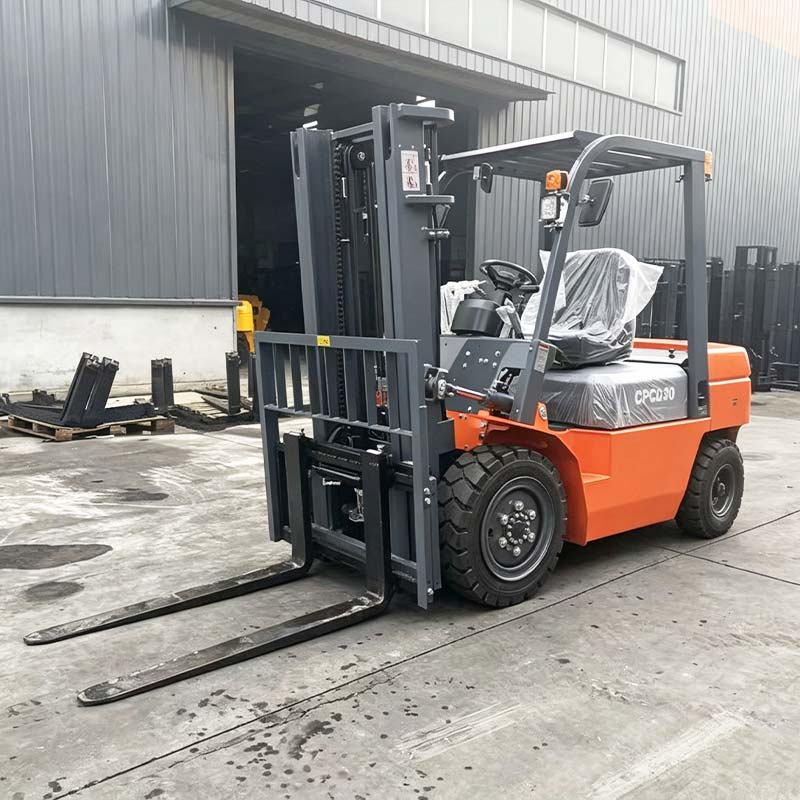
A 3 ton forklift is commonly considered for heavy palletized goods, building materials, timber bundles, machinery components and industrial raw materials. However, the actual suitability depends on load dimensions and center of gravity.
| Load Type | Typical Consideration | Is a 3 Ton Forklift Potentially Suitable? |
|---|---|---|
| Standard palletized industrial goods | Usually compact load center and predictable weight distribution | Often suitable when total weight remains within rated capacity |
| Timber or lumber bundles | Long load length can increase load center | Suitable only after checking load length and weight distribution |
| Steel products | Dense and heavy loads may approach capacity quickly | Requires accurate load weight and capacity verification |
| Large machinery components | Center of gravity may be irregular or off-center | Application must be evaluated individually |
| Coils or cylindrical loads | Often require dedicated attachments | Attachment weight and revised capacity must be considered |
2. 2 Ton vs 3 Ton vs 5 Ton Diesel Forklift
One of the most common questions from forklift buyers is whether they should select a 2 ton, 3 ton or 5 ton machine.
The best choice depends not only on the heaviest load, but also on reserve capacity, working space, transport cost and operating frequency.
| Comparison | 2 Ton Diesel Forklift | 3 Ton Diesel Forklift | 5 Ton Diesel Forklift |
|---|---|---|---|
| Rated Capacity | Approx. 2,000 kg | Approx. 3,000 kg | Approx. 5,000 kg |
| Typical Standard Lift Height | Often around 3,000 mm | Often around 3,000 mm | Often around 3,000 mm |
| Machine Weight | Lower | Medium | Significantly higher |
| Purchase Cost | Lower | Medium | Higher |
| Fuel Consumption | Generally lower | Moderate | Generally higher |
| Maneuverability | Better in tighter spaces | Balanced | Requires more operating space |
| Typical Application | Medium pallet loads and lighter industry | General industrial and heavy material handling | Heavy components and high-capacity operations |
When a 2 Ton Forklift May Be Enough
If nearly all of your loads remain well below 2,000 kg and operating space is limited, a 2 ton forklift may be more economical. It can reduce purchase cost, shipping weight, fuel consumption and turning-space requirements.
When a 3 Ton Forklift Makes More Sense
A 3 ton diesel forklift becomes attractive when routine loads move beyond the practical comfort zone of a 2 ton machine, but a 5 ton forklift would be unnecessarily large and expensive.
This is why the 3 ton class is often considered a practical middle ground for industrial buyers. It provides additional capacity reserve without the size, weight and operating cost associated with much heavier machines.
When You Should Move Up to 5 Tons
If your normal loads are frequently above 3,000 kg, if you use heavy attachments, or if your loads have large forward load centers, a 5 ton forklift may be a more appropriate choice. Running a 3 ton forklift continuously near its maximum capacity is generally less desirable than selecting a machine with suitable reserve capacity.
3. Engine and Power System of a 3 Ton Diesel Forklift
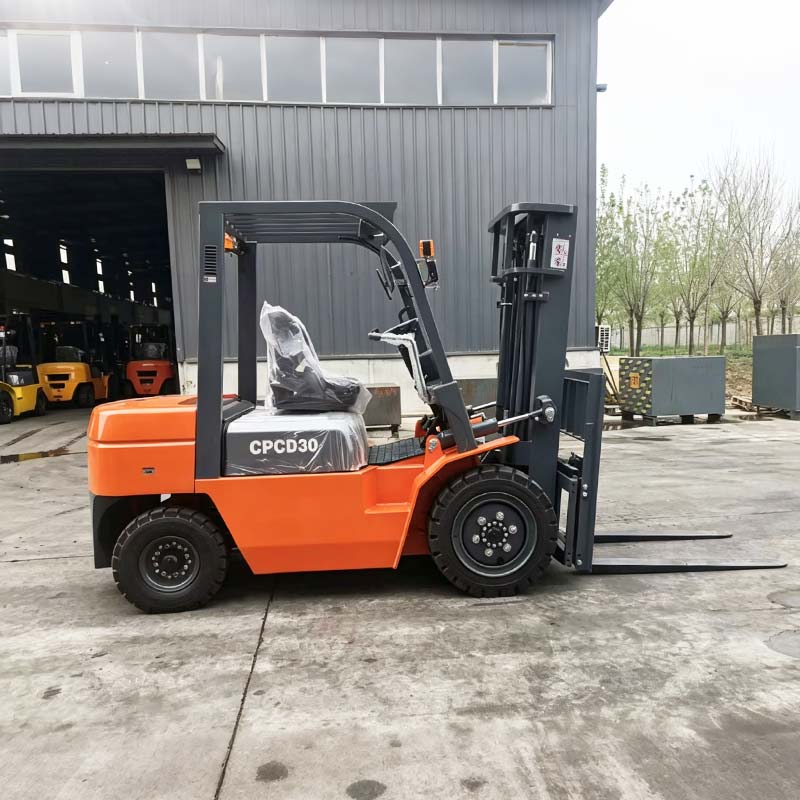
Diesel forklifts are commonly selected for outdoor work because they provide fast refueling, durable mechanical systems and suitable power delivery for demanding material handling environments.
The CSTAR CSQD-30 is available with two listed diesel engine options:
- Quanchai Stage II QC490GP
- Xinchai Stage II C490BPG
Both are four-cylinder diesel engine options used in industrial equipment applications. When choosing between engine configurations, buyers should consider local spare parts availability, service capability, destination-market requirements and purchasing preferences rather than selecting an engine only by brand name.
For frequent operation, the complete powertrain is just as important as the engine itself. The CSQD-30 uses a hydraulic shift transmission, which is suited to repeated forward and reverse movement during loading and unloading operations.
The machine is also equipped with a 60 L fuel tank, allowing practical working periods between refueling intervals. Actual fuel consumption depends heavily on workload, engine speed, driving distance, lift frequency, idle time and site conditions, so buyers should avoid comparing forklifts only by a single claimed fuel-consumption figure.
4. Mast Selection for a 3 Ton Diesel Forklift
The standard CSQD-30 lifting height is 3,000 mm, but mast selection should always be based on your actual stacking height and overhead clearance.
Simplex Mast
A simplex mast is suitable for basic low-height lifting where maximum lift height is not demanding. Its relatively simple structure can be appropriate for open yards and low stacking applications.
Duplex Mast
A duplex mast is often selected when buyers require a combination of practical lifting height and reduced collapsed mast height. Depending on the configuration, free-lift capability can also be useful when working beneath ceilings, inside loading areas or in other height-restricted environments.
Triplex Mast
A triplex mast provides greater lifting height while maintaining a lower collapsed height than would otherwise be possible with a long fixed mast structure. It is commonly considered for higher racking or specialized loading applications.
However, increasing lift height should never be considered independently from capacity. A load that is acceptable at a lower height may not necessarily have the same residual capacity at a much higher lift position.
For buyers handling heavy loads close to 3,000 kg, ask the supplier to confirm the rated or residual capacity at your required lift height before ordering a high mast.
5. Pneumatic Tires vs Solid Tires for 3 Ton Forklifts
The standard specification of the CSQD-30 lists air-inflated pneumatic tires, with 28×9-15 front tires and 6.50-10 rear tires.
Pneumatic tires are generally suitable for yards, outdoor logistics areas and surfaces where shock absorption and traction are important. They can provide a more comfortable ride on moderately uneven ground compared with harder tire configurations.
Solid tires may be considered where puncture resistance is more important, such as scrap yards or environments containing sharp metal debris. However, tire selection should always match the actual operating surface and forklift configuration.
| Application | Typical Tire Preference | Main Reason |
|---|---|---|
| Warehouse yard | Pneumatic or solid depending surface | Balance of comfort, durability and floor condition |
| Lumber yard | Pneumatic often suitable | Better shock absorption on moderately uneven surfaces |
| Construction material yard | Depends on debris level | Solid tires may reduce puncture risk |
| Freight terminal | Pneumatic or solid | Selection depends on pavement condition and operating intensity |
6. Product Spotlight: CSQD-30 3 Ton Diesel Forklift
The CSTAR CSQD-30 diesel forklift is a 3,000 kg counterbalance forklift designed for industrial material handling applications.
Its standard specification combines a 3,000 kg rated capacity, 500 mm load center, 3,000 mm lift height, hydraulic shift transmission and pneumatic tires.
| Specification | CSQD-30 |
|---|---|
| Power | Diesel |
| Rated Lifting Load | 3,000 kg |
| Load Center Distance | 500 mm |
| Driving Mode | Seat Driving |
| Length with / without Forks | 3,930 / 2,690 mm |
| Width | 1,210 mm |
| Mast Lowered Height / Overhead Guard Height | 2,130 / 2,100 mm |
| Wheelbase | 1,700 mm |
| Front Overhang | 479 mm |
| Rear Overhang | 520 mm |
| Minimum Ground Clearance | 110 mm |
| Maximum Lift Height | 3,000 mm |
| Free Lift | 160 mm |
| Minimum Turning Radius | 2,240 mm |
| Mast Tilt, Front / Rear | 6° / 12° |
| No-Load Maximum Lift Speed | 505 mm/s |
| Full-Load Maximum Lift Speed | 485 mm/s |
| No-Load Maximum Travel Speed | 20 km/h |
| Full-Load Maximum Travel Speed | 18 km/h |
| Full-Load Maximum Gradeability | 20% |
| Service Weight | 4,200 kg |
| Front Tire Size | 28×9-15 |
| Rear Tire Size | 6.50-10 |
| Tire Type | Air-Inflated Pneumatic Tire |
| Brake / Service Brake | Power Brake – Pedal |
| Parking Brake | Mechanical – Manual |
| Battery | 12 V / 80 Ah |
| Engine Options | Quanchai Stage II QC490GP / Xinchai Stage II C490BPG |
| Fuel Tank Capacity | 60 L |
| Transmission | Hydraulic Shift |
| Gear Lever | 1 |
7. Typical Applications for a 3 Ton Diesel Forklift
Freight Yards and Container Cargo Handling
A 3 ton diesel forklift can be suitable for moving palletized cargo around freight terminals, loading areas and container yards. It should not be confused with a dedicated container handler designed to lift entire shipping containers.
For operations inside a container or enclosed loading space, overall height and ventilation must be considered carefully. The CSQD-30 has an overhead guard height of 2,100 mm and a mast-lowered height of 2,130 mm. Buyers should compare these dimensions with the actual doorway and container clearance before operation.
Lumber Yards and Sawmills
Three-ton forklifts are frequently considered for timber bundles, boards and processed lumber because they combine useful load capacity with manageable machine dimensions. Long timber loads may move the center of gravity forward, so load center must be checked carefully.
Heavy Manufacturing
Manufacturing plants often need to move tooling, raw materials, fabricated components and heavy pallets. A 3 ton forklift can provide useful capacity reserve compared with smaller 2 ton machines while remaining easier to maneuver than heavier 5 ton models.
Construction Material Handling
For packaged bricks, cement, fabricated steel components and other building materials, diesel power can be useful in outdoor yards. However, a standard industrial forklift should not automatically be treated as a rough-terrain forklift. Surface stability, slopes, ground clearance and tire configuration must be evaluated before use on unfinished construction terrain.
8. Attachments and Customization Options
Common forklift attachments for the 3 ton class may include side shifters, fork positioners, clamps and other load-handling accessories.
A side shifter allows the carriage to move laterally, making pallet positioning easier without repositioning the entire forklift. A fork positioner allows operators to adjust the distance between forks hydraulically, which can improve efficiency when handling different pallet sizes.
However, attachments affect forklift capacity. Their own weight and forward projection can change the load center and reduce residual capacity. OSHA specifically notes that attachments may change forklift stability, visibility and capacity.
Before ordering an attachment, provide the supplier with your load weight, dimensions, lifting height and attachment requirement so that the final configuration can be evaluated correctly.
CSTAR Machinery supports configuration and OEM requirements for different applications. Buyers can discuss mast options, tire configuration, attachments, branding and other project-specific requirements before production.
9. Total Cost of Ownership of a 3 Ton Diesel Forklift
Purchase price is only one part of forklift cost. A more useful comparison is total cost of ownership, including fuel, maintenance, downtime, spare parts, transport and expected working hours.
A practical TCO calculation can be expressed as:
Total Cost of Ownership = Purchase Cost + Fuel Cost + Maintenance + Parts + Downtime + Transport Cost – Residual Value
Compared with a 2 ton machine, a 3 ton forklift is normally heavier and may consume more fuel under similar conditions, but it also provides greater capacity reserve. Compared with a 5 ton forklift, a 3 ton machine generally requires less fuel, occupies less operating space and is cheaper to transport.
This is why the 3 ton class can represent a practical cost-performance balance for companies whose loads commonly fall between approximately 2,000 kg and 3,000 kg.
Actual fuel use should be calculated from the real duty cycle rather than from a single advertised number. Buyers should consider:
- Daily working hours
- Percentage of time spent idling
- Average load weight
- Driving distance
- Number of lift cycles
- Operating surface and gradients
- Maintenance condition
10. 3 Ton Diesel Forklift Buying Checklist
Before placing an order, confirm the following:
- What is the maximum actual load weight?
- What are the load dimensions?
- Is the load center within the forklift’s rated condition?
- What is the maximum required lifting height?
- What is the minimum doorway or overhead clearance?
- Will the forklift work primarily indoors or outdoors?
- Is the working surface smooth, uneven or debris-covered?
- Are pneumatic or solid tires more appropriate?
- Will a side shifter, fork positioner or clamp be required?
- Does the attachment reduce rated capacity?
- Is the turning radius suitable for the operating area?
- Are local engine service and spare parts available?
- What shipping dimensions and machine weight affect freight cost?
For a detailed quotation or configuration recommendation, view the CSQD-30 3 Ton Diesel Forklift Truck and send CSTAR Machinery your load weight, pallet dimensions, lift height and working environment.
Frequently Asked Questions About 3 Ton Diesel Forklifts
1. How high can a 3 ton diesel forklift lift?
The standard CSQD-30 specification provides a 3,000 mm maximum lift height. Other mast configurations may be available depending on project requirements. When selecting a higher mast, buyers should also verify residual capacity at the required lift height.
2. What is the difference between a 2.5 ton and a 3 ton diesel forklift?
The main difference is nominal lifting capacity: approximately 2,500 kg versus 3,000 kg. A 3 ton forklift provides an additional 500 kg of rated capacity, which can be valuable when loads frequently approach the upper limit of a 2.5 ton machine. However, actual suitability still depends on load center, mast height and attachments.
3. What engine does the CSQD-30 use?
The CSQD-30 is listed with two diesel engine options: Quanchai Stage II QC490GP and Xinchai Stage II C490BPG. The best choice can depend on destination-market requirements, local service support and customer preference.
4. Can a 3 ton diesel forklift work inside a shipping container?
It depends on the specific container, access height, mast configuration and ventilation conditions. The CSQD-30 has a mast-lowered height of 2,130 mm and an overhead guard height of 2,100 mm. These dimensions must be compared with the actual entry clearance. Diesel exhaust also requires careful ventilation management in enclosed spaces.
5. How much fuel does a 3 ton diesel forklift consume?
Fuel consumption varies significantly with engine configuration, load weight, idle time, travel distance, lift frequency and surface conditions. A reliable estimate should be based on your actual duty cycle rather than a universal liters-per-hour figure.
6. Is a used 3 ton diesel forklift worth buying?
A used forklift can be economical if its service history, engine condition, transmission, hydraulic system, mast chains, forks, brakes and tires are properly inspected. Buyers should also verify the hour meter, capacity plate and availability of replacement parts. For high-frequency industrial use, the lower purchase price of an older machine should be weighed against potential downtime and repair cost.
Conclusion
A 3 ton diesel forklift is a practical choice for buyers who need more capacity than a 2 ton machine but do not require the size and operating cost of a 5 ton forklift. The key is to evaluate more than the headline 3,000 kg capacity.
Load center, load dimensions, lift height, mast configuration, tire type, attachments and working conditions all affect real-world performance. For the CSQD-30, the standard specification includes a 3,000 kg capacity at a 500 mm load center, a 3,000 mm lift height, hydraulic shift transmission, pneumatic tires and Quanchai QC490GP or Xinchai C490BPG diesel engine options.
If your typical loads are within this operating range, the CSQD-30 3 Ton Diesel Forklift can provide a balanced solution for industrial yards, manufacturing, lumber handling and freight applications.
For buyers who are still comparing capacities, engine types or other diesel forklift configurations, see our Diesel Forklift Buying Guide.
For additional forklift safety information, including load capacity, attachments and vehicle stability, refer to the OSHA Powered Industrial Trucks guidance.