
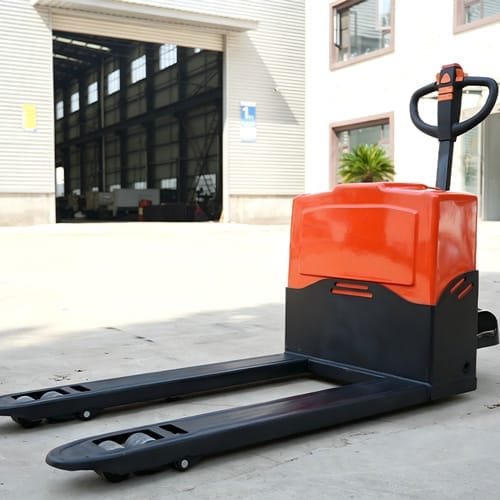
Choosing the right pallet truck is an important decision for warehouses, distribution centers, manufacturing plants, retail operations, and logistics facilities. Although pallet trucks are relatively simple material handling machines, the wrong configuration can reduce productivity, increase operator fatigue, or create unnecessary maintenance and replacement costs.
The best pallet truck depends on more than rated load capacity. Buyers should also consider whether the equipment will be used for short-distance or frequent transport, whether operators need to ride on the machine, the condition of the warehouse floor, required travel distance, battery technology, fork dimensions, turning space, and the frequency of daily operation.
This pallet truck buying guide explains the key specifications and application factors that overseas procurement managers and warehouse operators should evaluate before purchasing. It covers manual and powered pallet trucks, walk-behind and ride-on configurations, load capacity, fork dimensions, battery options, operating environments, safety, maintenance, and total cost of ownership.
1. Understand Pallet Truck Types and Their Applications
Pallet trucks, also called pallet jacks or pallet movers, are designed primarily for horizontal pallet transportation. Compared with forklifts and stacker forklifts, they generally focus on moving palletized loads rather than lifting them to substantial storage heights.
The first purchasing decision is therefore to determine how far and how frequently the pallet truck must move loads, and whether the operator should walk behind the machine or ride on it.
Manual Pallet Trucks
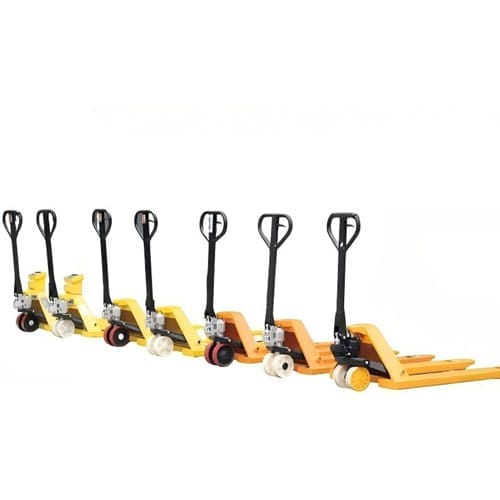
Manual pallet trucks use hydraulic lifting and human pushing or pulling force to move pallets. They are commonly used for short-distance transportation, loading and unloading support, retail backrooms, small warehouses, and low-frequency material movement.
Their main advantage is mechanical simplicity. They do not require a traction battery, charger, or electric drive system, which can reduce acquisition and maintenance complexity. However, operator effort increases with load weight, travel distance, floor resistance, and frequency of operation.
Electric Walk-Behind Pallet Trucks
Electric walk-behind pallet trucks use a powered drive system while the operator controls the machine from a tiller. They are generally better suited to operations involving repeated pallet movement, heavier loads, or longer travel distances.
OSHA’s warehousing guidance identifies specific pallet jack risk factors, including overexertion strains from manually moving materials and wrist strain from repeatedly operating the pallet jack throttle — risks that generally decrease as travel frequency and distance shift operations toward powered equipment. OSHA also recommends routine maintenance of pallet jacks so they operate with the minimum hand, arm, and finger force required. See OSHA’s warehousing hazards and solutions guidance.
Ride-On Pallet Trucks
Ride-on pallet trucks allow the operator to travel on the machine rather than walking behind it. They can improve productivity when pallets must be transported over longer distances inside a warehouse or distribution center.
Ride-on configurations usually make more sense when transport distance and utilization are high enough to justify the additional machine size, controls, battery capacity, and maintenance requirements.
| Type | Typical Application | Operator Position | Best Suited For |
|---|---|---|---|
| Manual Pallet Truck | Short-distance pallet movement | Walk-behind | Low-frequency handling and simple warehouse tasks |
| Electric Walk-Behind | Frequent pallet transportation | Walk-behind | General warehouses and repeated daily movement |
| Ride-On Pallet Truck | Longer travel distances | Ride-on | Distribution centers and high-utilization operations |
2. Choose the Right Load Capacity
Rated load capacity is one of the first specifications buyers should check. A pallet truck should be selected according to the heaviest load it is expected to handle, not simply the average load.
Common pallet truck capacities in the market include approximately 1.5, 2.0, 2.5, and 3.0 tonnes, although available capacities vary by manufacturer and equipment type. These ranges should be treated as industry reference points rather than universal standards.
| Approximate Capacity Class | Typical Application | Purchasing Consideration |
|---|---|---|
| 1.5 Ton | Light warehouse and retail handling | Suitable when pallet loads remain relatively light |
| 2.0 Ton | General warehouse applications | Practical capacity for many standard pallet operations |
| 2.5 Ton | Medium-duty material handling | Useful when standard loads regularly exceed 2 tonnes |
| 3.0 Ton and above | Heavy palletized loads | Requires careful consideration of chassis strength, battery, floor conditions, and application |
Do not select capacity using weight alone. Load dimensions, pallet condition, floor quality, ramps, gradients, and operating frequency can all affect the suitability of a pallet truck.
For example, a 2-ton pallet truck may be technically capable of carrying a 2-ton pallet, but an operation involving frequent ramps, uneven floors, or long travel distances may require a different configuration than an operation moving the same weight over a short distance on a smooth warehouse floor.
Actual rated capacity and operating limitations should always be confirmed against the manufacturer’s specification sheet.
3. Select the Right Fork Dimensions and Pallet Compatibility
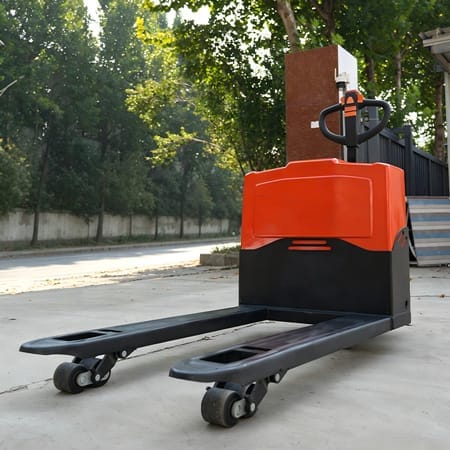
Fork dimensions are often overlooked during purchasing because buyers focus mainly on capacity and battery type. In practice, fork length, fork spacing, overall width, and ground clearance determine whether the pallet truck can safely and efficiently handle the pallets used in your facility.
Fork Length
Forks should be long enough to support the pallet correctly without creating unnecessary interference at the opposite side. Common pallet configurations vary by region, industry, and pallet design, so the correct fork length should be based on the actual pallet dimensions used at the facility.
Fork Width and Pallet Entry
Fork width and spacing should match the pallet entry openings. A pallet truck with unsuitable fork spacing may not enter the pallet correctly or may place excessive stress on the pallet structure.
Ground Clearance
Ground clearance becomes more important where floors are uneven or pallet entry points are damaged. It should be considered together with pallet bottom-board design and the actual warehouse floor condition.
Before ordering, provide the supplier with the pallet length, pallet width, pallet entry direction, maximum load weight, and any special pallet construction requirements.
4. Choose Between Walk-Behind and Ride-On Pallet Trucks
The correct operator configuration depends mainly on travel distance, operating frequency, warehouse layout, and productivity requirements.
| Factor | Walk-Behind Pallet Truck | Ride-On Pallet Truck |
|---|---|---|
| Short-Distance Handling | Excellent | Suitable but may be unnecessary |
| Long Travel Distance | Less efficient for continuous movement | Better suited |
| Operator Fatigue | Higher during prolonged travel | Generally lower during long transport cycles |
| Manoeuvrability | Excellent in tight spaces | Requires more operating space |
| Purchase Cost | Generally lower | Generally higher |
| Typical Utilization | Low to high depending on model | Best for medium to high utilization |
When Should You Choose a Walk-Behind Pallet Truck?
A walk-behind pallet truck is usually the practical choice when travel distances are short, aisle space is limited, and operators frequently need to position pallets precisely around racks, loading areas, or workstations.
When Should You Choose a Ride-On Pallet Truck?
Ride-on pallet trucks become more attractive when operators repeatedly travel longer distances across a warehouse or distribution center. They can reduce walking time and improve transport efficiency when utilization is high enough to justify the additional equipment cost.
For example, a distribution center moving pallets continuously between receiving docks and storage zones may benefit more from a ride-on configuration than a small workshop that moves a few pallets only a short distance.
The appropriate configuration should therefore be based on the complete movement cycle, not simply on the rated capacity of the machine.
5. Select the Right Battery Technology
For electric pallet trucks, battery selection influences operating availability, charging requirements, maintenance, and long-term cost. Lead-acid and lithium-ion batteries are the two main technologies encountered in the market.
| Factor | Lead-Acid Battery | Lithium-Ion Battery |
|---|---|---|
| Initial Cost | Generally lower | Generally higher |
| Charging | Typically requires longer charging periods | Generally faster and more flexible |
| Opportunity Charging | More limited | Well suited to many applications |
| Routine Maintenance | Higher, depending on battery design | Generally lower |
| Multi-Shift Operation | May require additional batteries or careful charging planning | Often well suited |
| Battery Room Requirement | May require dedicated charging and handling procedures | Typically simpler charging arrangement |
When Is Lead-Acid a Practical Choice?
Lead-acid batteries can remain attractive for businesses that prioritize lower initial purchase cost and operate equipment mainly during a single shift or relatively moderate daily utilization.
However, buyers should account for charging time, battery handling, ventilation requirements where applicable, and maintenance procedures when calculating the real operating cost.
When Is Lithium-Ion a Better Choice?
Lithium-ion technology can be attractive for high-utilization warehouses, multi-shift operations, and facilities where short charging opportunities are available during breaks or shift changes.
The higher initial battery cost should therefore be evaluated against equipment utilization and the expected reduction in charging-related downtime and routine battery maintenance.
6. Match the Pallet Truck to the Warehouse Environment
The warehouse environment has a direct effect on pallet truck performance, maintenance, and operator safety. A machine designed for smooth indoor concrete floors should not automatically be assumed suitable for ramps, loading docks, cold storage, wet areas, or rough outdoor surfaces.
Floor Conditions
Check whether the operating surface is smooth concrete, coated flooring, asphalt, uneven concrete, or another material. Damaged floors, debris, expansion joints, and steep ramps can increase rolling resistance and influence wheel wear.
Cold Storage
Freezer and chilled environments can require specific battery, lubrication, electrical, and corrosion considerations. Buyers should confirm the manufacturer’s cold-storage operating limits rather than assuming a standard pallet truck can operate continuously in low temperatures.
Wet or Outdoor Areas
Outdoor and wet applications require additional attention to corrosion protection, wheel selection, electrical protection, and environmental limits. Confirm the equipment’s rated operating conditions with the manufacturer before using it outside a controlled warehouse environment.
Loading Docks and Doorways
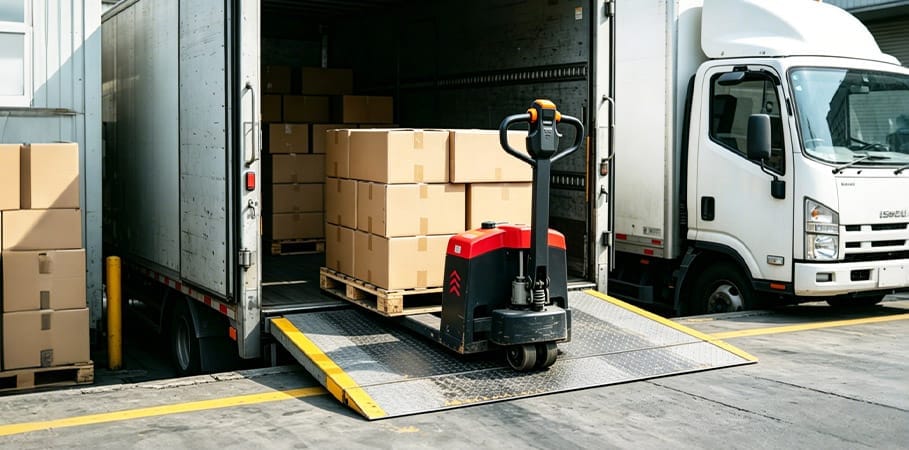
Loading docks introduce additional risks because of ramps, vehicle movement, uneven transitions, and limited visibility. OSHA recommends sufficient clearances in aisles, loading docks, doorways, and turning areas, and emphasizes that aisles and passageways should remain clean and unobstructed. See OSHA’s warehousing hazards and solutions guidance.
For facilities with restricted doorways or narrow staging areas, overall machine width and turning characteristics should be checked before ordering.
7. Consider Travel Distance and Daily Utilization
Travel distance is one of the easiest ways to determine whether a manual pallet truck is still practical or whether powered equipment would provide a better return.
For occasional movement over short distances, a manual pallet truck may offer the lowest total cost. As frequency and travel distance increase, an electric pallet truck can reduce physical effort and improve transport consistency.
| Operating Pattern | Potentially Suitable Equipment | Main Reason |
|---|---|---|
| Occasional short-distance movement | Manual pallet truck | Low acquisition and maintenance complexity |
| Frequent short-distance movement | Electric walk-behind | Reduced operator effort |
| Frequent medium-distance movement | Electric walk-behind | Better productivity for repeated cycles |
| Long-distance continuous movement | Ride-on pallet truck | Reduced walking and greater transport efficiency |
| Very high pallet throughput | High-performance powered equipment | Designed around continuous material flow |
There is no universal operating-hour threshold that determines when one type must replace another. The correct decision depends on labor cost, travel distance, load weight, floor conditions, utilization, and required throughput.
8. Evaluate Safety and Operator Requirements
Safety should be considered as part of equipment selection rather than treated as a separate issue after purchase.
OSHA highlights several pallet-jack hazards, including collisions, running over feet, and limited visibility around doors and other restricted areas. It also recommends operator training, safe operating procedures, appropriate equipment maintenance, and adequate working space. Review OSHA’s pallet jack safety guidance.
For electric pallet trucks, buyers should consider the following equipment features and operating factors:
- Emergency stop function
- Horn and warning devices
- Operator visibility
- Braking performance
- Travel speed control
- Battery charging procedures
- Emergency reverse or anti-crush features where provided by the design
- Operator training and site-specific procedures
Requirements vary by jurisdiction, workplace, and equipment category. Before importing or deploying equipment, confirm the applicable local safety and workplace regulations and ensure the final machine configuration meets those requirements.
9. Calculate Total Cost of Ownership
Purchase price alone does not provide a reliable basis for comparing pallet trucks. A lower-priced machine may have higher labor, battery, maintenance, or downtime costs over its operating life.
A practical TCO analysis should include acquisition cost, energy consumption, scheduled maintenance, wear parts, battery replacement, operator productivity, downtime, and expected service life.
| TCO Factor | What to Evaluate |
|---|---|
| Purchase Cost | Machine, battery, charger, and selected options |
| Energy Cost | Electricity consumption and charging efficiency |
| Maintenance | Drive system, wheels, hydraulic components, brakes, controls |
| Wear Parts | Load wheels, drive wheels, forks, hydraulic components |
| Battery Cost | Charging infrastructure, service, and eventual replacement |
| Downtime | Parts availability, technical support, repair response |
| Productivity | Travel speed, operator effort, pallet cycles per shift |
Factory-Direct vs. Dealer Supply
For overseas buyers, factory-direct purchasing can provide advantages in configuration flexibility and direct communication with the manufacturer. However, the lowest initial quotation is not necessarily the lowest total cost.
Procurement teams should also evaluate spare-parts availability, warranty terms, technical documentation, shipping arrangements, after-sales communication, and the supplier’s ability to support future equipment requirements.
For buyers comparing a pallet truck with other warehouse equipment, a dedicated stacker forklift buying guide can help determine whether a pallet truck or lifting equipment is more appropriate for the application.
10. Choose the Right Pallet Truck for Your Operation
The right pallet truck is the one that fits the actual material flow of the facility. A small warehouse with short travel distances may benefit from a manual or compact electric pallet truck, while a large distribution center may need a ride-on model designed for repeated long-distance pallet movement.
Capacity should be matched to the heaviest load, while fork dimensions should be matched to the pallets actually used. Battery technology should be evaluated against daily utilization and charging availability, and the machine’s dimensions should be checked against aisles, doorways, loading docks, and staging areas.
For businesses that are still comparing equipment types, the pallet truck category page provides a useful starting point for reviewing available pallet truck configurations and matching equipment to different warehouse applications.
Before placing an order, provide the manufacturer with your load capacity, pallet dimensions, operating environment, daily travel distance, number of shifts, preferred battery type, and any special requirements. This gives the supplier enough information to recommend an appropriate configuration instead of quoting equipment based only on nominal capacity.
11. Pallet Truck Pre-Purchase Checklist
Use the following checklist before requesting a quotation or approving a purchase:
- Load Capacity: What is the maximum pallet weight?
- Pallet Dimensions: Are the fork length, width, and spacing compatible?
- Travel Distance: How far does the equipment move pallets during each operating cycle?
- Operating Frequency: How many pallet movements are completed per shift?
- Operator Configuration: Is walk-behind or ride-on equipment more efficient?
- Battery: Is lead-acid or lithium-ion better suited to the operating schedule?
- Floor Conditions: Are the surfaces smooth, uneven, wet, or inclined?
- Clearance: Can the machine pass through all doors and aisles?
- Safety: Does the configuration meet applicable local requirements?
- Maintenance: Are wear parts and technical support readily available?
- Future Requirements: Will pallet volume, load weight, or operating hours increase?
A pallet truck should be selected based on the complete material-handling process rather than a single specification. Matching load capacity, dimensions, drive configuration, battery technology, environment, and utilization can improve productivity while reducing avoidable operating costs.
12. FAQ
1. What is the difference between a pallet truck and a forklift?
A pallet truck is primarily designed for horizontal movement of palletized loads, while a forklift is designed to transport and lift loads to significantly greater heights. Pallet trucks are generally more compact and are commonly used for short- to medium-distance warehouse transportation.
2. How do I choose the right pallet truck capacity?
Start with the heaviest palletized load you expect to handle and then consider pallet dimensions, operating conditions, travel distance, and floor conditions. Common market capacities include approximately 1.5 to 3.0 tonnes, but the actual requirement should be confirmed using the manufacturer’s rated capacity and specification sheet.
3. Should I choose a manual or electric pallet truck?
A manual pallet truck can be practical for occasional short-distance handling. An electric pallet truck is generally more suitable for frequent pallet movement, heavier loads, or longer travel distances because it reduces the physical effort required from the operator.
4. Is a lithium-ion pallet truck better than a lead-acid model?
Neither battery technology is universally better. Lithium-ion can be advantageous for high-utilization and multi-shift operations because of faster charging and opportunity-charging capability. Lead-acid can remain attractive where initial cost is more important and daily utilization is moderate. The best choice depends on your operating schedule and total cost of ownership.
5. Do pallet trucks require operator training?
Training requirements depend on the equipment type, jurisdiction, workplace, and application. Employers should provide appropriate training and site-specific procedures, and operators should understand the manufacturer’s operating instructions. In the United States, OSHA provides guidance relating to powered pallet jacks and workplace training requirements.
6. What information should I provide when requesting a pallet truck quotation?
Provide the supplier with the maximum load weight, pallet dimensions, required fork dimensions, travel distance, operating hours, number of shifts, floor conditions, ambient temperature, ramp requirements, operator configuration, and preferred battery technology. Detailed application information allows the manufacturer to recommend a more suitable configuration.