
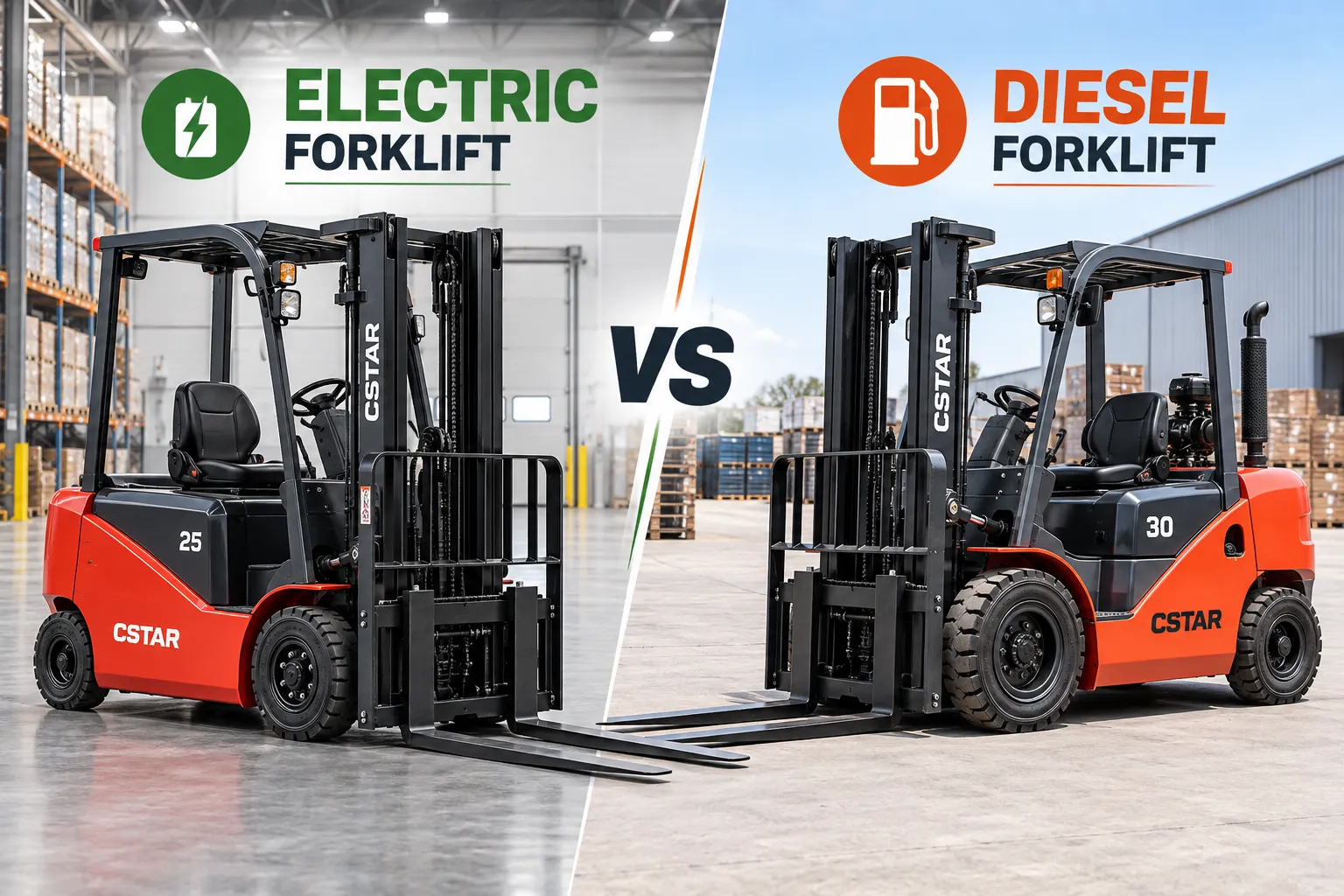
Choosing between an electric forklift and a diesel forklift starts with your daily operation: where the truck works, what it carries, and when it can stop for charging or refueling.
Electric forklifts are often a strong fit for warehouses where exhaust emissions and noise matter. Diesel forklifts are a common option for outdoor material handling where fuel access and operating schedules favor an engine-powered truck. However, outdoor use does not automatically rule out electric power. Suitability depends on the design of the specific forklift. Toyota’s forklift fuel guide
A useful electric forklift vs diesel forklift comparison should therefore go beyond purchase price. It should test whether each option can handle your loads, fit your site, and stay available throughout the working day.
Electric vs Diesel Forklifts at a Glance
| Factor | Electric Forklift | Diesel Forklift |
|---|---|---|
| Power source | Rechargeable battery | Diesel engine |
| Exhaust during operation | No engine exhaust at the truck | Produces engine exhaust |
| Indoor and outdoor suitability | Common indoors; outdoor use depends on model design | Common outdoors; exhaust must be considered around enclosed areas |
| Energy replenishment | Battery charging or an approved battery exchange arrangement | Refueling |
| Power-system maintenance | Battery, connectors, charging equipment and electrical components | Engine, fluids, filters and associated systems |
| Key purchasing question | Can the battery and charging plan support the workload? | Can the site support fuel use, exhaust and engine servicing? |
Both types still need maintenance of shared components such as brakes, tires, forks and hydraulic systems. Battery power does not eliminate routine inspections. OSHA’s pre-operation guidance
Indoor and Outdoor Suitability
Indoor Warehouses and Production Areas
If most work takes place inside a warehouse, start by evaluating an electric forklift. The absence of engine exhaust at the truck is an important advantage when equipment operates close to workers, products and storage areas.
Look beyond the power source when comparing models. Door clearance, aisle space, floor conditions and the required lifting height can narrow the shortlist just as quickly.
When reviewing an electric forklift range, compare these dimensions and operating requirements alongside battery specifications.
Outdoor Yards and Loading Areas
Diesel forklifts are worth considering for outdoor loading and material handling, particularly where refueling fits the existing operation.
Electric forklifts may also suit outdoor work, provided the manufacturer approves the model for those conditions. Check the truck’s suitability for water exposure, temperature and the surface it will travel over. Manufacturer guidance shows that outdoor capability varies between electric forklift designs. Toyota’s fuel options and buying considerations
For either power source, describe the actual route to your supplier. A paved loading yard and a construction site with soft or uneven ground are different applications.
Lifting Capacity and Performance
Start with the load, then compare the trucks.
A nominal capacity alone is not enough to select a forklift. Ask the supplier to confirm capacity for your required lift height, load dimensions and attachment configuration. Manufacturer capacity tables can distinguish between load centers, mast configurations and attachments, rather than providing one figure for every application. Toyota capacity-table example
Give each supplier the same information:
- Maximum load weight and dimensions.
- Required lifting height.
- Pallet type and fork requirements.
- Any planned attachment.
- Travel distances, ramps and typical lifting frequency.
Then request a comparison of the proposed configurations.
Avoid choosing solely because one truck has a diesel engine or a higher motor-power figure. What matters for purchasing is whether the complete truck can perform your work at the required rate — not any single spec on its own.
A demonstration using representative loads and routes can help resolve questions that a specification sheet leaves open.
Battery Runtime, Charging and Diesel Refueling
Electric Forklift Battery Runtime
“Battery life” can mean two different things: working time per charge, or the battery’s service life before replacement. It’s worth separating the two before comparing quotes.
For daily planning, ask how the quoted runtime was established. What work was the forklift doing? How much time involved travel or lifting, and how much was idle?
Treat an eight-hour scheduled shift separately from eight hours of continuous material handling. Build a simple record of busy periods, breaks and parked time, then ask the supplier to match the battery configuration to that pattern.
Charging Time and Available Breaks
Charging time and the available charging window need to be assessed together. Check whether the battery and charger can replenish enough energy during scheduled breaks or overnight downtime to support the next period of work.
For a single-shift operation, a long overnight charging window may make an appropriate lead-acid configuration practical. Operations running several shifts need a more deliberate plan, potentially involving suitable charging during breaks or battery exchange.
The charging window is a purchasing input, not something to work out after delivery. Toyota’s shift-cycle guidance similarly emphasizes the duration and timing of breaks when selecting an energy source. Toyota’s shift-cycle guide
Where Lithium and Lead-Acid Fit
Lithium-ion systems can support opportunity charging during breaks when the battery and charger are designed for it. Lead-acid charging requirements vary by battery type and charging system, so avoid assuming that every lead-acid battery can follow the same schedule.
Confirm the approved charging method with the supplier. A battery that can accept a particular charging method still needs compatible equipment and an operating routine that makes that method useful. Toyota’s charging-method guide
Will the forklift actually reach the charging point during the breaks you’re counting on? That’s the question worth answering before you commit to a battery type.
Diesel Refueling
For diesel, map out where refueling happens, who handles it and how fuel is supplied. Include the time required to reach the refueling point in your operating plan.
Compare two complete daily schedules: one with charging or battery exchange, and one with refueling. This makes the tradeoff easier to judge than comparing a charging-time figure with a refueling-time figure in isolation.
Purchase Price and Total Operating Cost
Request comparable quotations before deciding which power source costs less.
For electric forklifts, check whether the quotation includes the specified battery and charger. Identify any electrical installation work, additional batteries or charging-space requirements separately.
For diesel forklifts, record fuel arrangements and the proposed maintenance schedule. Across both quotations, match capacity, mast, tires, attachments and service coverage as closely as possible.
Use the same ownership period and expected operating hours for the comparison:
| Cost Item | Information to Collect |
|---|---|
| Initial equipment | Complete truck specification and included equipment |
| Site preparation | Charging installation or fuel arrangements |
| Energy | Estimated consumption and local electricity or diesel prices |
| Scheduled maintenance | Service intervals, parts and labor |
| Major replacements | Battery replacement and other expected repair allowances |
| Availability | Spare equipment, battery exchange or downtime arrangements |
| End-of-ownership value | Expected resale value, with assumptions stated |
Electric forklifts often require a higher initial investment once the battery, charger and any necessary electrical installation are included. Diesel may therefore be worth evaluating first for suitable outdoor applications with a tight upfront budget. Compare complete quotations for equivalent configurations before deciding.
Over the ownership period, energy prices, annual operating hours, maintenance and battery replacement can change the result. Additional batteries or charging equipment needed for multiple shifts should also be included. Toyota’s fleet-cost considerations
A supplier’s statement that a forklift is “cheaper to run” is a starting point. Ask for the consumption assumptions and apply your own working hours and energy prices.
Maintenance and Daily Checks
Both power sources require an inspection and maintenance routine.
Shared checks include the condition of forks and tires, visible leaks, brakes, steering and safety equipment. Electric trucks also require attention to the battery, cables and connectors. Diesel trucks add engine-related checks such as oil, cooling and fuel-system condition. The applicable checks should follow the truck’s manual. OSHA’s pre-operation checklist guidance
Battery maintenance also depends on the battery type. Do not apply instructions for a flooded lead-acid battery to a sealed maintenance-free battery without checking the manufacturer’s requirements.
Before buying, ask who will provide local service, which parts are stocked and what the warranty covers. These answers belong in the comparison alongside energy and purchase costs.
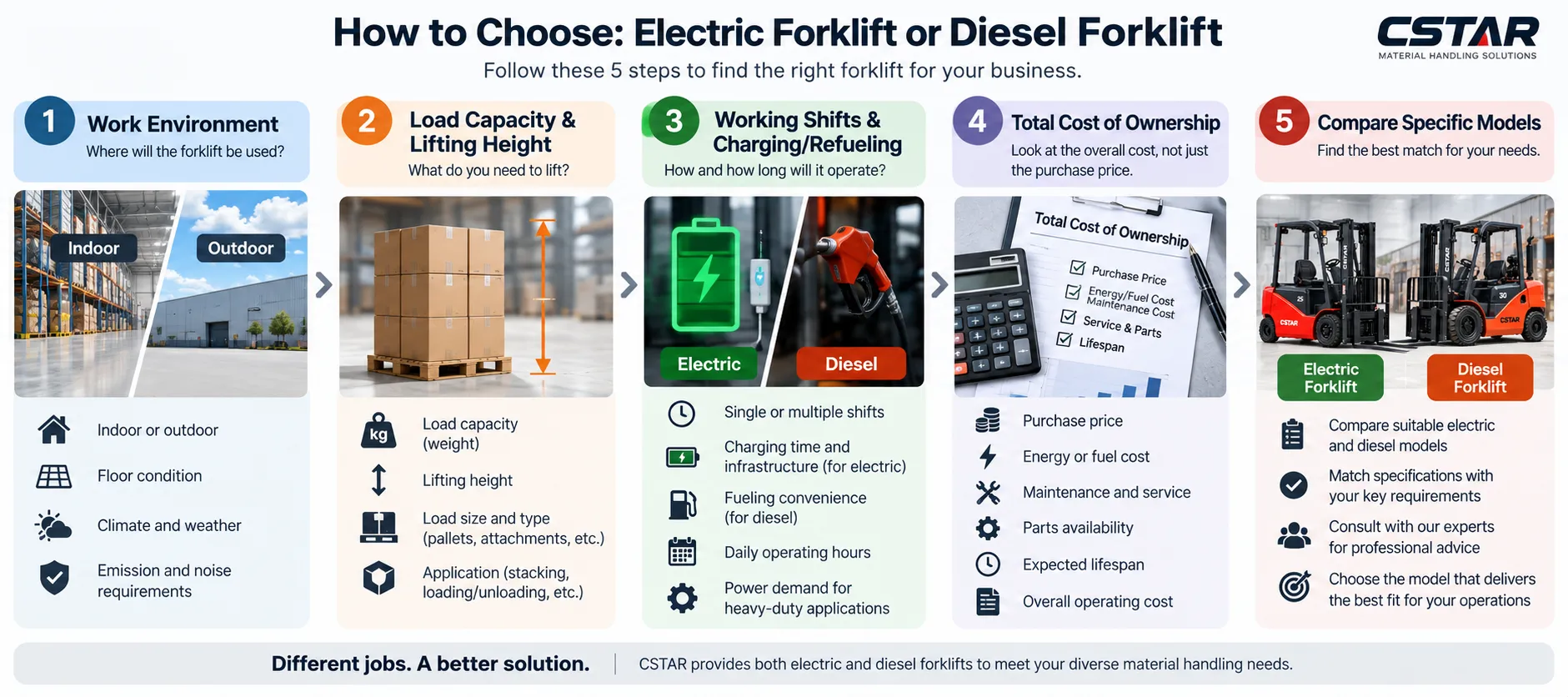
Which Forklift Fits Your Operation?
Use the following situations to build a shortlist, then verify the specific model and configuration.
| Your Situation | What to Evaluate First |
|---|---|
| Most handling takes place indoors | Electric models that meet the load, clearance and aisle requirements |
| One shift with a long overnight break | An electric battery and charger configuration matched to that charging window |
| Several shifts with predictable breaks | Approved opportunity charging or a suitable battery exchange plan |
| Mainly outdoor work with established fuel access | Diesel models, while also checking whether an outdoor-rated electric model fits |
| Mixed indoor and outdoor routes | A truck approved for the full route and conditions |
| A tight upfront budget for outdoor work | Evaluate diesel models first, then compare complete quotations and ownership costs for equivalent configurations. |
| High annual use | Total ownership cost and a realistic plan for keeping the truck available |
For example, a warehouse with overnight downtime should investigate whether a suitable electric truck can complete its workload and recharge before the next shift. A yard with limited electrical infrastructure should include installation costs before committing to battery power. Neither decision can be made from the forklift’s purchase price alone.
Frequently Asked Questions
Is an electric or diesel forklift better for warehouse use?
For primarily indoor warehouse work, start by evaluating an electric forklift because it produces no engine exhaust at the truck. Confirm that the selected model meets your load capacity, lift height, aisle and charging requirements.
Can electric forklifts be used outdoors?
Yes, if the manufacturer approves the specific model for the conditions. Check its suitability for water exposure, temperature, tires and ground conditions. Outdoor capability varies by model, and a paved yard is different from soft or uneven ground.
Are diesel forklifts cheaper than electric forklifts?
Diesel forklifts may have a lower initial cost for comparable configurations, especially where fuel arrangements already exist. Compare complete quotations, then include energy, maintenance, charging installation and battery replacement over the same ownership period.
How long does an electric forklift run on one charge?
There is no single runtime that applies to every electric forklift. Battery configuration and the actual workload affect working time per charge. Ask how the quoted runtime was measured and whether it covers your travel, lifting, breaks and shift pattern.
Can electric forklifts support multiple shifts?
Yes, when battery capacity and the charging or battery exchange plan match the workload. Suitable lithium-ion systems can support charging during breaks, but the battery and charger must be approved for that method. Check how much energy can be replenished during the available downtime.
Before requesting a quotation, prepare your maximum load, lifting height, route conditions, daily operating hours and available charging or refueling arrangements.
You can then browse CSTAR’s electric forklifts and diesel forklifts to compare specific models, or share those operating details when requesting a recommendation.