
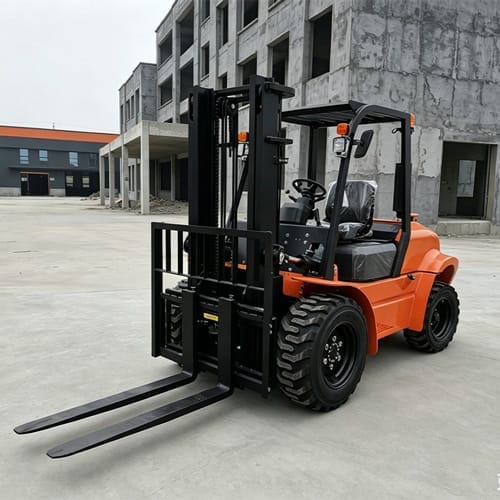
When you request quotes for a new forklift, you rarely get a single, standardized number. Even when two suppliers both quote a “3-ton forklift,” the bottom-line figures can look completely different. Differences can reflect the truck configuration, power system, delivery terms and the service included in each offer.
One quotation might cover a baseline warehouse truck with a standard two-stage mast, a lead-acid battery, and ex-works (EXW) factory pickup. Another might include a taller mast with free lift, a side shifter, a different battery configuration, and ocean freight to your destination port. Both offers carry the same “3-ton” label, yet they represent two very different purchases. This guide breaks down the specifications and commercial terms that shape a forklift price, so you can compare quotations on an equal basis and build a realistic budget.
What Determines the Price of a New Forklift?
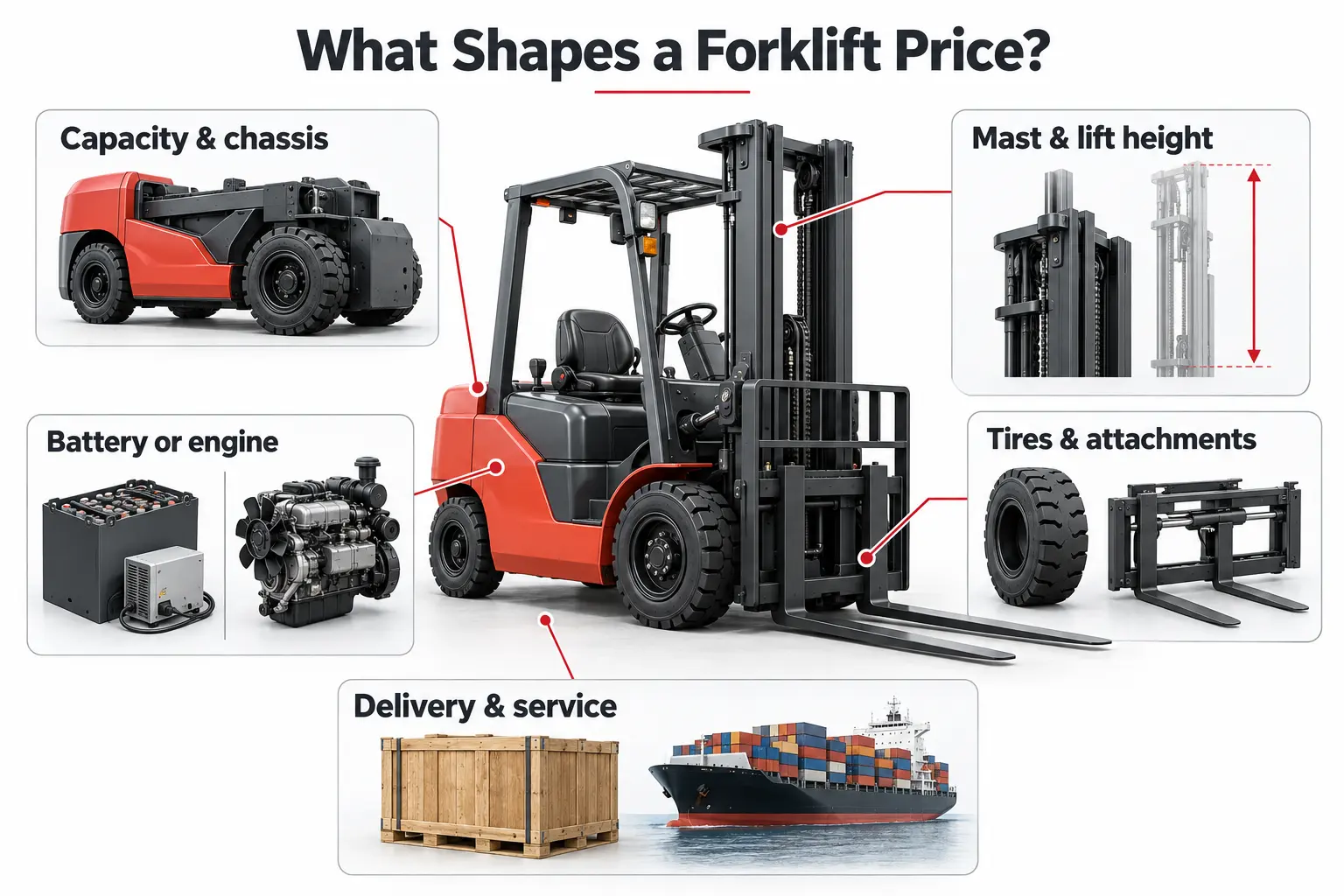
A new forklift’s purchase price reflects several factors: its rated capacity and chassis design, mast configuration, power system, tires and attachments, and the scope of delivery and service. On an electric truck, for instance, a quotation may include the battery and charger as a complete package or list them separately. Similarly, export packing, freight, and local handover can either be built into the total or left outside the quote.
In short, a forklift price only makes sense when tied to a clear specification sheet. Before you compare numbers across suppliers, check that each offer states the currency, quotation issue date and validity period, delivery location, and whether the figure is an initial budget estimate or a confirmed transaction price. This guide focuses on new equipment; evaluating a used forklift requires inspecting its mechanical condition, operating hours, and remaining battery or engine life rather than relying on a standard specification list.
Which Specifications Change the Purchase Price?
When reviewing a supplier’s technical sheet, focus on the specification groups below to see where cost differences originate.
| Spécification | How it relates to price | What to check when comparing quotes |
|---|---|---|
| Rated capacity and truck design | The chassis, counterweight, drive axle, and hydraulics are sized for the rating and layout | Rated capacity, the stated load center, and the specific truck category |
| Mast and lift height | Mast stage count, lift height, and free lift are separate configuration items | Mast type (e.g., 2-stage or 3-stage), maximum fork height, free lift, and lowered height |
| Battery and charger (electric) | Battery specification affects the package price; chargers may be quoted separately | Battery chemistry, voltage, amp-hour (Ah) capacity, and charger specification |
| Engine configuration (diesel) | Engine selection and emission setup vary by model and destination market | Exact engine model and whether it meets local regulatory requirements |
| Tires, forks, and attachments | Each item may be included as standard or priced as an optional upgrade | Tire type, fork dimensions, and every attachment listed as standard or optional |
Rated Capacity and Truck Design
Rated capacity is the headline figure on any quote, but you are paying for the entire structure behind it. Because the frame, counterweight, drive axle, mast, and hydraulics are engineered around that rating, two trucks with the same nominal tonnage can still differ in chassis design. Forklift pricing also does not scale in a neat ratio with tonnage—you cannot estimate a 3-ton forklift price simply by adding a fixed percentage to a 2-ton model. Keep in mind that rated capacity always applies to a specified load center and lift height. If your pallets are oversized or lifted higher than standard, you may need a different capacity class altogether. Our guide de capacité du chariot élévateur walks through how to verify the right tonnage class before requesting quotes.
Configuration du mât et hauteur de levage
A single “lift height” figure leaves too much unspoken on a quotation. A complete mast specification includes the stage design (such as a two-stage standard mast or a three-stage full-free-lift mast), maximum fork height, free lift height, and lowered mast height. Mast stage count, lift height and free lift affect the lifting assembly and its price. For container work, also compare the lowered mast height, overhead guard height and load clearance with the available space. Ask suppliers to write out the full mast specification so you are comparing identical lifting assemblies.
Battery and Charger on Electric Forklifts
Battery and charger specifications affect an electric forklift’s purchase price, so compare them alongside the truck itself. Look for three details: battery chemistry (lead-acid or lithium-ion), system voltage, and capacity (Ah). Two trucks sharing the same model code can be quoted with very different battery packs. Confirm whether a matching charger is included in the base price, and check whether spare batteries or fast chargers are listed as separate line items. If you are weighing the upfront price difference between battery types against your shift schedule, see our lithium-ion vs. lead-acid forklift battery guide.
Engine Specification on Diesel Forklifts
A diesel forklift quotation should state the exact engine make and model alongside its emissions configuration. Because emissions regulations vary widely across countries and regions, a general label on a spec sheet is not enough—you need to confirm that the quoted engine configuration is approved for import and operation in your destination market. Rather than treating engine options as a simple “good-better-best” price ladder, verify that the proposed engine matches your local compliance rules and parts support.
Tires, Forks, and Attachments
Make sure tire type (pneumatic or solid, with non-marking options where required), fork length and section size, side shifters, fork positioners, or clamps are itemized as either standard equipment or optional extras. Keep in mind that attachments affect more than the invoice total: they add weight and can alter the effective load center. Always check the manufacturer-approved net capacity for the exact truck-and-attachment combination you plan to buy, and remember that ordering longer or thicker forks does not increase the rated lifting capacity of the forklift itself.
Electric vs. Diesel Forklift Price: What Should You Compare?
Comparing an electric forklift price against a diesel forklift price is only meaningful when both quotations are built around the same job. Lock in the same rated capacity, load center, lift height, mast type, attachments, and delivery terms first. Once those match, you are comparing the electric truck’s battery and charger package directly against the diesel truck’s engine and emissions configuration.
It also helps to separate the upfront purchase price from ongoing operating expenses. What you pay on the invoice is only the entry cost; what you spend on electricity or diesel fuel, routine servicing, filters, and replacement components accumulates over years of operation. A lower initial quote for one power source does not automatically make it the more economical choice over a five-year horizon. Compare matching hardware configurations first, then model your site’s energy and maintenance costs separately. Our electric vs. diesel forklift guide explains how indoor air quality, outdoor terrain, and shift patterns factor into that decision.
What Is Included in a Forklift Quotation?
Two quotations with identical truck prices can still result in very different landed budgets depending on where the supplier’s scope stops. One quote may cover the bare machine at the factory gate, another may include port delivery, and a third may bundle local commissioning and spare parts.
| Cost item | What the quotation should state | How it affects your budget |
|---|---|---|
| Batterie et chargeur | Whether both are included, along with their exact specifications | A truck quoted without them requires a separate budget allocation |
| Standard forks and attachments | Which fork size is standard and which attachments are priced as options | Attachments can change the price and available lifting capacity, depending on the configuration. |
| Packing and container loading | Packing method, container fit, and whether mast dismantling is required | May be included in export quotes or billed as a separate preparation fee |
| Freight and marine insurance | The exact point to which transport and insurance are covered under the trade term | Determines how much onward freight you must arrange and pay for |
| Assembly, commissioning, or handover | Whether on-site setup or inspection is included, and who performs it | Important if the mast or attachments are shipped disassembled for container loading |
| Initial spare parts kit | Any filters, seals, or wear parts included with the shipment | Reduces early maintenance lead times when stocked with the initial order |
| Warranty and service support | Warranty duration, covered components, and how parts or technical support are delivered | Directly shapes long-term operating risk and maintenance budgets |
| Import duties, taxes, and port charges | Whether destination customs clearance and local taxes are included | Allocation depends on the delivery terms and contract; confirm local taxes and handling charges |
For international orders, physical dimensions and vehicle weight also influence shipping costs. Some configurations require mast removal for container loading. Confirm the shipping dimensions, shipment weight, packing method and reassembly requirements before budgeting for transport. The forklift service weight guide explains where to find vehicle weight and which configuration details to confirm for shipping.
International quotations rely on commercial trade terms to define where the seller’s cost and risk end. The International Chamber of Commerce’s Incoterms 2020 rules define eleven standard terms:
- EXW (Ex Works): The seller makes the goods available at the named place, not loaded on the collecting vehicle. The buyer generally arranges collection, onward transport and export clearance. State the collection point and any separately agreed loading assistance.
- FOB (Free on Board): For sea and inland waterway transport. The seller clears the goods for export and delivers them on board the vessel at the named shipment port. Risk transfers at that point, and the buyer arranges the main carriage.
- CIF (Cost, Insurance and Freight): For sea and inland waterway transport. The seller arranges and pays freight and the required cargo insurance to the named destination port. Risk transfers when the goods are on board the vessel at the shipment port, not when they arrive at destination. Higher insurance cover can be agreed.
Import clearance, duties and taxes are generally the buyer’s responsibility under these three rules. Destination handling and unloading charges depend on the agreed rule and carriage contract; some may already be included in the freight. Record the exact rule, named place or port and Incoterms edition in the quotation. The ICC Academy explanation of C and D rules clarifies the distinction between paying transport costs and bearing transport risk.
Why Can Two 3-Ton Forklift Quotes Differ?
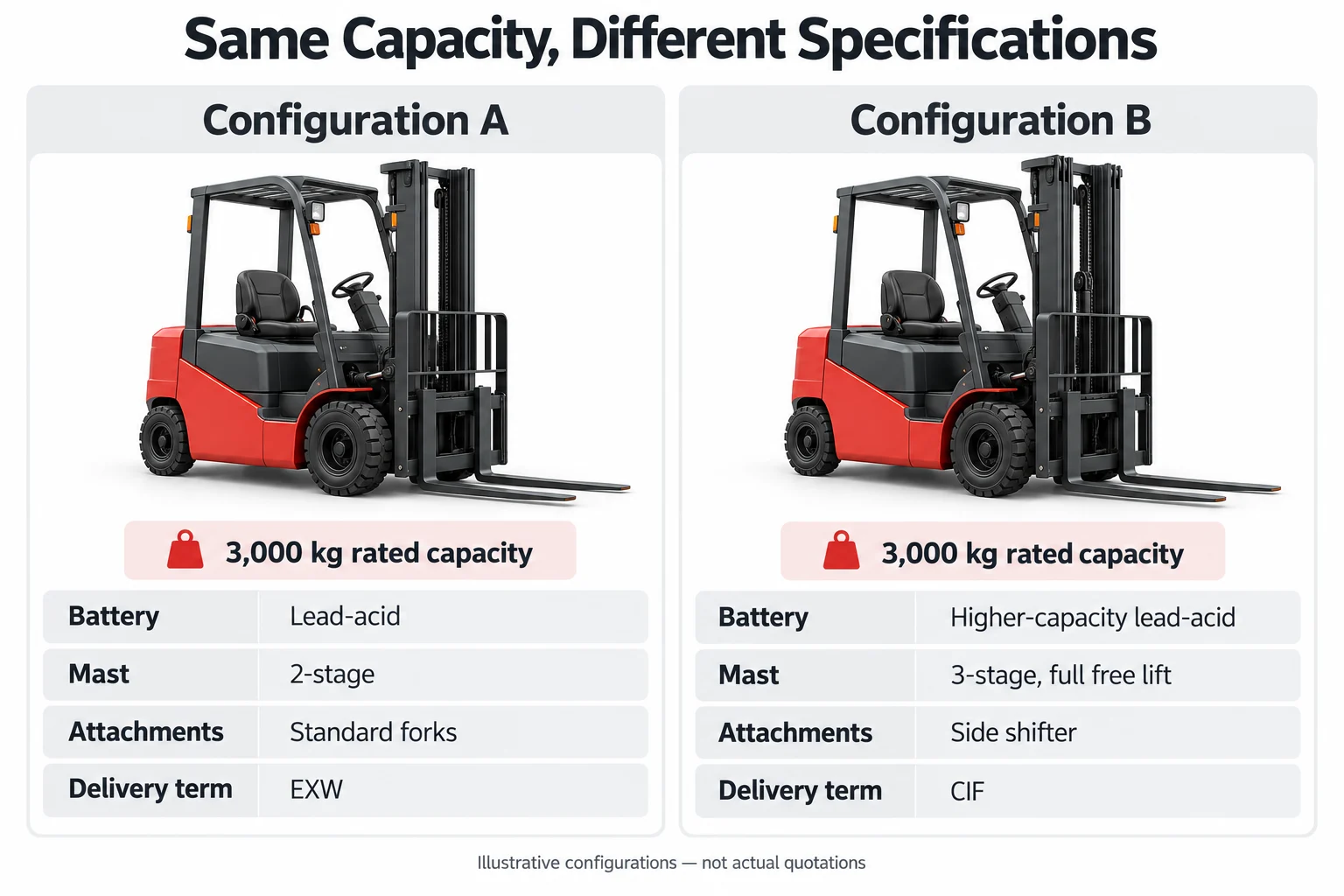
To see how quickly specifications and trade terms separate two offers, consider the illustrative comparison below. Both columns describe a 3,000 kg electric counterbalance forklift, with different specifications and delivery scopes. This is a configuration example, not a pair of actual quotations.
| Quotation item | Configuration A | Configuration B |
|---|---|---|
| Base truck | Electric counterbalance forklift with a 3,000 kg nominal rating; confirm available capacity for the selected mast and attachments | Electric counterbalance forklift with a 3,000 kg nominal rating; confirm available capacity for the selected mast and attachments |
| Batterie et chargeur | Standard lead-acid battery pack with standard charger | Higher-capacity lead-acid battery pack with a matching charger |
| Configuration du mât | Standard 2-stage mast, 3,000 mm lift height | 3-stage full-free-lift mast with increased lift height; container clearance checked separately. |
| Attachments and tires | Standard forks, standard tires | Side shifter fitted, non-marking solid tires specified |
| Delivery scope | EXW at a named collection point; buyer arranges onward transport | CIF to a named destination port; seller arranges freight and required cargo insurance |
| Parts and service scope | Standard warranty terms only | Standard warranty plus an initial wear-parts package and handover guidance |
Purchase Price vs. Total Cost of Ownership
The purchase price gets the equipment onto your floor, but your multi-year budget depends on the total cost of ownership (TCO). When evaluating how much a forklift will cost over its working life, include:
- Initial investment: The truck, required battery and charger, attachments, packing, freight, insurance, applicable import duties and taxes, and any initial setup costs.
- Energy costs: Electricity or diesel based on local rates, actual consumption and the expected workload.
- Planned maintenance and consumables: Filters, fluids, tires, brake components, and hydraulic servicing.
- Major component replacement: A replacement battery pack or major powertrain overhaul, if your planned ownership period extends beyond the component’s service life.
- Downtime costs: Replacement equipment or measurable lost operating time during repairs, without double counting expenses already included elsewhere.
- Residual value: What the machine can realistically be sold for when retired.
You can organize those figures with a straightforward formula:
Total ownership cost over a defined period = Initial investment + Energy, maintenance, component replacement and downtime costs − Residual value
To keep the comparison fair, measure every candidate truck over the same number of years and the same annual operating hours, and make sure each expense is counted only once (for example, do not count battery replacement under both routine maintenance and major component overhauls). Base residual value on real local resale data rather than an assumed percentage.
A Practical Checklist for Comparing Forklift Prices
Before signing off on a purchase order, run your shortlisted quotations through this seven-point check:
- Do all quotations specify the same truck type, rated capacity, and load center?
- Do the mast stage count, maximum lift height, free lift, and lowered height match?
- Is the power system written out in full—battery chemistry, voltage, and Ah on electric trucks, or the exact engine model and emission spec on diesel trucks?
- Are the battery, charger, forks, and required attachments included in the total or priced separately?
- Does every quote state the currency, validity period, order quantity, and production lead time?
- Are the delivery terms, named port or place, packing method and warranty clearly stated, with any differences accounted for?
- Which destination costs—such as ocean freight, customs duties, port handling, or local assembly—still need to be added to your budget?
Once every supplier answers those questions on the same baseline, any remaining price difference reflects a true commercial difference you can evaluate with confidence.
Foire aux questions
Does an electric forklift price include the battery and charger?
It depends on the supplier’s quotation format. Some offers bundle the truck, battery, and charger into a single price, while others list the battery or charger as separate line items. Always verify the battery type, voltage, capacity (Ah), and charger specification on the quote before comparing electric forklift prices.
Why do two forklifts with the same lifting capacity have different prices?
Rated lifting capacity is only one specification. Two forklifts with the same tonnage rating can differ in mast design, lift height, battery or engine configuration, tire type, attachments, and delivery terms (such as EXW versus CIF). Comparing those specifications and delivery scopes helps explain the price difference.
Is a diesel forklift always cheaper than an electric forklift?
No universal rule applies. Upfront prices depend on the specific battery package or engine configuration being compared, while long-term costs depend on local electricity versus diesel prices, shift hours, and maintenance needs. Compare matching configurations for both power types and calculate total cost of ownership separately.
Turning a Forklift Price into a Budget
A useful forklift budget starts with a defined workload and configuration. Once you define your heaviest load, target lift height, aisle constraints, and preferred trade terms, suppliers can quote against the exact configuration your site requires.
To review baseline configurations and published model specifications, explore CSTAR’s chariots élévateurs électriques et chariots élévateurs diesel.