
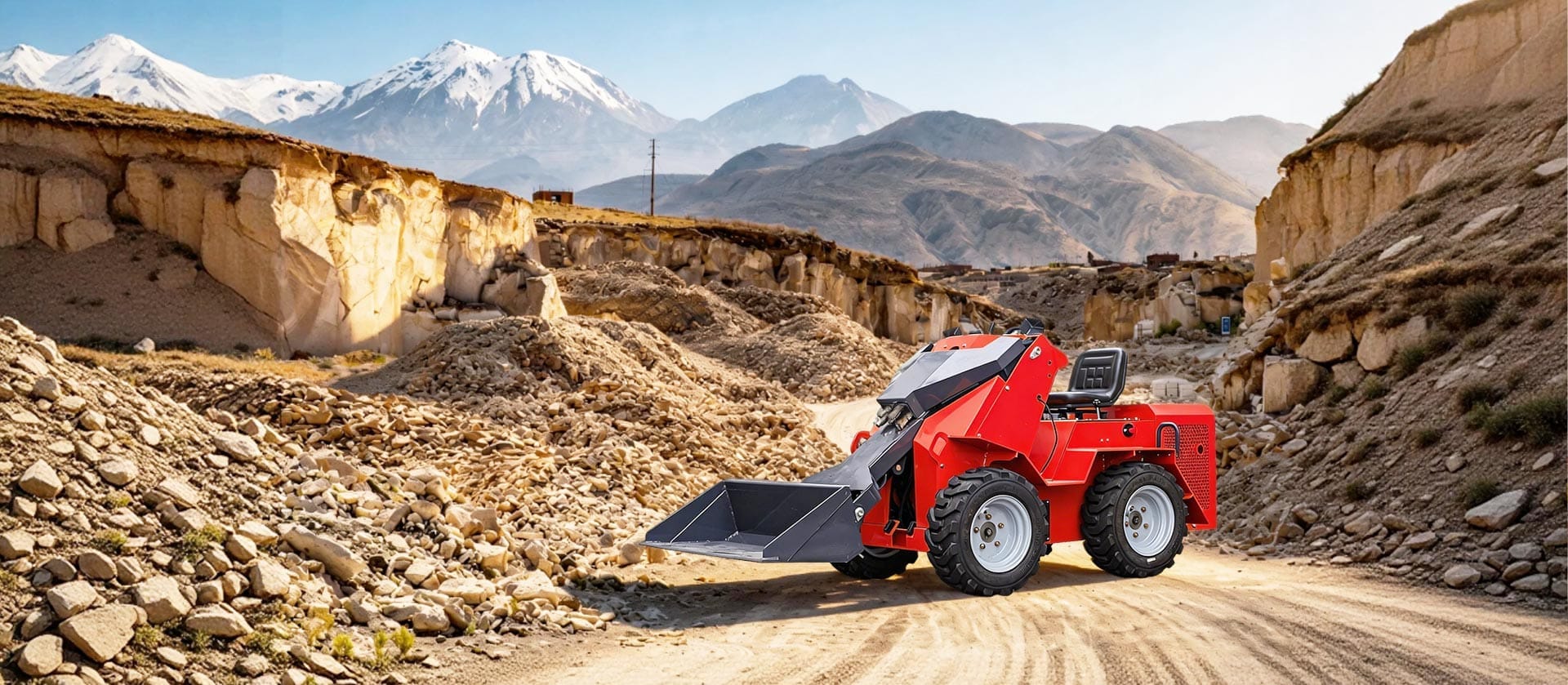
Choosing the right skid steer loader is not simply a matter of selecting the largest machine or the highest horsepower within your budget. The right loader should match the actual demands of your jobsite, including lifting requirements, ground conditions, available working space, attachment needs, and daily operating hours.
Skid steer loaders are widely used for landscaping, agriculture, construction, utility work, site preparation, snow removal, material handling, and light demolition because one compact machine can perform many different tasks when equipped with the right attachment. However, choosing the wrong operating capacity, lift configuration, undercarriage, or hydraulic system can reduce productivity and increase operating costs.
This guide explains the most important specifications and purchasing factors to consider when selecting a skid steer loader, including rated operating capacity (ROC), lift height, hydraulic flow, machine dimensions, wheel versus track configurations, lift arm geometry, emissions requirements, attachments, and total cost of ownership.
1. Decoding Key Skid Steer Loader Specifications
Skid steer loader specifications can look complicated because manufacturers publish many different measurements. For most buyers, however, a small number of specifications have the greatest impact on whether a machine will actually perform well on the job.
The most important factors to compare include rated operating capacity, tipping load, lift height, dump height, horsepower, auxiliary hydraulic flow, machine width, turning characteristics, operating weight, and attachment compatibility.
Rated Operating Capacity (ROC)
Rated Operating Capacity, or ROC, is one of the most important specifications when comparing skid steer loaders. It helps buyers understand how much load the machine is designed to handle under the applicable rating method.
For conventional skid-steer loaders, ROC is commonly stated as 50% of the tipping load. Compact track loaders are commonly rated using 35% of tipping load under the corresponding industry practice. Some manufacturers publish both values, so buyers should always check the exact test method and rating shown on the machine’s specification sheet instead of comparing ROC numbers without checking their basis. :contentReference[oaicite:2]{index=2}
This distinction matters because two machines with similar-looking ROC figures may not be directly comparable if their ratings are based on different percentages or standards.
When evaluating lifting performance, also consider the load center, attachment weight, bucket configuration, and the height at which the load must be carried. A loader should not be selected based on ROC alone.
Lift Height and Dump Height
Lift height determines how effectively the skid steer can place material into trucks, trailers, hoppers, containers, or elevated stockpiles.
Dump height is particularly important for applications such as loading aggregate, soil, mulch, feed, or construction debris into another vehicle. If the dump height is too low, the loader may have sufficient capacity but still be unable to complete the intended loading task efficiently.
Before purchasing, identify the highest point the bucket or attachment must reach and compare that requirement with the manufacturer’s lift and dump specifications.
Horsepower and Hydraulic Flow
Horsepower is important, but it should not be treated as the only indicator of machine performance. The hydraulic system is equally important when you plan to use demanding attachments.
Standard-flow auxiliary hydraulics may be sufficient for general-purpose attachments such as buckets, forks, or some grading tools. High-flow hydraulics can be important for attachments that require greater hydraulic power, such as certain brush cutters, cold planers, trenchers, or other hydraulic-powered implements.
Before purchasing a high-demand attachment, check:
- Auxiliary hydraulic flow rate
- Hydraulic pressure
- Attachment flow requirements
- Attachment operating weight
- Electrical and control requirements
- Quick-attach compatibility
Matching the hydraulic system correctly can have a greater practical impact on attachment productivity than simply choosing a machine with more engine horsepower.
Machine Width and Turning Characteristics
Machine dimensions are critical when working in narrow construction sites, residential properties, greenhouses, farms, warehouses, or other restricted areas.
Measure the narrowest gate, doorway, driveway, or access point before purchasing. Also consider the loader’s operating width with the selected bucket or attachment rather than checking the bare machine width alone.
Because skid steer loaders steer by controlling the speed of the wheels or tracks on each side, their maneuverability is one of their major advantages. However, the operating surface still affects turning efficiency, tire wear, traction, and ground disturbance.
Practical Skid Steer Size Guide
There is no universal industry rule that says a particular ROC always belongs to a specific machine class. The following ranges are therefore best used as practical buying categories rather than formal standards.
| Practical Class | Approximate ROC Range | Typical Applications |
|---|---|---|
| Light-duty | Under 1,700 kg | Landscaping, property maintenance, light material handling, small construction jobs |
| Mid-duty | 1,700–2,500 kg | General construction, agriculture, site preparation, municipal work |
| Heavy-duty | Over 2,500 kg | Heavy material handling, demanding construction, large attachments, industrial applications |
These ranges should be treated as a starting point only. The correct machine depends on the required load, attachment, lift height, ground conditions, and the manufacturer’s actual operating specifications.
2. Wheeled vs. Tracked Skid Steer Loaders
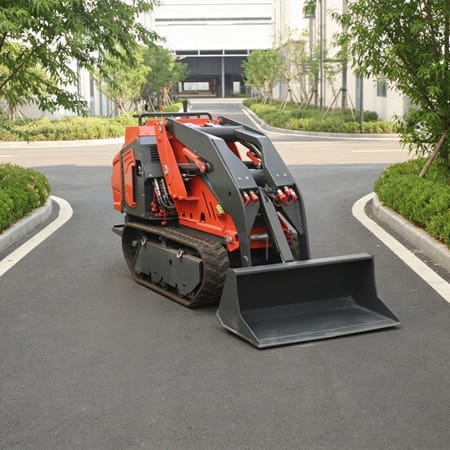
One of the most important decisions is choosing between a wheeled skid steer loader and a tracked configuration, often referred to as a compact track loader. The right choice depends heavily on ground conditions and the type of work you perform.
| Factor | Wheeled Skid Steer | Tracked Skid Steer / CTL |
|---|---|---|
| Hard Surfaces | Excellent | Good, depending on track type |
| Soft or Wet Ground | More likely to lose traction | Better flotation and lower ground pressure in many configurations |
| Travel Speed | Generally faster | Generally slower |
| Routine Undercarriage Maintenance | Generally simpler | More components to inspect and maintain |
| Turf and Finished Surfaces | Depends on tire selection and operating technique | Can provide reduced ground pressure, but turning can still disturb finished surfaces |
| Rough or Muddy Terrain | Less suitable in difficult ground conditions | Often better suited |
When Should You Choose a Wheeled Skid Steer?
A wheeled skid steer is often a practical choice when the machine will spend most of its time on firm surfaces such as concrete, asphalt, compacted soil, yards, and construction sites with relatively stable ground.
Wheeled machines can also be attractive when higher travel speed, easier tire replacement, and straightforward routine maintenance are important considerations.
When Should You Choose a Tracked Skid Steer?
A tracked configuration can be more appropriate when flotation, traction, and ground access are major concerns. Tracks distribute the machine’s weight over a larger contact area and can perform well on soft, wet, loose, or uneven terrain.
The trade-off is that tracked machines generally require more attention to undercarriage components, track condition, alignment, and wear.
Practical Rule
Choose wheels when speed, firm surfaces, and simpler undercarriage maintenance are your priorities. Choose tracks when traction, flotation, and performance on soft or uneven ground are more important.
3. Vertical Lift vs. Radial Lift
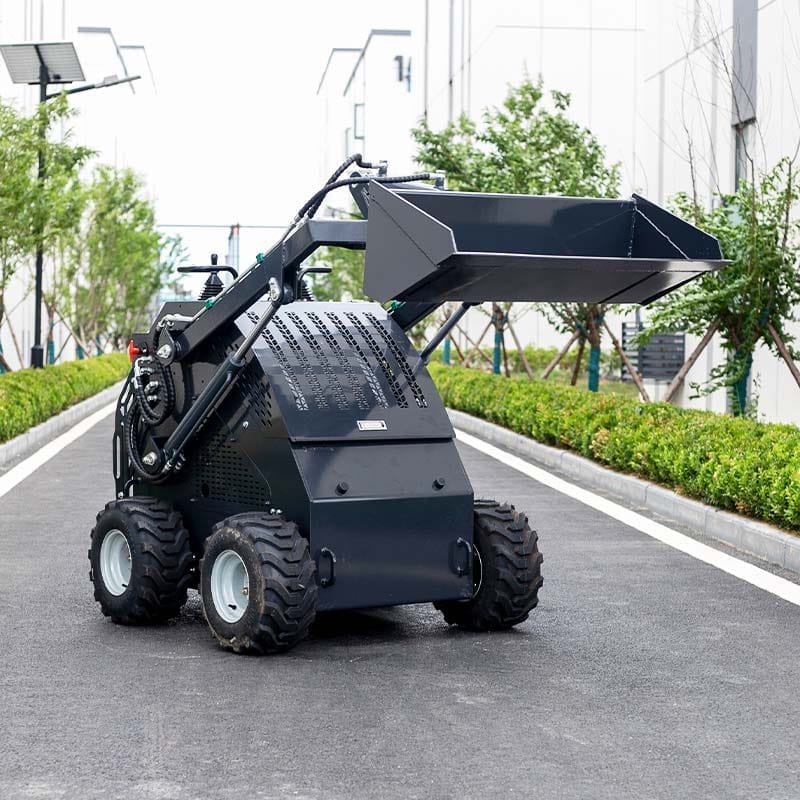
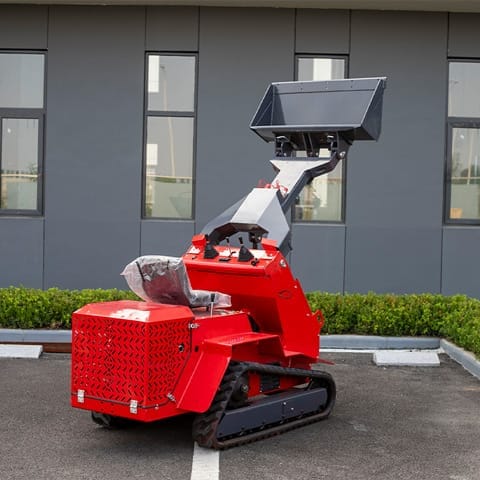
Lift arm geometry has a significant effect on how a skid steer loader performs during lifting, loading, digging, and grading operations.
The two major configurations are radial lift and vertical lift. Neither is universally better. Each is designed around different operating priorities.
| Feature | Radial Lift | Vertical Lift |
|---|---|---|
| Lift Path | Curved lift path | More vertical lift path |
| Lower-Height Work | Strong suitability for digging and grading tasks | Suitable for general loading and lifting |
| Full-Height Reach | Generally less reach at maximum height | Generally greater reach at higher lift positions |
| Truck Loading | Suitable depending on application | Often preferred for high-reach loading |
| Ground Engagement | Strong choice for digging, grading, and backfilling | Versatile for lifting and loading operations |
Vertical Lift Skid Steer
Vertical lift loaders are particularly attractive for applications where the attachment needs to maintain useful forward reach at higher lift positions. This can make them well suited to loading trucks, placing materials, and stacking or handling materials above ground level.
Radial Lift Skid Steer
Radial lift loaders follow a curved lift path and are often valued for digging, grading, backfilling, and other jobs performed mainly at low-to-medium working heights.
Industry buying guides commonly describe radial lift machines as strong performers at lower heights, while vertical lift machines emphasize higher reach. The right choice should therefore be driven by the dominant application rather than by the lift-arm name alone. :contentReference[oaicite:3]{index=3}
4. Engine and Emissions Compliance
For export buyers, engine selection is not only about horsepower and fuel consumption. The destination market may have specific emissions and documentation requirements, and these requirements can vary according to engine category, power range, machine type, and market.
Tier 4 Final in North America
EPA Tier 4 standards are part of the United States regulatory framework for nonroad diesel engines and equipment. The EPA specifically identifies heavy equipment and other nonroad machinery within its diesel emissions program, with Tier 4 requirements supported by engine and emissions-control technologies. :contentReference[oaicite:4]{index=4}
However, buyers should not assume that every skid steer exported to every country must have the same emissions configuration. The exact requirement depends on the market and the engine covered by the applicable regulations.
EU Stage V
For the European Union, Regulation (EU) 2016/1628 establishes emission limits and type-approval requirements for internal-combustion engines used in non-road mobile machinery. The regulation covers construction and agricultural machinery among other categories. :contentReference[oaicite:5]{index=5}
Before purchasing a diesel skid steer for export, ask the supplier to provide the exact engine model, emissions certification or documentation applicable to the destination market, and any other compliance documents required for import or project bidding.
Emissions compliance should be confirmed before the purchase order, not after the machine has been shipped.
View EPA regulations for nonroad diesel heavy equipment
View EU Regulation 2016/1628 on EUR-Lex
5. Match the Skid Steer Loader to Your Application
A skid steer loader becomes truly useful when the machine configuration matches the job. Instead of choosing equipment only by size, evaluate the combination of load requirement, ground condition, attachment, working space, and daily utilization.
Farm and Ranch Work
Skid steer loaders can be useful for cleaning livestock areas, moving feed, handling manure, carrying materials, clearing debris, and maintaining farm roads.
For agricultural applications, traction, ground conditions, attachment compatibility, and ease of cleaning may be more important than maximum travel speed alone.
Landscaping and Grounds Maintenance
Landscape contractors frequently need one machine to perform several tasks, including soil movement, grading, material transport, brush clearing, and site preparation.
For this type of work, a highly maneuverable machine with a useful attachment range can provide more value than a machine selected purely for maximum ROC.
Municipal Maintenance and Snow Removal
Municipal operators may use skid steer loaders for road maintenance, snow removal, debris handling, drainage work, and seasonal maintenance.
When selecting a configuration for snow or winter service, pay particular attention to hydraulic compatibility, tire or track selection, operator visibility, attachment width, and cold-weather operating requirements.
Material Handling and Yard Work
In construction yards, factories, material storage areas, and recycling operations, skid steer loaders may be used for moving bulk materials, loading, stockpile management, and general site maintenance.
For operations involving pallets or primarily horizontal pallet movement, a dedicated pallet truck or forklift may be more efficient than using a skid steer. CSTAR also offers a pallet truck range for dedicated material-handling applications.
Light Demolition and Site Preparation
With suitable attachments, skid steer loaders can support selected demolition, breaking, grading, surface preparation, and debris-clearing tasks.
For heavier excavation work, however, a dedicated excavator may provide better digging geometry and reach. If your operation involves frequent trenching, digging, or foundation work, see our mini excavator buying guide for a more detailed comparison.
6. The Attachment Multiplier: Think Beyond the Bucket
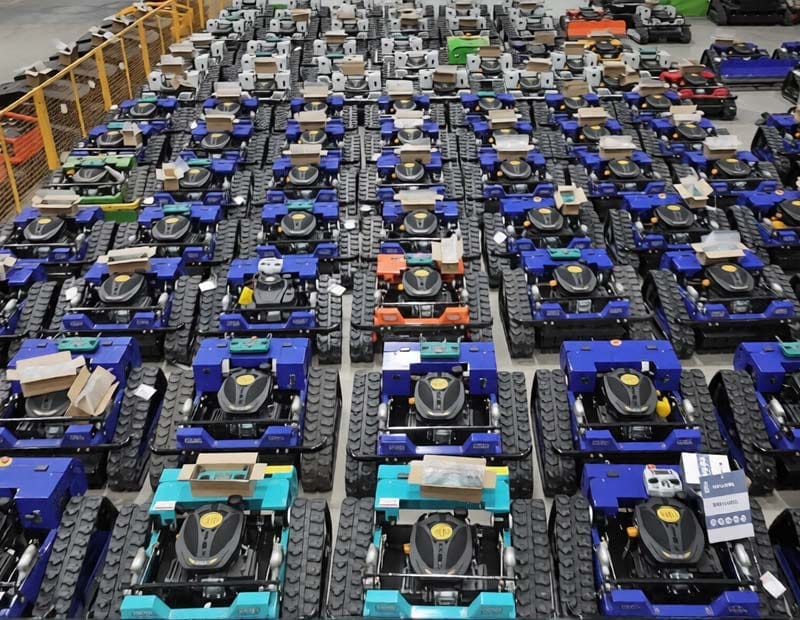
The value of a skid steer loader is closely connected to the attachment ecosystem. A machine that can work with several compatible attachments can serve multiple functions without requiring separate dedicated machines for every task.
Common Skid Steer Attachments
- General-purpose buckets
- Pallet forks
- Grapples
- Leveling and grading attachments
- Snow blades and snow pushers
- Hydraulic breakers
- Augers
- Brush cutters and forestry attachments
- Trenchers
- Brush and surface sweepers
Check the Quick-Attach Standard
Before buying, confirm which quick-attach or mounting interface the loader uses and whether the attachments you plan to purchase are compatible.
A loader may have enough lifting capacity for an attachment but still be unsuitable if the mounting interface, hydraulic connection, electrical controls, or attachment dimensions are incompatible.
Standard Flow vs. High Flow Hydraulics
Auxiliary hydraulic flow is one of the most important specifications when selecting attachments.
| Attachment Type | Typical Hydraulic Requirement | What to Check |
|---|---|---|
| Bucket | Low hydraulic demand | Mechanical compatibility and rated capacity |
| Pallet Forks | Low to moderate | Mounting interface and load rating |
| Grapple | Low to moderate | Flow, pressure, and auxiliary controls |
| Hydraulic Breaker | Moderate to high | Required flow and pressure |
| Brush Cutter | Often high | High-flow compatibility and hydraulic output |
| Cold Planer / Specialized Hydraulic Tools | High | High-flow system and attachment specifications |
Do not select a high-flow attachment solely because the loader has high engine horsepower. The auxiliary hydraulic flow and pressure must meet the attachment manufacturer’s operating requirements.
7. Understanding Total Cost of Ownership
The purchase price is only one part of the real cost of owning a skid steer loader.
A more useful comparison considers fuel or energy consumption, maintenance, wear parts, downtime, attachment costs, transport, and resale value over the machine’s working life.
| TCO Factor | What to Consider |
|---|---|
| Purchase Price | Machine configuration, engine, lift type, tires/tracks, attachments |
| Fuel Consumption | Engine size, operating hours, workload, ground conditions |
| Maintenance | Engine service, hydraulic system, filters, lubrication, undercarriage |
| Wear Parts | Tires, tracks, cutting edges, bucket teeth, hoses and attachment components |
| Downtime | Spare-parts availability, supplier support and repair response |
| Resale Value | Machine condition, operating hours, maintenance history and market demand |
Factory-Direct vs. Dealer Purchase
For international buyers, factory-direct purchasing can sometimes reduce intermediary costs and provide more opportunities for OEM or configuration customization. However, the lowest purchase price should not automatically be treated as the lowest total cost.
Supplier support, spare-parts availability, technical documentation, shipping arrangements, warranty handling, and after-sales communication can have a significant impact on the actual operating cost.
Tracks and Tires as Wear Costs
For wheeled machines, tire selection and replacement frequency should be considered based on the ground conditions and workload.
For tracked machines, undercarriage maintenance is an important cost factor. Track condition, rollers, idlers, sprockets, alignment, and operating technique can all affect service life and maintenance expenses.
8. Pre-Purchase Checklist: What Should You Confirm?
Before requesting a quotation or placing an order, confirm the following specifications against your actual job requirements:
- Rated Operating Capacity: What is the heaviest load you need to carry?
- Load Center: What are the dimensions and weight distribution of the typical load?
- Lift Height: How high must the attachment reach?
- Dump Height: Can the loader safely load your target truck, trailer, or hopper?
- Lift Path: Is vertical or radial lift better for your main tasks?
- Ground Conditions: Will you work mainly on firm surfaces or soft and uneven terrain?
- Wheels or Tracks: Which undercarriage better matches the work environment?
- Hydraulic Flow: Does the auxiliary system match your intended attachments?
- Machine Width: Will the loader fit through the narrowest access point?
- Operating Weight: Can your site and transport equipment handle the machine?
- Emissions: Does the engine meet the destination market’s applicable requirements?
- Attachments: Are your current and future attachments compatible?
- Spare Parts: Can the supplier support routine maintenance and wear parts?
- After-Sales Support: Is technical support available after delivery?
The goal is not to buy the biggest skid steer loader available. The goal is to choose the machine that provides enough capacity, hydraulic performance, reach, traction, and versatility for your actual work without paying for capabilities you will rarely use.
9. Choose the Right Skid Steer Loader for Your Operation
There is no single skid steer loader configuration that is ideal for every application. A landscaping contractor may prioritize maneuverability and attachment versatility, while a construction contractor may need higher ROC, stronger auxiliary hydraulics, and a vertical lift configuration for truck loading.
Farm operators may prioritize traction and flotation, while municipal users may need a versatile machine capable of seasonal work such as snow removal, material handling, and road maintenance.
CSTAR Machinery offers Mini Skid Steer Loaders with different configuration options, including wheel and crawler types, helping buyers match machine configuration to the intended application. :contentReference[oaicite:6]{index=6}
When comparing models, provide the supplier with your required load capacity, application, ground conditions, lift requirements, attachment list, destination country, and transport limitations. These details allow the manufacturer to recommend a more appropriate configuration instead of quoting a machine based only on its nominal size.
FAQ
1. Do I need a license to operate a skid steer loader?
Operator requirements depend on the country, state or province, workplace, and type of project. There is no universal worldwide skid steer operator license requirement. In the United States, for example, OSHA distinguishes earthmoving equipment such as skid-steer loaders from vehicles covered by its powered industrial truck standard, while employers still have broader obligations to provide appropriate safety instruction for construction work. :contentReference[oaicite:7]{index=7}
Before operating a skid steer, check the local workplace, construction-site, insurance, and project requirements and follow the manufacturer’s operator training recommendations.
2. Should I choose a wheeled or tracked skid steer loader?
Choose a wheeled skid steer when you mainly operate on firm surfaces and want good travel speed and generally simpler tire-based maintenance. Choose a tracked configuration when flotation, traction, and performance on soft or uneven ground are more important. The best choice also depends on how much ground disturbance your work can tolerate.
3. What ROC do I need for my skid steer loader?
Start with the heaviest load and attachment combination you expect to use, then consider the load center and lift height. ROC is not a universal apples-to-apples number across every loader configuration, so always compare the manufacturer’s stated rating method and the actual operating conditions.
4. How do I know whether an attachment will fit my skid steer?
Check the mounting interface, quick-attach system, attachment weight, auxiliary hydraulic flow, hydraulic pressure, electrical controls, and the loader’s rated capacity with that attachment installed. For hydraulic attachments, flow and pressure must match the attachment manufacturer’s requirements.
5. Is Tier 4 Final required for every skid steer loader?
No. Emissions requirements depend on the destination market, engine category, power range, model year, and applicable regulations. Tier 4 requirements are part of the U.S. nonroad diesel emissions framework, while the European Union uses its own non-road engine type-approval and emissions framework under Regulation (EU) 2016/1628. Buyers should confirm the exact requirements for the destination market before purchasing. :contentReference[oaicite:8]{index=8}
6. Should I buy a new or used skid steer loader?
A used machine may offer a lower initial purchase price, but buyers should evaluate operating hours, maintenance history, hydraulic condition, tire or track wear, attachment condition, structural damage, and spare-parts availability. A new machine usually offers clearer configuration specifications, warranty support, and lower uncertainty at the beginning of its service life.
For export purchases, also compare shipping cost, import requirements, technical documentation, and after-sales support rather than comparing purchase prices alone.