
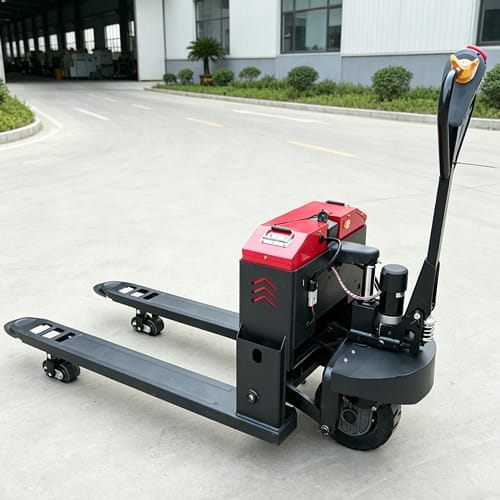
Choose pallet truck fork size by matching the fork spread, length and lowered height to the pallet’s entry openings and underside construction. Compare 550 mm and 685 mm overall fork widths, then check the exact fork length and where the load wheels will sit. A truck needs enough capacity and a compatible fit.
Pallet trucks, also called pallet jacks, carry their load wheels beneath the forks. Those wheels must pass through the intended entry path and reach suitable floor-contact positions when lifting. Pallet footprint alone does not describe that path.
This guide focuses on dimensional compatibility. For manual versus electric operation, batteries and broader equipment selection, see our pallet truck buying guide.
Which Pallet Truck Dimensions Should You Check?
Start with the pallet and mark the intended entry direction. For an 800 × 1200 mm pallet, entry through the 800 mm face puts the 1200 mm dimension along the forks. Entry through the 1200 mm face changes that depth to 800 mm.
| Measurement | Meaning | Compare it with |
|---|---|---|
| Overall fork width | Outside-to-outside spread across both forks | The positions and widths of the pallet’s entry channels |
| Individual fork width and inner gap | Width of each fork and the clear gap between them | Blocks, stringers and other structures between or beside the forks |
| Fork length | The dimension identified on the manufacturer’s drawing | Pallet depth along the forks, load support and far-side clearance |
| Lowered fork height | Height of the fork’s upper surface with the forks fully lowered, as specified | The clear entry height along the insertion path |
| Load-wheel geometry | Wheel size and position beneath the forks | Bottom boards and floor-contact spaces during entry, lifting and withdrawal |
For example, two 160 mm-wide forks with a 550 mm overall spread leave a 230 mm inner gap. At 685 mm overall spread, the gap becomes 365 mm. These combinations are listed for the CSHP-XJ20 electric pallet truck.
Measure the clear openings rather than the pallet’s outer edges. A wide opening at the entrance may narrow farther inside because of blocks, boards or other underside features.
550 mm vs 685 mm Fork Width
These dimensions describe overall fork spread, not the width of one fork or necessarily the widest part of the truck. Select the spread that places both forks within the entry channels and beneath appropriate pallet support areas.

| Overall fork width | When to evaluate it | Main fit checks |
|---|---|---|
| 550 mm | The pallet’s entry channels and bearing surfaces suit a narrower fork spread | Each fork clears its channel, the central structure fits between the forks and the pallet receives suitable support |
| 685 mm | The pallet provides wider-spaced entry channels and support positions | The wider spread clears the blocks and places the forks under the intended bearing areas |
A 550 mm configuration is not inherently a light-duty option. The CSHP-H30 product range includes a 3,000 kg-rated configuration with 550 mm overall fork width. Likewise, 685 mm spread does not establish a higher capacity. Read the rating for the exact truck configuration.
1100 mm vs 1200 mm Fork Length—and Where 1150 mm Fits
The difference between 1100 mm and 1200 mm forks is 100 mm. Its importance depends on pallet support, fork-tip projection and the location of the load wheels.

| Fork length | What the dimension changes | What still needs checking |
|---|---|---|
| 1100 mm | A shorter insertion length than the other examples | Adequate pallet support and the intended wheel positions |
| 1150 mm | An intermediate length listed on models such as the CSHP-XJ20 | The exact fit; do not round it to 1100 or 1200 mm on the quotation |
| 1200 mm | An additional 100 mm of length compared with 1100 mm forks | Far-side clearance, load-wheel position and maneuvering space |
A 1200 mm-deep pallet does not necessarily require forks exactly 1200 mm long. The selected truck must provide appropriate support while placing its wheels correctly relative to the pallet’s bottom boards.
For a practical comparison, take a 1000 × 1200 mm pallet entered through its 1000 mm face. Ask the supplier to mark the fork tips and load wheels for each candidate on the underside drawing. That shows the actual fit more clearly than matching the nominal fork length to pallet depth.
Lowered Fork Height and Load-Wheel Clearance
After checking width and length, measure the vertical space available along the entry path. The pallet’s overall height is different from its clear opening height.

Both the CSHP-XJ20 and the listed CSHP-H30 configurations specify an 85 mm minimum fork height. This is a model-specific entry dimension, not a universal value for pallet trucks. The opening needs sufficient working clearance for the actual truck and pallet condition; an opening nominally equal to 85 mm is not evidence of a workable fit.
Also distinguish three measurements:
- Lowered fork height: the entry height specified with the forks lowered.
- Fork thickness: the thickness of the fork structure, not its complete height above the floor.
- Ground clearance: clearance beneath the specified part of the truck.
The CSHP-XJ20, for example, lists 40 mm fork thickness alongside 85 mm minimum fork height. Substituting one for the other would give the wrong entry check.
Bottom boards introduce a separate check. The load wheels must reach the appropriate floor-contact spaces as the truck lifts. The Palletsmith operating manual specifically emphasizes matching the forks to the pallet and positioning the rollers between bottom boards. Review the complete wheel path, not only the clearance at the fork tips.
Published CSTAR Fork-Size Examples
These published configurations provide reference dimensions. They are not a compatibility chart for every pallet.
| Model / configuration | Overall fork width | Fork length | Minimum fork height |
|---|---|---|---|
| CSHP-XJ20 electric | 550 / 685 mm | 1150 mm | 85 mm |
| CSHP-H30 manual, narrower configuration | 550 mm | 1100 mm | 85 mm |
| CSHP-H30 manual, wider configuration | 685 mm | 1200 mm | 85 mm |
The CSHP-H30 product page also lists extended-fork configurations. Keep the selected width, length and wheel arrangement together on the quotation rather than assuming every listed option can be combined freely.
Euro Pallets and Other Pallet Formats
The EPAL Euro pallet has an 800 × 1200 mm footprint. Use the actual pallet drawing to check openings and underside construction instead of choosing a truck from the “Euro” or “standard” label alone.
| Pallet and entry face | Depth along the forks | Main assessment |
|---|---|---|
| 800 × 1200 mm; enter the 800 mm face | 1200 mm | Fork spread, individual openings, support and wheel position |
| 800 × 1200 mm; enter the 1200 mm face | 800 mm | Shorter insertion path, fork projection and wheel passage across underside features |
| 1000 × 1200 mm; enter the 1000 mm face | 1200 mm | Measured openings and support layout for the proposed fork spread |
| Custom, plastic or closed-bottom pallet | Measure the intended direction | The complete underside geometry and compatibility with the truck’s load wheels |
A four-way entry description identifies available access directions, but a particular pallet truck still needs suitable fork and wheel geometry for the chosen side. In a mixed-pallet warehouse, check each regularly handled pallet family and required entry direction.
Fork Size and Warehouse Maneuvering Space
Fork width is only part of the working outline. The truck body or pallet may be wider, and the load sweeps through additional space during a turn.
Compare overall truck dimensions, handle movement, operator position and the manufacturer’s working aisle requirement for your pallet orientation. Turning radius alone is not the required aisle width.
Check the full sequence: approach, insertion, lifting, turning and withdrawal. Include load overhang, doorways and rack-end obstructions. Our aisle width and measurement guide explains how to distinguish truck turning dimensions from clear working space.
How to Measure Your Pallet Before Ordering
- Record the footprint and entry direction. Mark the side facing the truck and the dimension running along the forks.
- Measure both fork channels. Record their clear widths, positions and the central structure between them.
- Measure clear entry height. Check the full insertion path and any lower underside projections.
- Map the bottom boards and openings. Provide underside photographs or a dimensioned drawing so the supplier can locate the load wheels.
- Record the load. Include pallet and goods weight, overhang and any uneven weight distribution.
- Document the route. Include the narrowest approach, turning area, doorway and relevant floor transitions.
Use sound, representative pallets for compatibility checks. Damaged or distorted pallets should be removed from service or assessed under the applicable pallet inspection procedures, rather than used to justify a different truck size.
Confirm the Complete Configuration
Ask the supplier to confirm overall fork width, individual fork width, inner gap, exact fork length, minimum fork height and load-wheel positions on the proposed model’s drawing.
The review should show adequate pallet support, clearance behind the fork tips and suitable wheel contact during lifting. Overlong forks can contact another pallet behind the load; unsuitable wheel positions can damage bottom boards. Extra fork length does not increase the truck’s rated capacity.
If fit remains uncertain, arrange a controlled check with the intended pallet and entry direction under the manufacturer’s instructions. Do not compensate for an unsuitable configuration by supporting a load only on the fork tips or improvising a partially inserted lifting position.
Pallet Truck Fork Size FAQ
What is a standard pallet jack fork size?
There is no single width-and-length combination for every pallet. The examples here include 550 and 685 mm overall fork widths and 1100, 1150 and 1200 mm fork lengths. Select the configuration using the pallet openings, support layout and wheel clearance.
Does 550 mm mean the width of each fork?
In the configurations discussed here, it means the outside-to-outside spread across both forks. Individual fork width and the gap between forks are separate measurements.
Does a 685 mm pallet truck fit every standard pallet?
No. The pallet name or footprint does not establish its channel spacing. Match both forks and the load-wheel path to the intended entry direction.
Are 1200 mm forks better than 1100 mm forks?
Choose the length that provides suitable support and wheel positions without unwanted projection. Neither length is preferable for every pallet.
Why can the forks enter but the truck cannot lift the pallet properly?
Entry clearance is only one part of compatibility. The load wheels may be positioned over bottom boards, or the forks may not support the pallet correctly. Stop and review the pallet underside and truck drawing rather than forcing the lift.
For a configuration check, send CSTAR your pallet measurements, underside photographs, entry direction, load weight and working-space dimensions.