
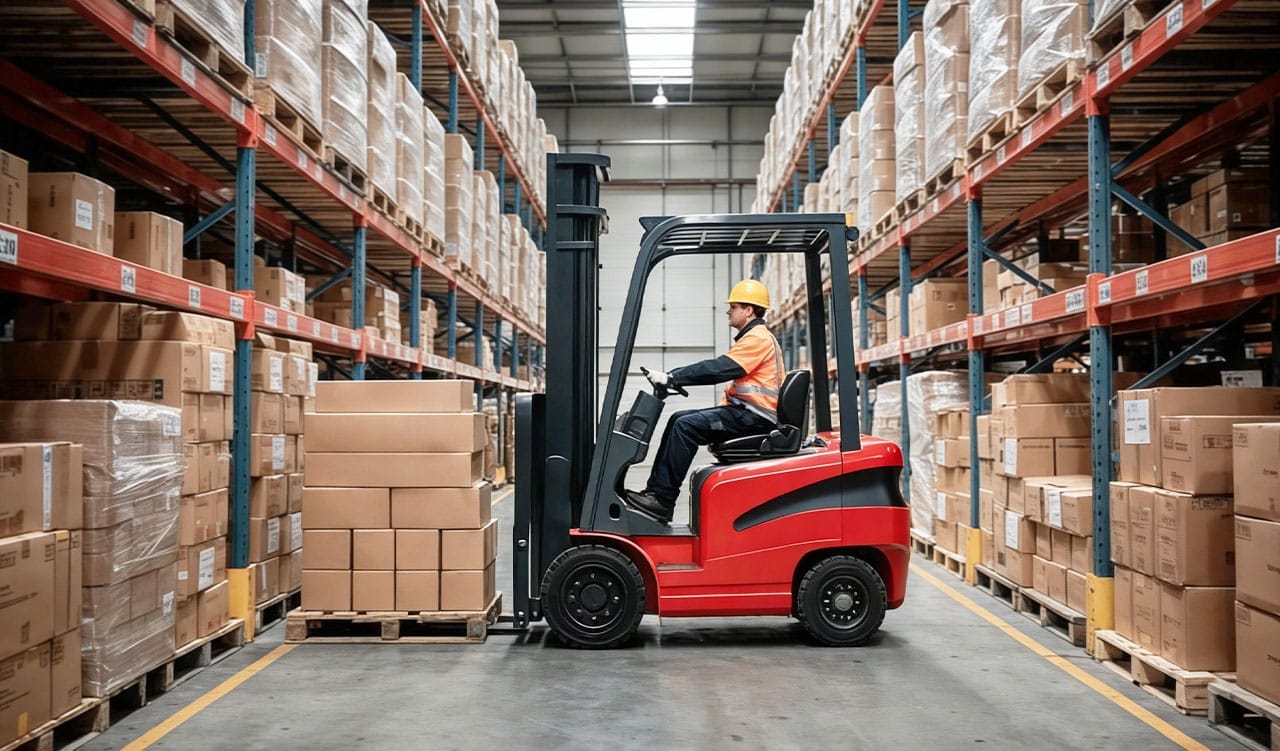
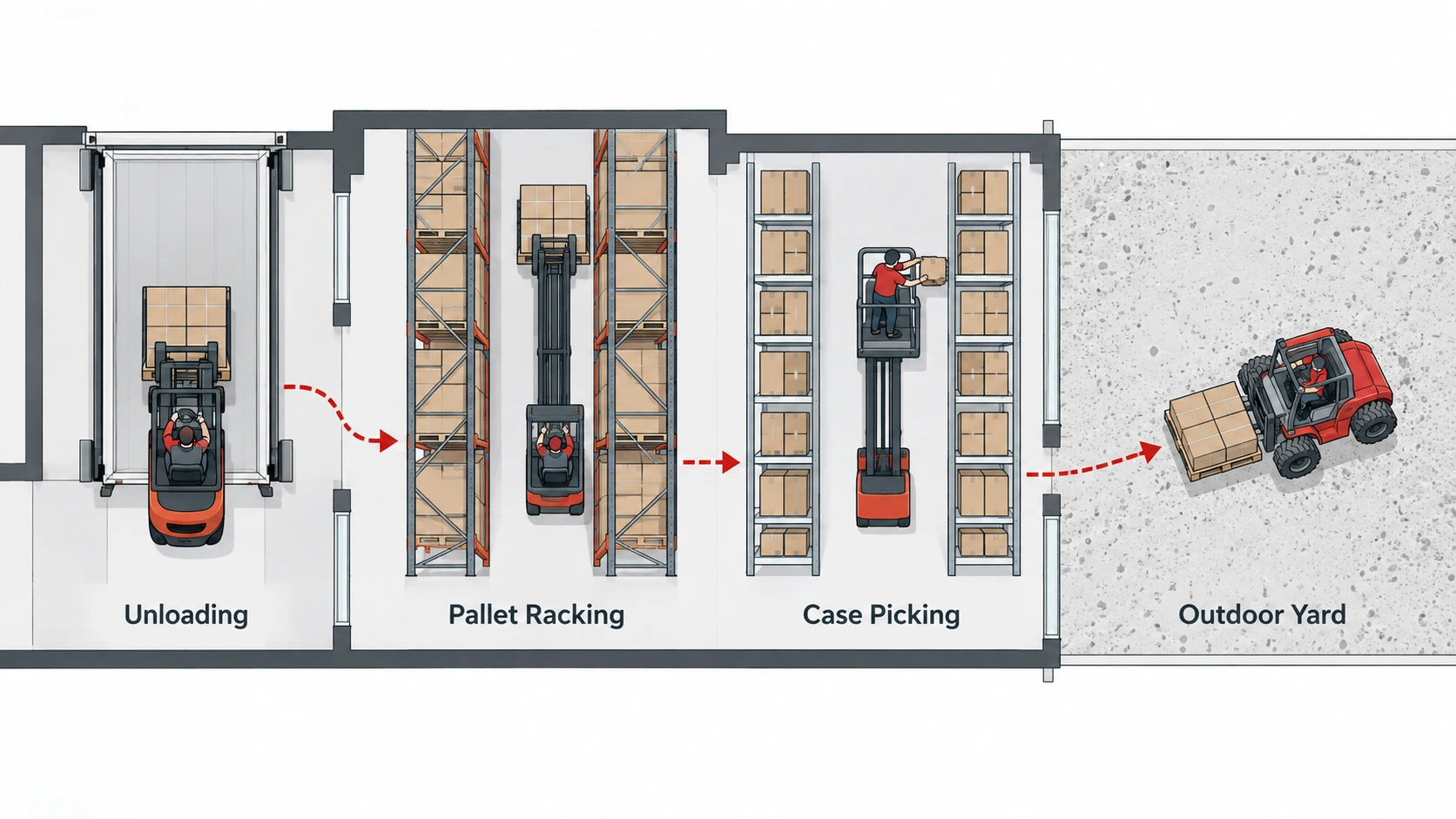
When trucks carrying palletized goods arrive at a warehouse, some loads must be stored directly in high-level racking, while others need to be broken down into individual cases for order picking. Warehouse managers planning these workflows quickly encounter a limitation: a single piece of equipment purchased under the generic label of “forklift” often cannot handle all these tasks efficiently.
A more effective approach to distinguishing between forklift types is to first define specific operational requirements—such as ground-level pallet handling, reaching into racks for storage and retrieval, case picking, transporting long or oversized loads, or operating on rough outdoor terrain. Once these needs are established, consider factors such as warehouse space and floor conditions before comparing specific models. The seven classes defined by the U.S. Occupational Safety and Health Administration (OSHA) serve as a classification standard for powered industrial trucks based on power sources and design characteristics, rather than an exhaustive procurement list covering every possible forklift design.
What Are the Main Types of Forklifts?
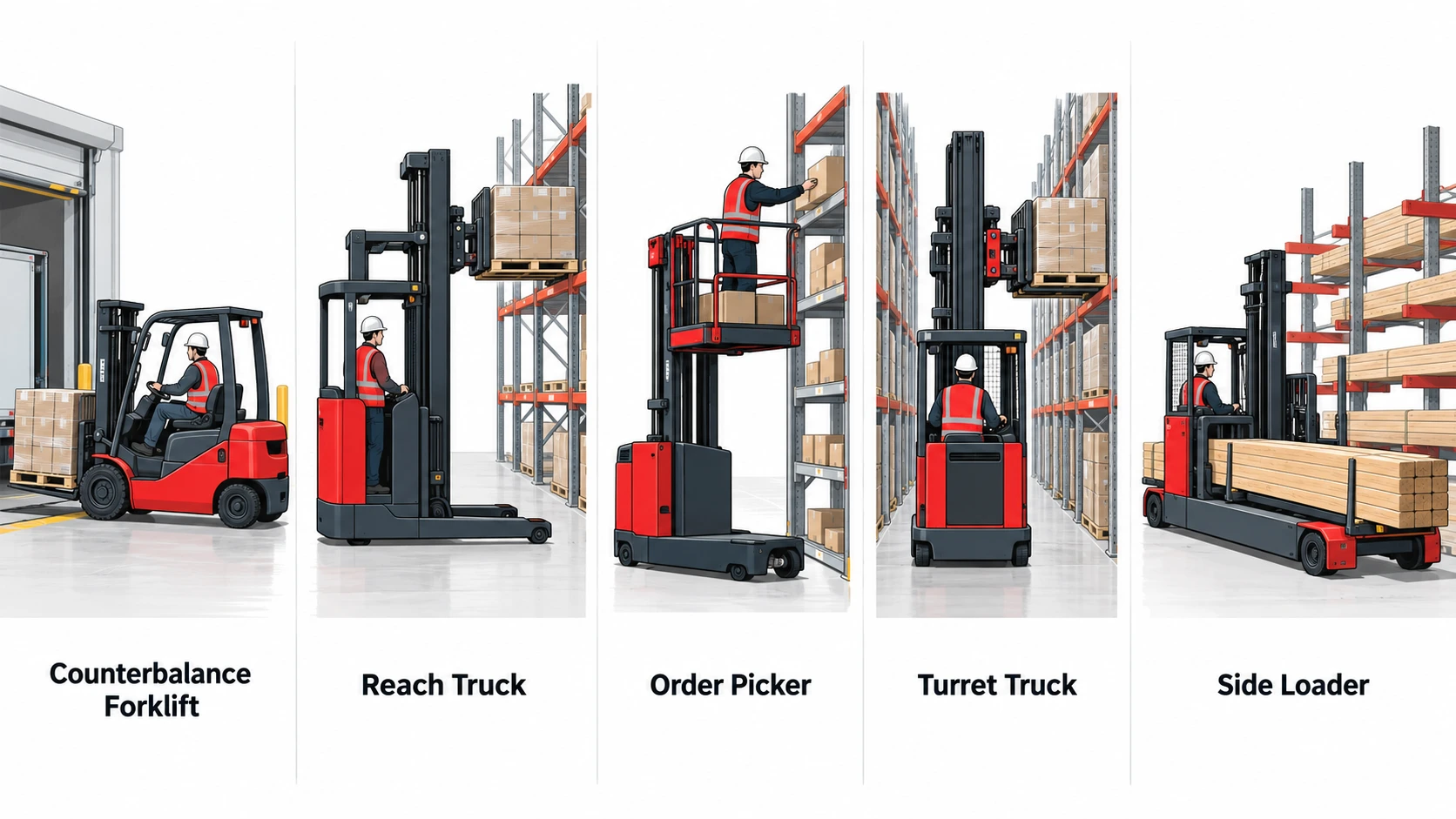
When buyers talk about forklift types, they usually mean categories based on the job: pallet handling, racking, order picking, long-load handling, or rough-terrain operation. Regulators, by contrast, classify forklifts mainly by power source and design. Those regulatory classifications matter, but they are not what this guide is built around. The table below outlines the task-based categories, and the sections that follow discuss each one in detail.
| Task | Start with | Confirm before buying |
|---|---|---|
| Routine pallet handling and ground moves | Counterbalance forklift | Load, floor, doorways and dock layout |
| Placing and retrieving pallets in racking | Reach truck | Rack layout, fork-entry direction, floor condition |
| Case or single-item picking at height | Order picker | Picking method and operator workflow |
| High-density, very-narrow-aisle pallet storage | Turret truck | Whether racking and aisles are built for this equipment |
| Long loads such as timber, pipe or profiles | Side loader | Load length and orientation during travel |
| Unpaved or uneven outdoor ground | Rough-terrain forklift | Ground conditions, ramps and the specific model’s rating |
| Heavier or non-standard loads | Heavy-duty forklift or a specific configuration | Load size, load center and any attachment |
Treat this table as a starting point for your own research. A real recommendation still comes from checking a specific model against your load and site — and that’s what the sections below walk through.
Counterbalance Forklifts for General Pallet Handling
When most people hear “forklift,” this is the shape they picture: forks at the front, no support legs reaching out ahead of the forks, and a counterweight built into the rear of the chassis that balances the load on the forks. That open front end lets a counterbalance truck approach most pallets directly, without positioning legs alongside or under them first. It’s a natural fit for unloading trailers, moving pallets across open floor, and putting loads into racking that isn’t packed into the tightest aisles a warehouse can offer.
“Counterbalance” describes the chassis, and the power source is a separate choice layered on top of it. Counterbalance trucks are built as electric, diesel and LPG models, and an electric and a diesel version of the same body style can do the same job with different trade-offs around runtime, fuel handling, ventilation and duty cycle. Suitability for indoor or outdoor work comes down to the specific model, its tires, and the floor or ground it’s driving on. Our Electric vs Diesel Forklift guide goes through that decision in more depth.
Reach Trucks and Narrow-Aisle Forklifts for Pallet Racking
Once pallets are going up into racking rather than just moving across a floor, aisle space becomes a larger part of the equipment decision. A reach truck uses base legs for stability and a reach mechanism to place pallets into racking. Depending on the design, the forks extend forward or the mast itself moves. The load is drawn back for travel, helping the truck work in narrower rack aisles than a comparable counterbalance forklift.
“Narrow aisle forklift” gets used loosely as a search term, so it’s worth treating it as a broad description rather than another name for the reach truck specifically. Order pickers and turret trucks, both covered later in this guide, work in narrow aisles too, and neither one is a reach truck. Working out how much aisle space a given model actually needs depends on the truck, the pallet, the load and the turn it has to make. That’s covered in the Forklift Aisle Width Guide.
Order Pickers, Turret Trucks and Side Loaders Solve Different Problems
These three sometimes appear together in equipment lists, but they answer different questions: who needs to reach the stock, how pallets enter dense racking, and how long loads travel.
Order Pickers for Case and Item Picking
An order picker carries the operator up with the forks, on a platform that rises alongside the load, so they can pull individual cases or items directly off shelving at height instead of climbing a ladder or lowering the load each time they need to see a different level. That’s a fundamentally different job from putting a full pallet away. It’s built around repeated, precise access to a shelf face, and full-pallet put-away is usually handled by other equipment entirely.
Turret Trucks for Very-Narrow-Aisle Pallet Storage
A turret truck turns its fork head toward racking on either side of the aisle, allowing it to place and retrieve pallets without turning the whole chassis at each pallet position. The required aisle width still depends on the truck, pallet and operating clearances, as well as aisle entry and exit. These trucks are often used with racking and aisle layouts designed for very-narrow-aisle work, sometimes with an aisle-guidance system.
Side Loaders for Long Loads
Pipe, timber, extrusions and other long material can be awkward to carry across the front of a conventional forklift. At an aisle intersection, the load may need far more swing room than the truck itself. A side loader picks up from the side and carries long loads lengthwise, often on a load deck, with the material aligned along the direction of travel. If long loads are a regular part of your operation, their length and travel route deserve attention alongside their weight.
Rough-Terrain and Heavy-Duty Forklifts for Demanding Work
These two categories get grouped together because they both sound like “the tough one,” but they answer different questions. A rough-terrain forklift is about the ground it drives on; a heavy-duty forklift is about the load it carries. A job can need one, both, or neither.
A rough-terrain forklift is built for unimproved or uneven ground, whether that’s a construction site, a lumber yard, or an outdoor storage area without a finished floor. It typically has larger tires and more ground clearance than a warehouse counterbalance truck, but pneumatic tires alone don’t make a machine rough-terrain rated; the frame, drivetrain and overall stability of the vehicle matter just as much. OSHA’s guidance on powered industrial trucks notes that “rough terrain” doesn’t guarantee a given truck can be safely operated on every kind of difficult ground; the specific site conditions still need to be checked against what that model is designed to handle.
A heavy-duty forklift answers a different question: it’s built to lift loads heavier, longer or more awkward than a standard counterbalance truck can manage, usually through a reinforced frame, a larger counterweight, and mast and tire choices sized for the job, sometimes paired with a purpose-built attachment. Manufacturers don’t share one weight figure that marks the line between “standard” and “heavy-duty,” so it’s worth skipping the guesswork; the load’s size, weight and load center are what actually determine the right configuration, which the Forklift Capacity Guide covers.
Where Pallet Stackers and Pallet Trucks Fit
“Forklift,” “stacker” and “pallet truck” get used somewhat interchangeably in casual conversation, and it’s worth pulling them apart before you start requesting quotes. A pallet truck, sometimes called a pallet jack, is built mainly for horizontal movement. It lifts a pallet just enough to clear the floor and roll it from one point to another, with no mast or lift height to place it into racking. A pallet stacker adds that mast, so it can lift a pallet vertically and place it into racking within whatever height and capacity that particular stacker is built for.
All three can end up moving a pallet from one place to another, so the task ranges overlap. That doesn’t make the names interchangeable, though; a stacker is its own design, not a scaled-down forklift or a pallet truck with a mast bolted on. If you’re weighing a stacker against a full forklift, or a pallet truck against a stacker, our Electric Stacker vs Forklift and Pallet Truck Buying Guide cover those comparisons in the detail this section doesn’t need to repeat.
How to Match the Truck Type to Your Warehouse Job
With the categories above in mind, the practical next step is working through your own operation in order, rather than jumping straight to a model number:
- Name the task. Are you moving full pallets, picking cases or single items, or handling long or oversized material? Each task points toward a different group of machines.
- Check the load. Weight, dimensions, pallet construction and fork-entry direction affect which designs can handle it.
- Look at the racking. How high does stock need to go, and how does the truck need to approach the rack?
- Walk the route. Include the unloading point, doorways, aisle ends, ramps and any outdoor ground — not just the straight rack aisle.
- Count the work. How many moves happen in a shift, and over what distance? This helps narrow the operator arrangement and power configuration.
That’s the information to have ready before you request a model. Real sites often involve a trade-off or two, which is exactly what a supplier conversation is for. Load capacity and aisle-width specifics are covered in more depth in the guides linked above.
Frequently Asked Questions
What are the most common types of forklifts in warehouses?
Common warehouse choices include counterbalance forklifts for general pallet handling and reach trucks for rack storage. Order pickers serve case and item picking. Pallet stackers and pallet trucks cover other pallet-handling tasks, depending on the load and lift height.
What is the difference between a counterbalance forklift and a reach truck?
A counterbalance forklift balances the load with weight at the rear and approaches pallets without front support legs. A reach truck uses base legs and a reach mechanism to place pallets in racking while working in a narrower aisle layout.
Is an order picker used to stack full pallets?
Usually not as its main job. An order picker raises the operator for case and item picking. Full-pallet put-away and retrieval are normally assigned to equipment selected for that load and rack layout, such as a reach truck or counterbalance forklift.
Is a pallet stacker a forklift?
A powered pallet stacker is a powered industrial truck, and “forklift” is sometimes used as a broad label that covers it. Pallet access, rated capacity, lift height and operator position all vary by model, so it’s worth comparing the specific designs rather than assuming a stacker and a counterbalance forklift can do the same job because both lift pallets. See OSHA’s classification of high-lift stacking equipment for how this fits within the broader regulatory categories.
Which forklift type is used on rough outdoor ground?
A rough-terrain forklift is designed for unpaved or uneven ground. The specific truck still needs to be matched to the site’s surface and slope.
Conclusion
Back to that delivery at the dock: unloading pallets, putting stock into racking and picking cases are three different jobs. Each points toward a different equipment design. Once you’ve separated the tasks, use your load, storage layout and travel route to narrow the model shortlist.
If you’d like help with that shortlist, send CSTAR your load weights and dimensions, pallet photos, highest storage level, aisle and doorway measurements, and a description of the floor or outdoor ground. Contact CSTAR.