
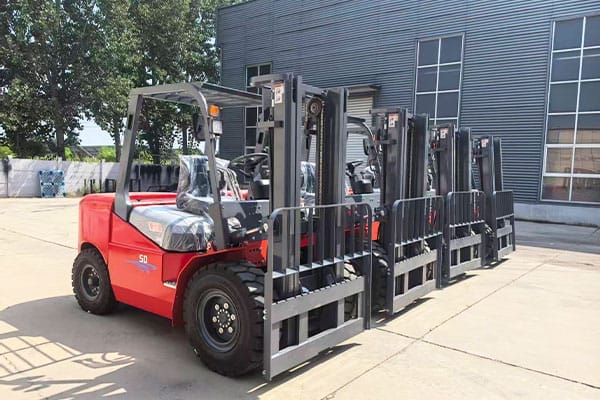
Before choosing a forklift for container unloading, establish whether the truck needs to enter the container. Then check the cargo, doorway and interior clearances, mast movement, supporting surfaces and access route. A truck may have enough lifting capacity yet lack the clearance or floor compatibility needed for the job.
This guide covers selecting equipment to load and unload cargo inside shipping containers. It does not cover lifting the container itself or shipping a forklift as cargo, which requires a separate transport and securing plan.
First decide: Does the forklift need to enter the container?
Define the handling method before comparing trucks. Full entry, outside reach and doorway transfer place different demands on the equipment and loading area.
The whole truck enters the container
The truck, load and operator need sufficient space throughout entry, pickup, placement and exit. Check the doorway, interior working envelope, floor condition, lighting and ventilation. Include the dock or ramp connecting the container to the yard or warehouse.
The truck stays outside while the forks or attachment reach in
Identify the actual pickup position and the distance from the fork face to the load’s center of gravity. Check the approved capacity for the proposed forks or attachment. Longer forks provide reach, but their length alone does not establish whether the truck can handle a load at that position.
Handling takes place at the doorway or loading dock
Establish how cargo reaches the transfer point and which equipment handles each part of the journey. For example, a pallet truck may move a pallet toward the doorway for collection by another truck. Assess the handover area, dock edges, supporting surfaces and separation between people and equipment.
Start with the load and container measurements
Record the heaviest load and its actual dimensions
Record the heaviest load the truck will be expected to handle, including occasional loads. An average pallet weight is insufficient for selecting capacity. Provide:
- The maximum weight of each pallet or individual item.
- Packed length, width and height, including overhang.
- Pallet construction, entry direction and weight distribution.
- Whether cargo is stacked and the required placement height.
- Any side shifter, clamp, fork extension or other attachment.
Measure the doorway and usable interior separately
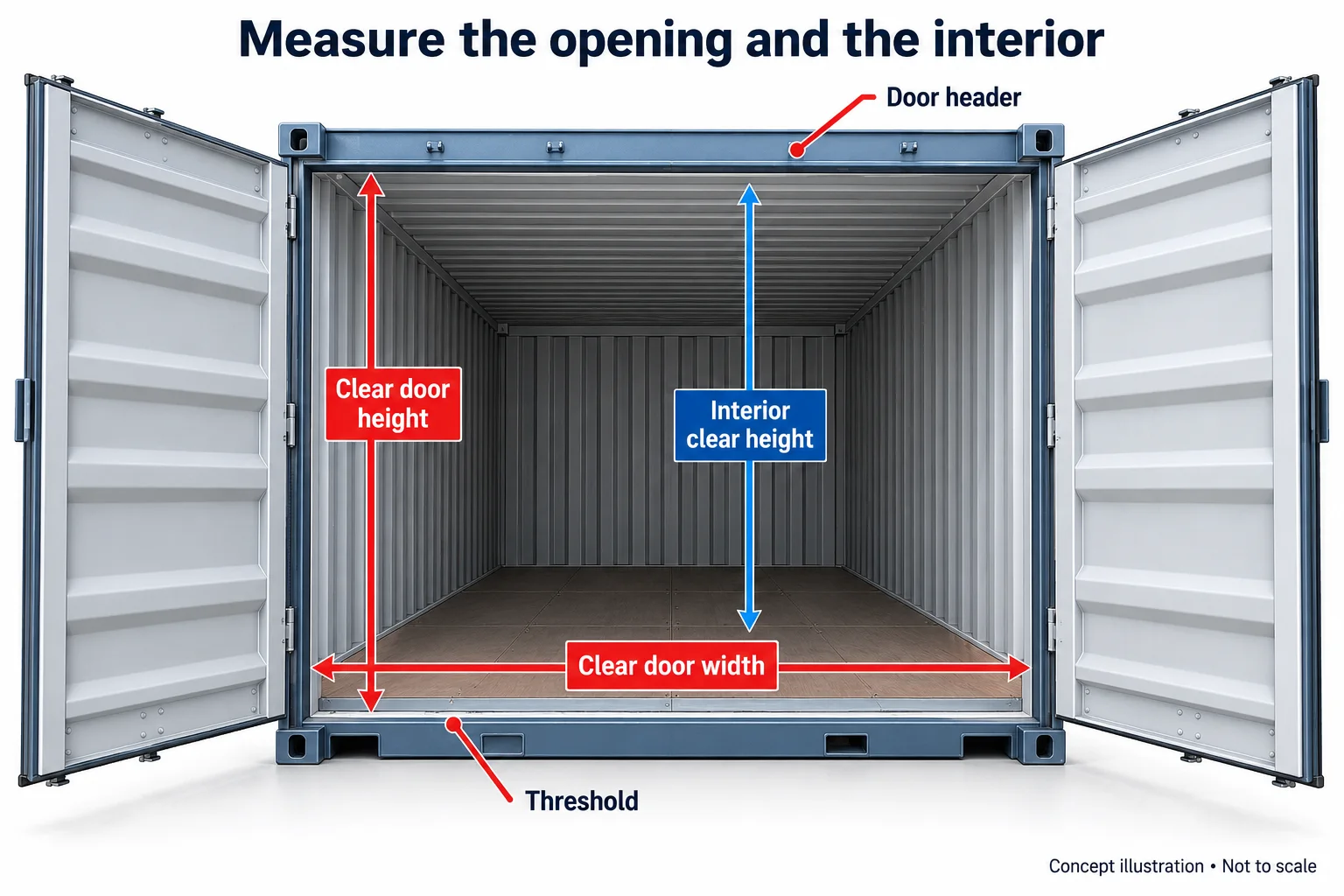
Measure the clear door width and height at the narrowest points. Record the sill, top header and any fittings that project into the opening. Inside, measure the usable width, height and working space available around the cargo.
External container dimensions do not describe the clear door opening. Confirm measurements for the actual container or the documented range of containers the truck will serve, including any obstructions or variations that affect access.
Check mast clearance throughout the movement
Check collapsed mast height and the highest truck components
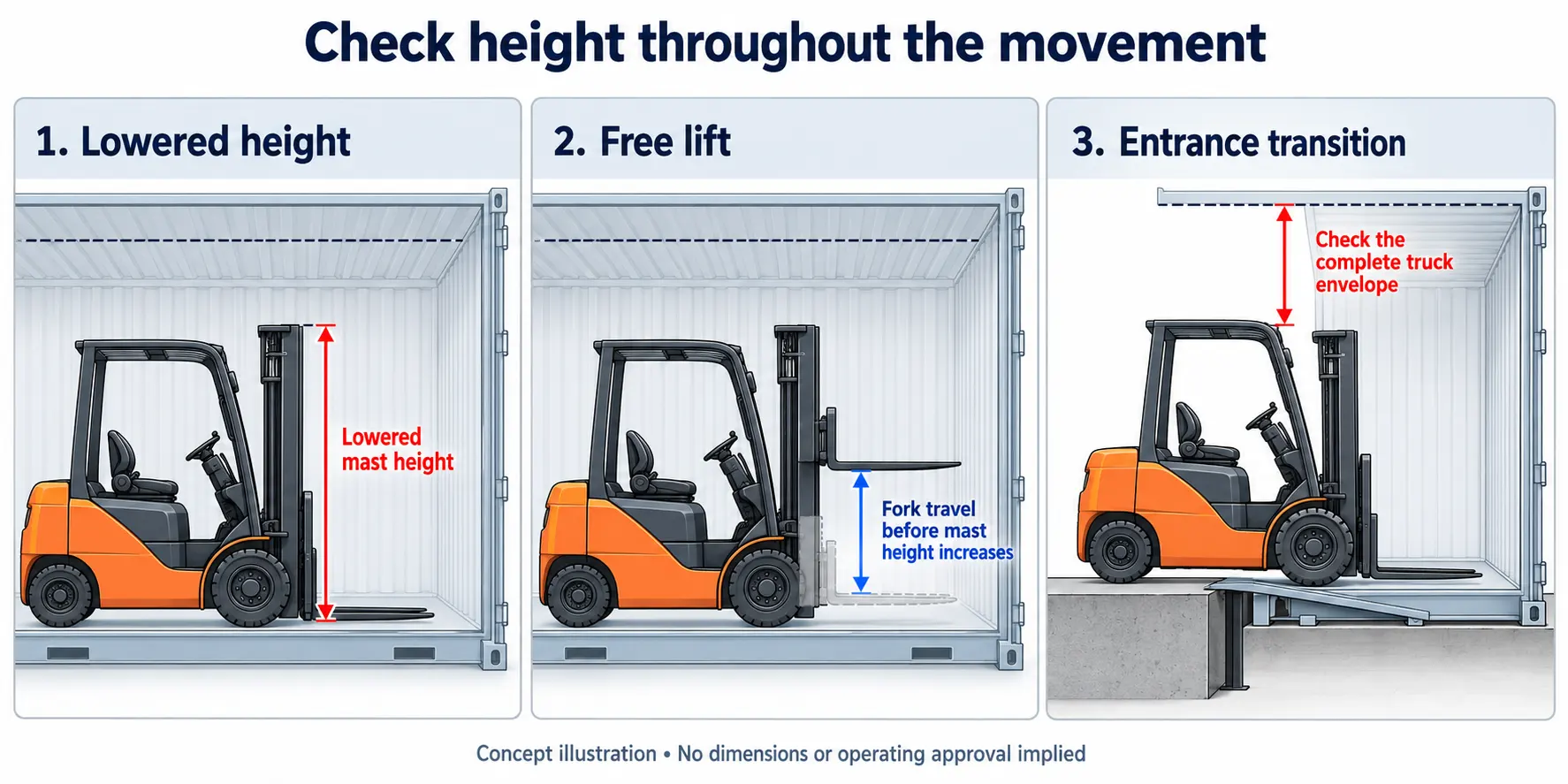
Collapsed mast height, also called lowered mast height, is an initial doorway check. Compare the opening with the highest part of the complete truck, including the overhead guard, load backrest and fitted equipment. Use the dimensional drawing for the configuration being quoted.
Match free lift to the lift needed inside
Free lift is the distance the forks can rise from their lowest position before the mast’s overall height begins to increase. A free lift forklift mast can therefore raise a load through part of its travel without immediately increasing mast height.
Limited free lift provides a short initial lifting range. Full free lift provides an extended range of fork and carriage movement before mast height increases. Mast stage count is a separate specification: confirm the quoted free lift rather than inferring it from a simplex, duplex or triplex label.
Compare the specified free lift with the movement required for the job. Raising a floor-level pallet for transport and placing one load above another require different fork travel. Check the highest position reached by the mast, load backrest and cargo throughout that movement.
For a comparison of mast stages, collapsed height and free lift, see our forklift mast types guide.
Check clearance at the doorway, ramp and transitions
The truck’s position changes as it crosses a ramp, dock plate or threshold, changing the clearance above its highest components. Check the doorway and transitions with the intended mast position and load arrangement. Establish the required clearance for the actual route with the equipment supplier and the person responsible for the site assessment.
Match capacity to the actual load and configuration
A forklift’s rated capacity applies at the load center and configuration shown on its data plate. Long cargo, uneven weight distribution or a pickup position farther from the fork face can increase the actual load center distance. OSHA’s load composition guidance explains how load position affects capacity and stability.
Longer forks do not automatically move the cargo’s center of gravity forward, but the way the load is positioned on them matters. Attachments can also change the truck’s approved capacity. Provide the actual load dimensions, pickup position and attachment details when requesting a capacity assessment.
Check the truck’s current data plate and the load chart for the selected mast, lift height, forks and attachments. For the relationship between rated capacity and load center, read How Much Can a Forklift Lift?
Assess the container floor, dock and ramp together
Use the relevant axle or wheel loads
Truck weight, combined truck-and-cargo weight, and axle or wheel loads answer different questions. The combined weight is not distributed equally across the wheels. Obtain the relevant empty and loaded figures for the proposed configuration rather than dividing the total weight by the number of wheels.
A container’s payload rating alone does not establish that its floor can accommodate a particular forklift. Give the vehicle and load data to the person responsible for assessing the container floor and the other supporting surfaces. Include the actual floor condition and any damage or repairs.
Our guide to forklift service weight and lifting capacity explains the distinction between shipping information and the data needed for a floor or ramp assessment.
Check the complete access route
Review every surface between the approach area and the cargo:
- Whether the container is on a trailer or at ground level.
- How the trailer, container and access equipment are supported and secured.
- The applicable load rating and use conditions of each ramp or dockboard.
- Usable width, surface condition, thresholds and changes in slope.
- Measures to prevent movement, slipping and falls from exposed edges.
The UK’s HSE guidance on loading areas addresses loading-area design and changes in vehicle platform height. In the US, OSHA’s warehousing guidance covers securing dockboards and preventing transport vehicles from moving during use. Apply the requirements relevant to your location and equipment.
Confirm permitted ramp operation for the actual truck, load and route. A published maximum gradeability figure is not, by itself, approval to work on a ramp of that slope.
Check fork length and working space
Match the forks to the pallet and cargo
Compare fork length, width, thickness and spacing with the pallet openings and required load support. Record the entry direction and underside construction. Fork tips projecting beyond a pallet can contact cargo behind it, so assess the complete pickup arrangement.
Include fork extensions and attachments in the quoted configuration and capacity review. Confirm their dimensions and approved use before ordering.
Plan the loading sequence and remaining space
Check the route at each stage of loading or unloading. Cargo placement changes the available working space, the operator’s view and the positions the truck can reach. Mark the intended pickup and placement points, any turns, and the exit route on a plan.
Where people also enter the work area, plan their separation from moving equipment. Include space for an accompanying operator when considering a walkie pallet truck or stacker.
Ast is the right-angle stacking aisle width for a specified truck, load and pallet orientation. It describes a particular stacking maneuver, not every movement inside a container. Use it alongside the dimensional drawing and actual route assessment. Our forklift aisle width guide explains how to read this specification.
Electric or diesel for container handling?
Compare power sources against the work environment and daily operating pattern. Physical fit remains a separate check for each model and configuration.
| Factor | What to assess |
|---|---|
| Exhaust and ventilation | Electric trucks produce no engine exhaust during operation. Internal combustion trucks require assessment of exhaust exposure, ventilation and controls in the work area. |
| Work environment | The route between the container, warehouse and outdoor yard, including environmental conditions along it. |
| Workload and energy supply | Operating hours, lifting frequency, travel distance and available charging or refuelling arrangements. |
| Ground and access | The specific truck’s tires, chassis and permitted use on the floor, ramp and transitions. |
Engine exhaust can accumulate inside a container. OSHA’s guidance on enclosed areas identifies carbon monoxide exposure as a hazard and recommends considering battery-powered equipment where ventilation is poor or exposure to exhaust byproducts is excessive. LPG equipment also produces engine exhaust.
Assess ventilation, exposure controls and truck suitability for the actual work area. An open container door alone does not establish adequate ventilation. Electric trucks still require the clearance, capacity and supporting-surface checks described above. For the broader comparison, read our electric vs diesel forklift guide.
When a pallet truck or stacker may fit
The required handling movement determines which equipment to assess. Horizontal pallet transfer, lifting and stacking place different demands on the truck.
- For a pallet truck, assess pallet entry, wheel loads, the access route and suitability for any ramp or threshold.
- For a stacker, also check support-leg access, the pallet underside, mast movement and operator space.
- For a counterbalance forklift, match the load and lifting task to the truck’s capacity, dimensions and supporting surfaces.
Container forklift selection checklist
Copy this checklist into your enquiry. Attach a measured layout and photographs of the entrance, floor, cargo and access equipment.
| Information to provide | Your details |
|---|---|
| Handling method: full entry, outside reach or doorway transfer | |
| Container type and identification | |
| Container position: on a trailer or at ground level | |
| Restraint, support and door-securing arrangements | |
| Clear door width and height | |
| Internal working dimensions and obstructions | |
| Floor condition and available supporting-surface assessment | |
| Maximum cargo weight, packed dimensions and weight distribution | |
| Pallet construction and fork-entry direction | |
| Required lifting and placement height | |
| Stacking arrangement and loading sequence | |
| Forks, extensions and attachments | |
| Dock, ramp, threshold and transition details | |
| Turning space, visibility and operator clearance | |
| Lighting, ventilation, exhaust controls and pedestrian arrangements | |
| Daily workload and charging or refuelling arrangements |
Ask the equipment supplier to return:
- A dimensional drawing for the quoted configuration.
- Collapsed mast height, free lift and relevant raised-component heights.
- The applicable capacity plate information and load chart.
- Axle or wheel loads for the specified empty and loaded conditions.
- Operating limits and configuration notes relevant to the proposed route.
These documents support equipment selection. Site safety and structural suitability remain separate assessments.
Frequently asked questions
Can a standard forklift enter a shipping container?
Check the specific truck against the doorway, interior clearance, cargo and supporting surfaces. “Standard forklift” does not identify a configuration or establish suitability for container entry.
Do I need a full free lift mast for container unloading?
Compare the available free lift with the fork travel required inside. Check the mast, load backrest and cargo heights throughout pickup and placement. The required lifting movement and available headroom determine the configuration.
Can a 3-ton forklift unload a container?
A 3-ton rating is only one part of the selection. Confirm capacity at the actual load center and lift height, then check vehicle clearance, attachments, floor loading and access equipment.
Can a diesel forklift work inside a shipping container?
Suitability requires assessment of exhaust exposure, ventilation, controls and the other site conditions. An open door does not establish adequate ventilation, and short operating periods should not be assumed safe without assessment.
Is a pallet truck enough for unloading palletized cargo?
A pallet truck may suit horizontal transfer when the pallets, floor and access route are compatible. Lifting or stacking needs a separate equipment assessment. Check ramp suitability and operator space for the particular pallet truck being considered.
Discuss a configuration for your container work
Send CSTAR Machinery your container and load details, including entrance and floor photographs, clearance measurements, pallet construction and dock or ramp information. This gives the team a practical basis for reviewing a specific truck configuration and the supporting documents needed for your assessment.