
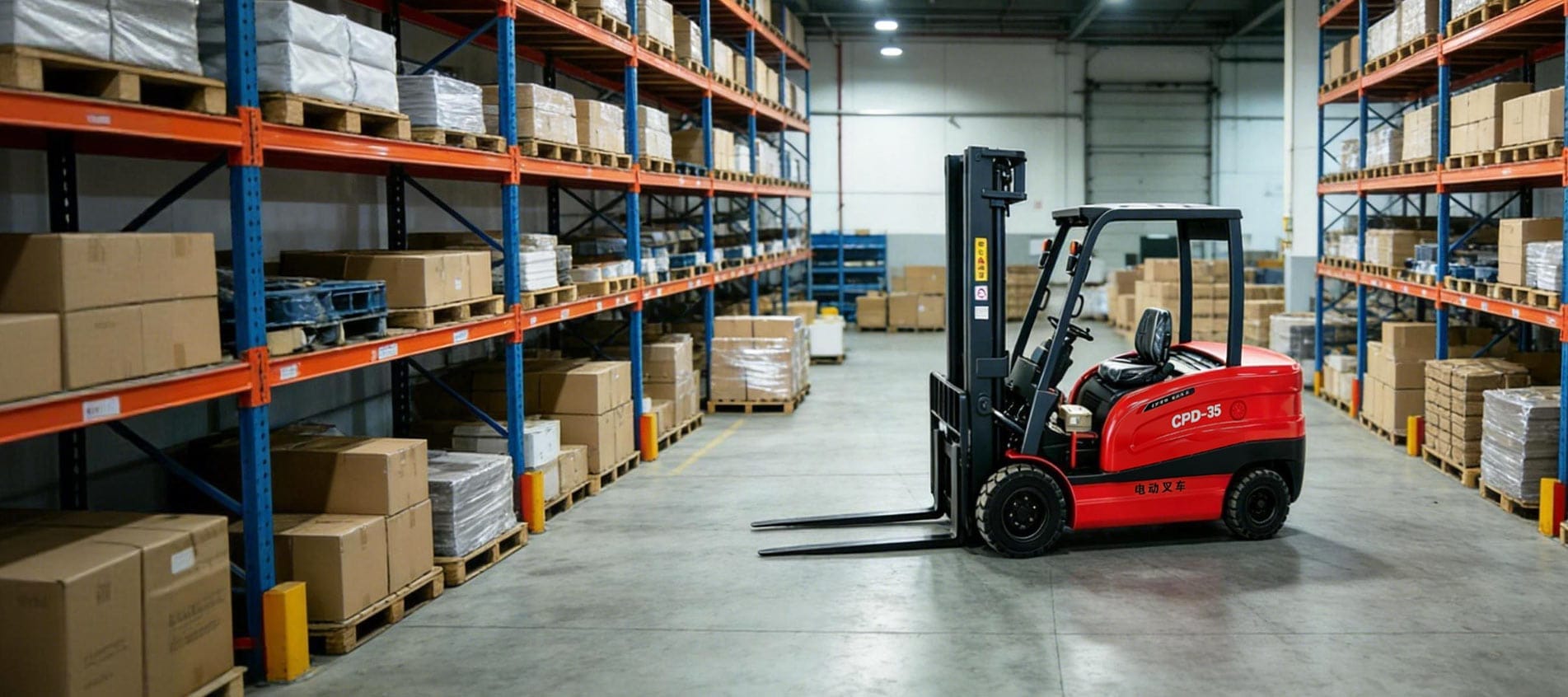
Short answer: many standard counterbalance forklifts are rated to lift about 1,000–10,000 kg (2,200–22,000 lb), while specialized industrial trucks can fall outside that range. The number is not universal: a forklift’s usable capacity depends on the load center, lift height, mast, forks or attachment, and the way the load is positioned. The capacity plate for the truck in its current configuration—not the model name alone—is the controlling reference.
A “3 ton forklift” therefore does not automatically handle every object weighing 3,000 kg. Its rating applies under stated conditions. A long crate, a high lift or a clamp attachment can change the capacity available for the job even when the scale weight of the cargo stays the same.
This guide explains the figures buyers most often confuse and shows what information CSTAR Machinery needs to recommend a suitable forklift configuration.
The Short Answer, by Rated Capacity
The table below is a starting point for comparing common capacity bands. It is not a substitute for an application review or the truck’s capacity plate.
| Rated-capacity band | Typical work to evaluate | CSTAR model to compare |
|---|---|---|
| 1.0 ton / 1,000 kg | Light pallet handling in compact warehouses, workshops and retail logistics | CSAE-10 electric forklift |
| 1.5 ton / 1,500 kg | Standard pallet loads in smaller warehouses and production areas | CSAE-15 electric forklift |
| 2.0 ton / 2,000 kg | General warehousing, manufacturing supply and pallet transfer | CSAH-20 electric forklift |
| 2.5 ton / 2,500 kg | Heavier palletized goods and medium-duty industrial handling | CSAH-25 electric forklift |
| 3.0 ton / 3,000 kg | Industrial pallets, freight yards, building materials and outdoor logistics | CSQD-30 diesel forklift |
| 4.0 ton / 4,000 kg | Dense industrial loads and heavier yard handling | CSQD-40 diesel forklift |
| 5.0 ton / 5,000 kg | Metal products, heavy components, timber and construction materials | CSQD-50 diesel forklift |
| 7.0 ton / 7,000 kg | Large fabrications, heavy raw materials and high-capacity yard work | CSQD-70 diesel forklift |
| 10.0 ton / 10,000 kg | Heavy machinery, steel, timber and high-capacity industrial logistics | CSQD-100 diesel forklift |
These figures describe rated-capacity bands. Before choosing a truck, test the heaviest real load against its load center, required lift height and attachment configuration.
Rated Capacity Is Always Tied to a Load Center
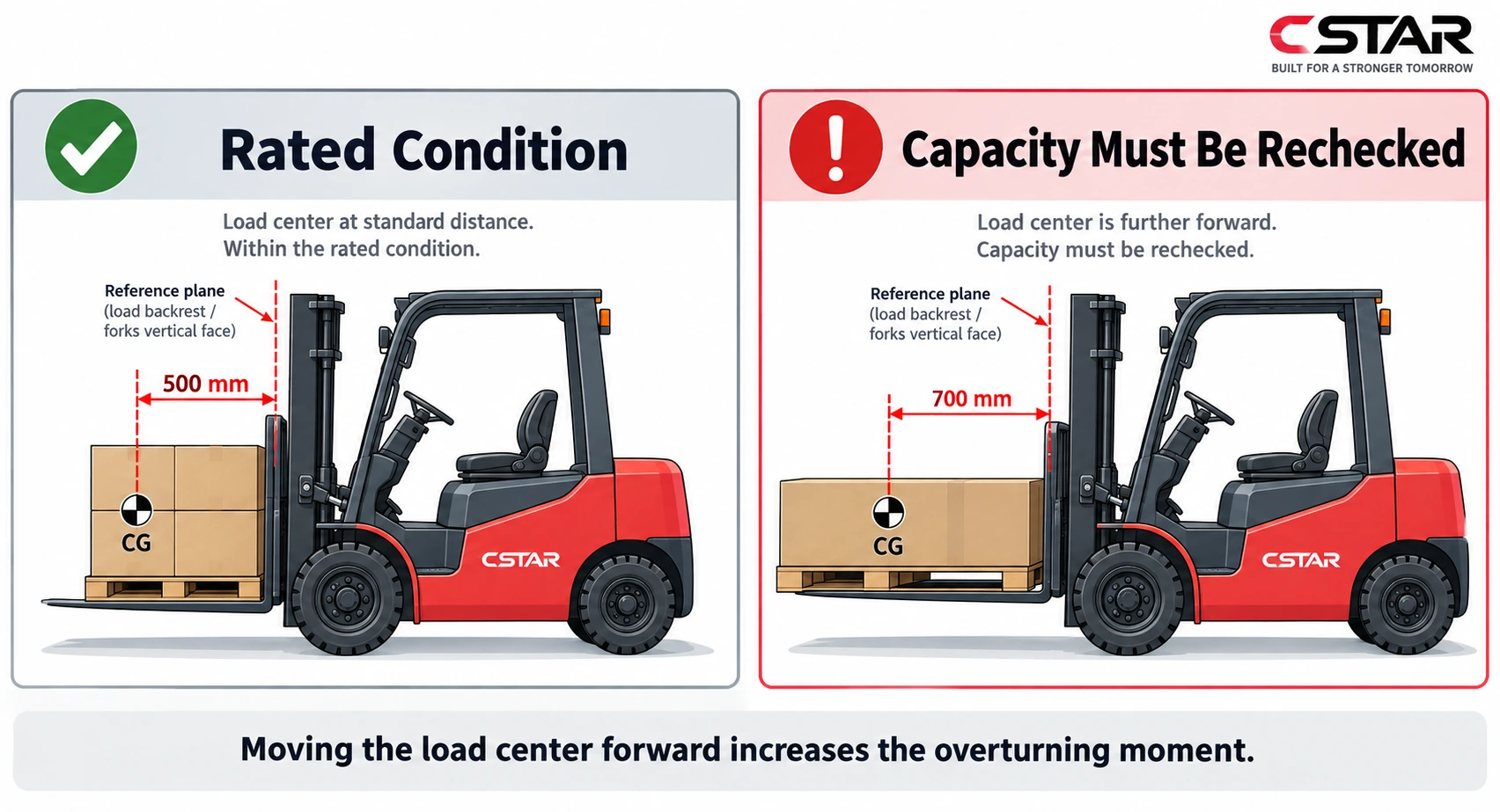 The load center is the horizontal distance from the vertical face of the forks to the load’s center of gravity. For a uniformly distributed 1,000mm-deep load positioned against the fork face, the center of gravity is approximately 500mm forward. A 1,200mm-deep uniform load is approximately 600mm forward. Real loads may be uneven, off-center or unable to sit fully against the fork face, so their actual center of gravity must be checked rather than assumed.
CSTAR specifications show how this reference can change with the truck size. The CSQD-30 is rated for 3,000 kg at a 500mm load center. The larger CSQD-100 is rated for 10,000 kg at a 600mm load center. The capacity and the load-center figure must be read together.
Illustrative example only — not an approved capacity or attachment derating formula.
Rated condition
3,000 kg × 500 mm
= 1,500,000 kg·mm
Center moves to 700 mm
1,500,000 ÷ 700
≈ 2,143 kg
What this illustration means: moving the center of gravity from 500mm to 700mm increases the overturning effect even though the cargo itself has not changed. The simple ratio shows why a capacity reduction should be expected. It is not an approved capacity calculation: mast geometry, lift height, attachments and truck design also matter. Use the manufacturer’s capacity chart or updated data plate for the exact configuration.
What Is the Load Center Distance of a Standard Forklift?
There is no single load center for every forklift. A 500mm load center is common on many compact and standard counterbalance forklifts, while 600mm is used on many larger-capacity trucks or configurations intended for deeper loads. Always use the load-center distance printed on the truck’s capacity plate; do not copy a value from another model of the same nominal tonnage.
Three Numbers That Get Confused: Rated Load, Maximum Load and Operating Weight
| Term | What it means | How to use it |
|---|---|---|
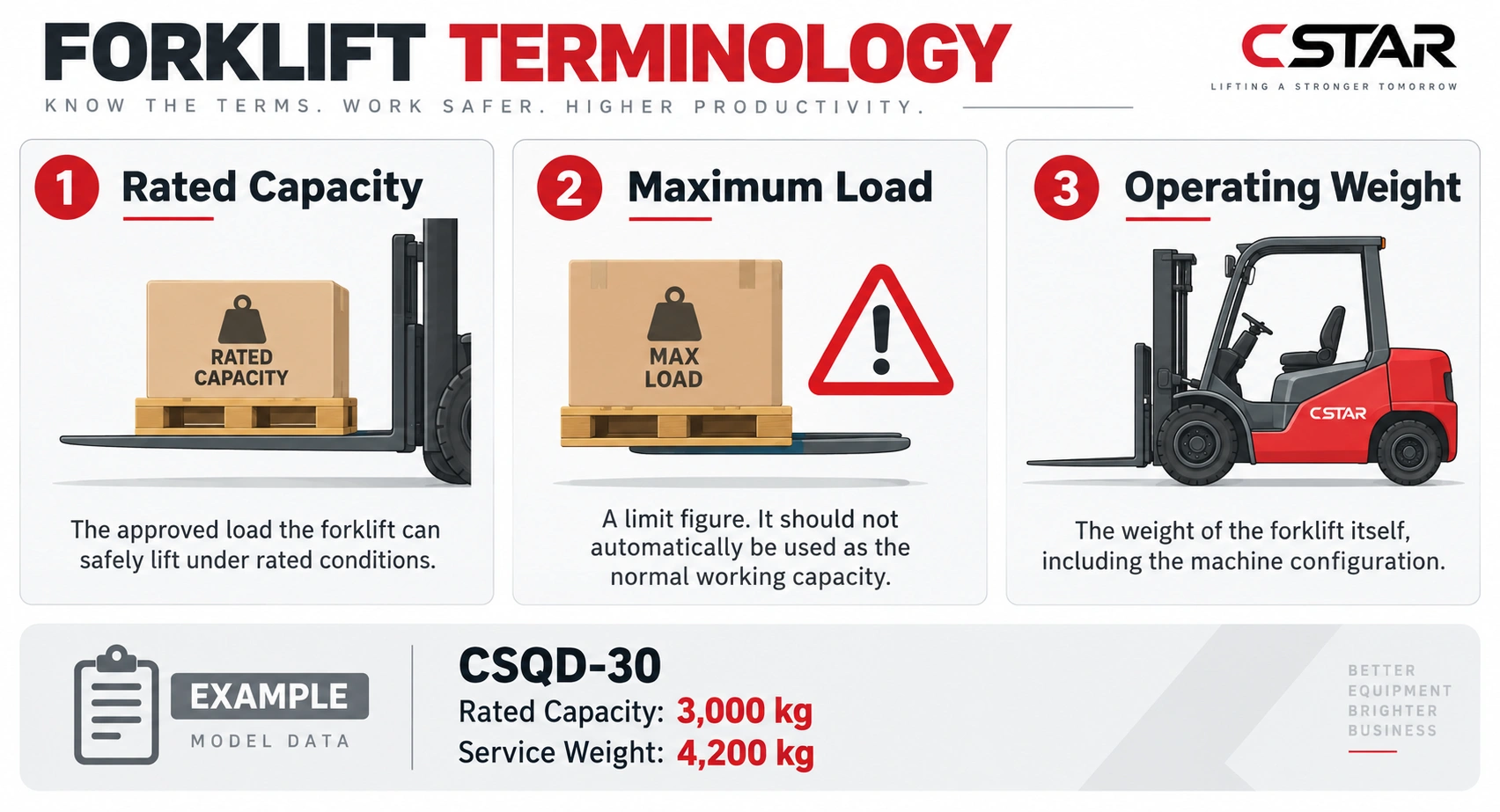
| Rated capacity / rated load | The manufacturer-declared load the truck can handle under stated conditions, including a specified load center and configuration. | Read it with the load center, lift height and attachment information on the current capacity plate. |
| Maximum load | An ambiguous brochure term that may refer to a peak, structural, tipping or test figure, depending on the equipment and manufacturer. | Do not treat it as routine working capacity unless the manufacturer identifies it as the approved rating for the exact operating configuration. |
| Operating / service weight | The weight of the forklift itself under a defined equipment condition, often including standard equipment and sometimes the battery or fuel. | Use it for floors, ramps, transport, trailers and site-access planning—not as lifting capacity. |
A real forklift example makes the distinction clear. The CSTAR CSAE-15 electric forklift lists a 1,500 kg lifting rating and a 2,300 kg vehicle weight. The CSQD-30 diesel forklift lists 3,000 kg at a 500mm load center but has a 4,200 kg service weight. In both cases, the larger machine-weight figure describes the truck, not additional cargo it may lift.
The same terminology problem appears elsewhere in compact machinery. A skid steer may list rated operating capacity, tipping load and operating weight as three separate values. Never move one of those figures into the “working capacity” column simply because it is the largest number on the page.
What Actually Changes Your Usable Capacity?
1. The Load Center Moves Forward
Long crates, machinery and unevenly packed pallets can place the center of gravity farther from the fork face. Even partially inserting the forks can create the same problem. What to do: provide the load’s overall dimensions, weight distribution and intended lifting position; ask for confirmed residual capacity rather than estimating from pallet weight alone.
2. The Required Lift Height Increases
The headline rating may apply only up to a stated height. Taller masts and higher placement can reduce residual capacity on some configurations. What to do: specify the highest fork height required under load and request the capacity at that height—not merely the truck’s unloaded maximum lift height.
3. An Attachment Is Added
A sideshifter, fork positioner, paper-roll clamp or other attachment adds weight and can move the combined load center forward. Either change can reduce the capacity available for the load.
Do not use a generic derating formula to determine the approved capacity of a forklift fitted with an attachment. The applicable capacity depends on the specific truck, mast, attachment, forks, load center and operating configuration. Use the capacity plate or the manufacturer-approved rating for the exact truck-and-attachment combination.
For U.S. workplaces subject to OSHA requirements, modifications or additions that affect capacity or safe operation require prior written approval from the manufacturer, and the affected capacity, operation and maintenance markings must be changed accordingly. See OSHA guidance on forklift attachments.
4. The Route Includes Slopes or Unsuitable Surfaces
A slope does not create a new nameplate rating, but it changes stability, traction, braking requirements and whether the move is permitted. Loose, damaged or uneven ground adds another operating constraint. What to do: record the maximum gradient, direction of travel, surface condition and whether the truck will carry a load on that section; compare them with the manufacturer’s operating instructions and site risk assessment.
How to Read a Forklift Spec Sheet Correctly
Start with the application, then use the specification sheet to verify it. A useful enquiry should contain the following information:
- Maximum load weight: include the pallet, stillage, bin or lifting frame—not just the goods inside it.
- Load dimensions and center of gravity: provide length, width, height, weight distribution and the side from which the load will be lifted.
- Required lift height: state the highest loaded fork position and any free-lift requirement.
- Attachment and fork details: list the sideshifter, clamp, fork extension or other equipment that will remain on the truck.
- Site conditions: include aisle width, door height, floor loading, gradients, surface type and indoor or outdoor use.
- Capacity confirmation: request the capacity plate or manufacturer’s load chart for the exact mast, attachment, forks and load center being quoted.
Also keep forklift weight separate from load capacity. Floor and ramp checks may need the combined effect of the truck and cargo, axle loading and local engineering requirements; adding two brochure numbers is not always a sufficient structural assessment.
The fastest way to receive a useful quotation
Send CSTAR Machinery the load weight, load dimensions, required lift height, preferred attachment, operating surface and available aisle or doorway measurements. We can then compare the application with a specific electric or diesel forklift configuration.
Forklift Capacity FAQ
Is 500mm always the standard forklift load center?
No. A 500mm load center is common on many compact and standard counterbalance forklifts, but other ratings—including 600mm—are also used. The correct value is the one stated on the capacity plate for that truck and configuration.
Does lift height affect how much a forklift can lift?
It can. Residual capacity may be lower at greater lift heights or with a different mast. Ask for the approved capacity at the highest loaded fork position your operation requires.
What is the difference between rated capacity and maximum capacity?
Rated capacity is a manufacturer-declared working rating under specified conditions. “Maximum capacity” is not precise unless the document defines the test, configuration and conditions behind it. Use the approved rated or residual capacity shown for the actual truck.
Can I use a forklift’s maximum-load figure as its working capacity?
No. Do not use a maximum, peak, test or tipping figure as routine working capacity. Keep the load within the approved capacity for the stated load center, lift height and attachment configuration.
Compare CSTAR Forklifts
Browse by power source, then compare capacity, dimensions and configuration against your actual load and working conditions.
Not sure which forklift capacity fits your load?
Send us your load weight, dimensions, required lift height and working conditions, and we can help you compare suitable CSTAR models.
Technical references: OSHA forklift nameplate guidance, OSHA attachment guidance and OSHA 29 CFR 1910.178. Local rules and manufacturer instructions may impose additional requirements.