
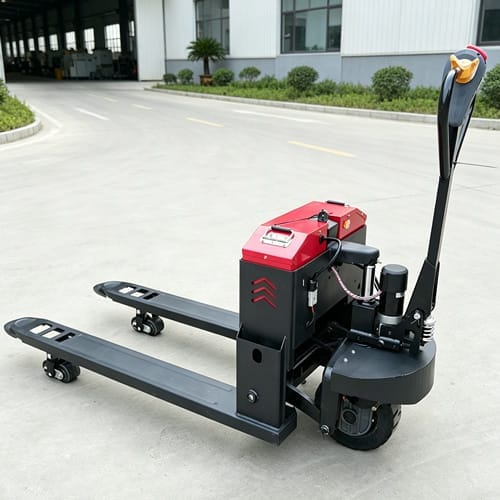
Choosing a pallet truck fork size starts with the pallet you need to move. A truck may have enough lifting capacity yet fail to enter the pallet, position its load rollers correctly or turn within your working area.
Quick answer: Compare 550mm vs 685mm overall fork width against the pallet openings and support layout. Compare 1100mm vs 1200mm fork length against pallet depth in the actual entry direction. Then check lowered fork height, roller clearance and loaded turning space. No width-and-length combination fits every pallet described as “standard.”
For truck types, batteries and broader purchasing decisions, see our
pallet truck buying guide.
Here, the focus is dimensional compatibility before ordering.
Measure the Pallet Before Comparing Fork Sizes
Record the pallet footprint, but also mark which side the truck will enter. For an 800 × 1200mm pallet, entry through the 800mm face means the forks travel along the 1200mm depth. Entry through the 1200mm face changes that depth to 800mm.
- Overall fork width: the outside-to-outside distance across both forks. This is what 550mm and 685mm describe.
- Individual fork width and inner gap: each fork must clear its opening while the space between the forks accommodates the pallet’s central structure.
- Fork length: check the usable length from the manufacturer’s drawing and compare it with the insertion path.
- Lowered fork height: the entry opening must provide clearance for the lowered forks and rollers.
- Bottom-board layout: check where the load rollers will sit when the truck is fully inserted and lifted.
For example, with two 160mm-wide forks, a 550mm overall width leaves a 230mm inner gap; a 685mm overall width leaves 365mm. These are the dimensions listed for the
CSTAR CSHP-XJ20 electric pallet truck.
Other models can differ, so do not infer the opening fit from overall width alone.
Measure clear space between obstructions, not the outside edges of the pallet. Include block positions, damaged boards and anything hanging below the deck. Also distinguish lowered fork height from ground clearance beneath the truck: those measurements answer different questions and should not be substituted for each other on an enquiry form.
550mm vs 685mm Fork Width: Which One Should You Choose?
| Overall fork width | When to consider it | What to confirm |
|---|---|---|
| 550mm | Narrower entry layouts, including suitable Euro pallet applications | Both forks clear the blocks and support the pallet at suitable positions |
| 685mm | Wider entry layouts with support positions suited to the wider fork spread | The forks clear the outer blocks, central structure and underside obstructions |
When 550mm Makes Sense
A 550mm configuration is worth checking when a wider pair of forks cannot clear the pallet entry. It is not a light-duty category: the
CSHP-H30 3-ton manual pallet truck
lists 550mm overall fork width and 1100mm fork length. Capacity depends on the rated truck configuration, not fork width alone.
When 685mm Makes Sense
A 685mm configuration spreads the forks farther apart and can suit pallets designed around those support positions. However, wider forks are not automatically safer or better for heavier loads. An unsuitable spread may strike pallet blocks or miss the intended bearing surfaces. Compare both options with the actual pallet drawing.
1100mm vs 1200mm Fork Length: Understanding the Difference
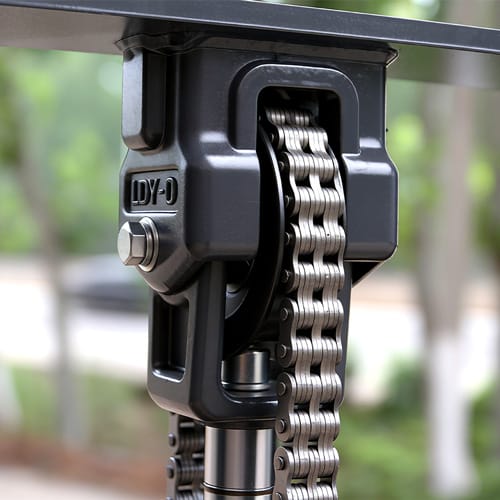
The difference is 100mm, but its value depends on where the pallet ends, where the load is concentrated and where the rollers contact the floor.
| Fork length | Potential benefit | Main check |
|---|---|---|
| 1100mm | Shorter fork projection where the pallet still receives adequate support | Load support, insertion depth and roller position |
| 1200mm | Additional reach where the pallet design needs and accommodates it | Far-side clearance, bottom-board interference and turning space |
Do not assume that a 1200mm-deep pallet requires exactly 1200mm forks. Pallet construction and the truck’s wheel geometry also matter. Equally, 1100mm forks should not be selected simply because they are shorter: the supplier must confirm adequate support for your pallet and load.
These are comparison sizes, not the only available lengths. CSTAR also lists 1150mm forks on the CSHP-XJ20. Keep the exact dimension on the quotation; treating 1100mm, 1150mm and 1200mm as interchangeable can hide a clearance problem.
Euro Pallet and Standard Pallet Matching
The EPAL Euro pallet
has an 800 × 1200mm footprint. “Standard pallet” is less specific: EPAL also lists 1200 × 1000mm and 1000 × 1200mm formats in its
pallet range.
A footprint does not describe every entry opening or bottom-board arrangement.
| Pallet and entry direction | Starting point | Decision before ordering |
|---|---|---|
| Euro 800 × 1200mm; enter the 800mm face | Check 550mm overall width first; insertion depth is 1200mm | Confirm the selected length, fork openings and roller clearance; do not assume 685mm fits |
| Euro 800 × 1200mm; enter the 1200mm face | Reassess the whole configuration; insertion depth is only 800mm | 1100mm or 1200mm forks may project beyond the pallet; confirm suitability for this direction |
| Industrial 1000 × 1200mm; enter the 1000mm face | Compare 550mm and 685mm with measured openings; depth is 1200mm | Choose according to support layout and roller position, not the “industrial” label |
| Custom, plastic or closed-bottom pallet | Use an underside drawing and a sample pallet | Confirm the truck can enter, lift and withdraw without interference |
Use this table to shortlist configurations, not as a universal fit guarantee. In a mixed-pallet warehouse, check every pallet family and every required entry direction. One successful fit does not establish compatibility with all incoming pallets.
A Practical Comparison for a 1200mm-Deep Pallet
Suppose your pallet measures 1000 × 1200mm and operators enter through the 1000mm face. Comparing 1100mm and 1200mm forks tells you that one option reaches 100mm farther along the insertion path. It does not tell you where either model’s rollers will finish. Send the underside drawing with the intended entry direction marked, and ask the supplier to show both fork tips and roller positions. That comparison is more useful than choosing the longer option simply because its nominal length matches the pallet.
Fork Size for Narrow Aisles and Warehouse Use
A 550mm fork width does not by itself prove that a truck needs less turning space. The pallet or truck body may be wider than the forks, and the load sweeps through a larger area during a turn.
Compare overall truck length and width, turning radius, handle movement and the manufacturer’s working aisle width for your pallet orientation. Turning radius alone is not the required aisle width.
Measure the tightest working location, including rack ends, doorways and the space needed to approach a pallet squarely. Ask for a layout review or demonstration with a representative load. A shorter fork configuration can help only when it also provides suitable pallet support and clearance.
Check the complete movement: approach, insertion, lifting, turning and withdrawal. A truck that travels straight down a passage may still lack room to collect a pallet from the side. Include the load’s overhang and the operator’s working position when reviewing the layout.
Long Fork Risks: More Reach Is Not Always Better
- Fork tips projecting beyond the pallet: they may contact another pallet, stored goods or equipment behind the load.
- Load rollers over bottom boards: if rollers bear on a board instead of the intended floor contact area during lifting, the truck can damage the pallet.
- More space needed during turns: extra length can increase the swept area and reduce clearance around obstacles.
- Unsuitable load support: extra fork length does not correct an off-centre load or increase the truck’s rated capacity.
Do not make an unsuitable combination work by leaving the forks partly inserted. Have the supplier verify the intended insertion position, load distribution and roller contact points. For unusually long pallets, request an application-specific configuration and confirmed capacity rather than treating 1200mm as an oversized-load solution.
The Palletsmith operating manual
also emphasizes matching fork length to the pallet and locating the rollers between its bottom boards.
Before You Order: Confirm the Fork Size in Writing
A useful enquiry gives the supplier enough information to check the complete handling arrangement. Prepare the following details before comparing quotations:
- Pallet measurements: length, width, clear opening height and width, and the intended entry direction. Include underside photographs with a ruler visible, or a dimensioned drawing.
- Pallet variations: list every regularly handled pallet type. Separate block pallets, stringer pallets and plastic designs instead of describing the entire inventory as standard pallets.
- Load information: state the maximum combined pallet and goods weight, any load overhang, and whether the weight is concentrated at one end.
- Operating space: provide aisle and doorway measurements, the direction of pallet pickup, and any nearby obstacles that restrict approach or withdrawal.
- Required confirmation: request overall fork width, individual fork width, inner gap, exact fork length, lowered height and roller positions on the proposed model’s drawing.
Ask the supplier to identify the exact configuration being quoted. If a sample check is arranged, use the pallet designs and entry directions from your enquiry. Confirm that the proposed truck can enter, support, lift and withdraw from each pallet without interference, with any loaded demonstration carried out under the manufacturer’s operating instructions.
Pallet Truck Fork Size FAQ
Does a 685mm pallet truck fit every standard pallet?
No. “Standard” does not specify the entry openings. Check the footprint, entry direction, fork spacing and underside construction before choosing 685mm.
Are 1200mm forks always better than 1100mm forks?
No. Choose the length that supports the pallet correctly without unwanted projection or roller interference. Extra length alone does not increase capacity.
Can a four-way Euro pallet be handled from either direction?
The EPAL design provides access from all four sides,
but a particular pallet truck still needs compatible fork and roller geometry for the chosen direction. Recheck the shorter insertion depth when entering through the longer face.
For help checking a configuration,
contact CSTAR with your pallet measurements,
underside photos, load weight and warehouse layout.