

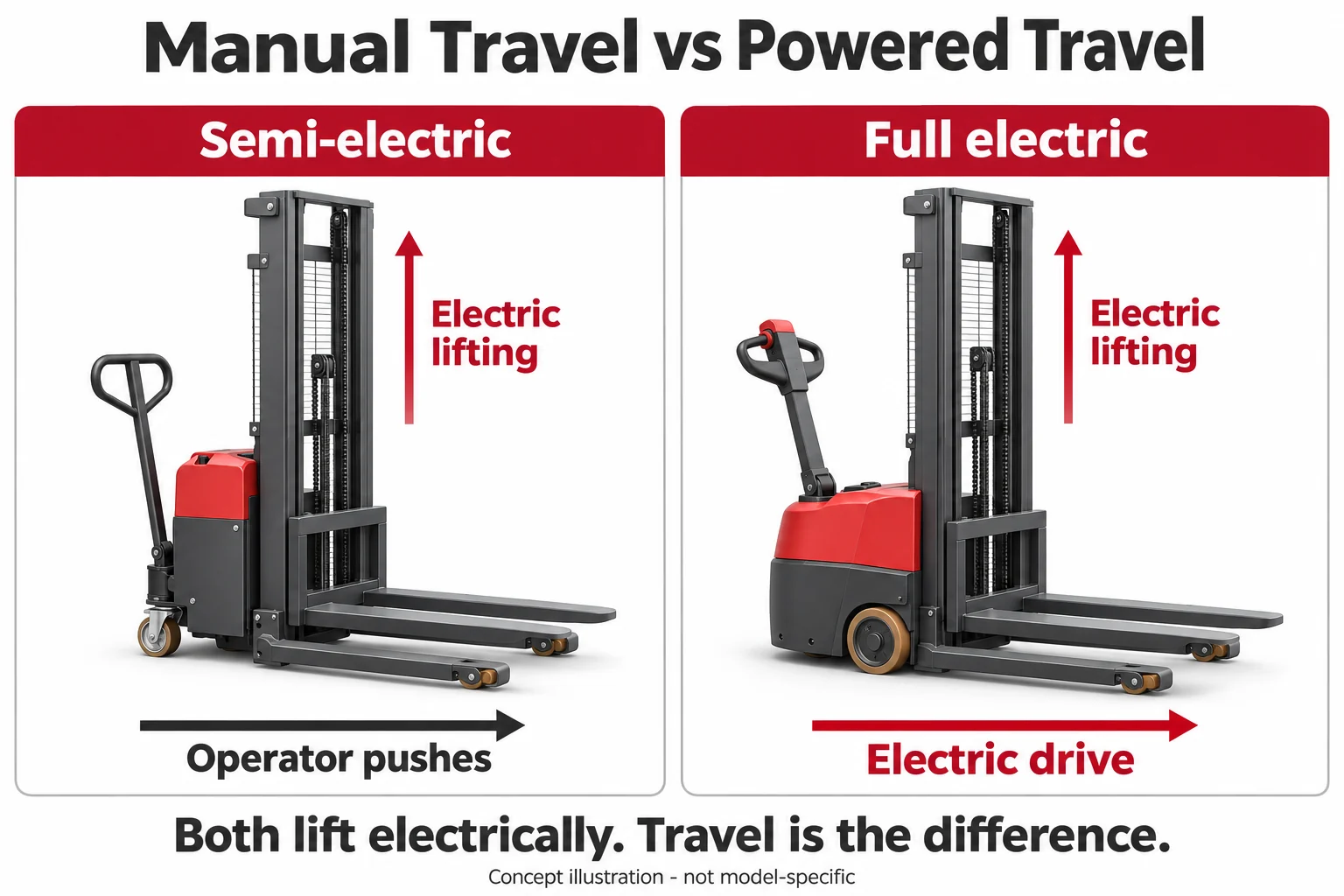
A semi electric pallet stacker lifts with an electric hydraulic system and is pushed by hand, while a fully electric pallet stacker uses powered travel as well as powered lifting. The semi electric vs full electric stacker decision turns on how far loaded pallets travel, how often they move, what the floor is like, whether the pallets suit the forks, and what the budget allows. Lifting power on its own seldom settles it.
Two stackers rated at 2 tons can still differ in how they move, in fork dimensions, in mast clearance and in how much effort they ask of the operator every day. This guide separates those differences, compares two real CSTAR models on the same basis, and ends with two worksheets you can fill in before you ask for quotations.
What Is the Difference Between a Semi-Electric and a Full Electric Stacker?
The comparison here is manual travel with electric lifting against electric travel with electric lifting. It is not the same as walkie versus stand-on, because a fully electric stacker can also be operated on foot. Our guide to walkie and stand-on stackers covers that separate question, and the stacker forklift range shows both formats.
Semi-Electric: Powered Lifting with Manual Travel
An electric motor powers the hydraulic lifting system, while the operator pushes the truck between locations. Pushing effort depends on the combined weight of the truck and load, the wheels and the floor. Assess a semi-electric model against your actual routes and workload as well as its rated capacity.
Full Electric: Powered Travel and Powered Lifting
A fully electric stacker uses electric power for both travel and lifting, and the operator controls it from a handle. A walkie version still needs the operator to walk with it. Powered travel does not make the truck autonomous, and it does not make it suitable for every floor or slope.
| Comparison point | Semi-electric | Full electric |
|---|---|---|
| Horizontal travel | Pushed by the operator | Electrically driven |
| Lifting | Electric | Electric |
| How the operator moves | Walks with the truck | Depends on the operating format of the model |
| Buying focus | Pushing effort, route and frequency of use | Drive control, workload and charging plan |
| Checks common to both | Load, pallet, lift height, clearances and floor | The same |
Which Type Fits Your Daily Handling Work?
Look at Loaded Travel, Not Just Lifting Frequency
Compare frequent lifting between neighbouring work stations with repeated pallet transfers from receiving to storage. The number of lifts can be the same in both while the horizontal work is very different, and horizontal work is the part a semi-electric truck leaves to the operator.
Include Empty Return Trips and Repositioning
A day’s travel is more than the loaded trips. Record the loaded runs, the empty returns, the alignment to each pallet, the turns and repositioning, and the places where the truck slows, such as doorways and cross aisles. Fill in this log for a typical day:

| Task step | One-way distance | Times per day | Loaded or empty | Turns and thresholds | Floor condition |
|---|---|---|---|---|---|
Daily horizontal travel = the sum, over all task steps, of (one-way distance × number of trips)
Count loaded and empty runs as separate lines. The total lets you compare workloads between sites and between options. It does not set a distance above which a fully electric truck becomes necessary, since that depends on the load, the floor and the people doing the work.
Can Two Stackers with the Same Capacity Do the Same Job?
Compare Capacity at the Required Lift Height
Line up these points for each truck:
- The rated capacity
- The load center it applies to
- The real dimensions of your load
- The mast chosen
- The lift height you need
- The capacity published for that configuration
A “2 Ton” in a model name does not mean 2 tons at any lift height and at any load center. Ask for the capacity at your height and your load center.
Match the Forks and Support Legs to the Pallet
Measure the pallet against the fork length, the fork outside width or its adjustment range, the lowest fork height, the pallet openings, the bottom board positions, and the path of the support legs and load wheels. Pallet compatibility depends on these dimensions and the support-leg layout, independently of the drive system, and our guide to pallet stacker dimensions and lift height explains how to take them.
Check Doorways and Working Space Separately
Keep these apart: the overall width, the overall length, the lowered mast height, the turning radius and the room needed to stack. A truck may fit through a doorway yet need more space to turn into a rack position. The width of the truck does not tell you the aisle needed for stacking.
Compare Real CSTAR Models on the Same Basis
The CSHF-BB20 semi-electric stacker and the CSHF-B20 walkie electric stacker are both rated at 2,000 kg and both list a 2,000 mm lift option. The table compares the listed 2,000 mm lift configurations and retains each product page’s terminology for its height dimensions.
| Item, 2,000 mm lift configuration | CSHF-BB20 | CSHF-B20 |
|---|---|---|
| Travel | Manual (hand-pushed) | Electric, 2 kW drive motor |
| Lifting | Electric, 1.6 kW motor | Electric, 3 kW motor |
| Rated capacity | 2,000 kg | 2,000 kg |
| Load center | Not listed | 500 mm |
| Lift height | 2,000 mm | 2,000 mm |
| Height field listed for this option | Overall height 1,600 mm | Mast lowered height 1,560 mm |
| Fork length | 1,100 mm | 1,150 mm |
| Fork width | Adjustable, 320 to 680 mm | Outside 700 mm, inside 340 mm |
| Minimum fork height | 90 mm | 85 mm |
| Overall length × width | 1,750 × 800 mm | 1,960 × 790 mm |
| Turning radius | Not listed | 1,500 mm |
| Battery | 12 V 120 Ah | 48 V; capacity not listed |
| Service weight | Not listed | 550 kg with battery |
Source: the linked CSTAR product pages. The BB20 page lists five lift options and gives a different overall width and height for its 1,600 mm option, so read the column for your own lift height.
What the comparison means for a purchase:
- The same tonnage does not mean the same forks. The BB20 lists 1,100 mm forks with a 320–680 mm adjustment range. The B20 lists 1,150 mm forks with a 700 mm outside width. That matters for the pallet types you handle.
- Minimum fork height meets the pallet opening. A 5 mm difference between 90 mm and 85 mm is small and still can decide whether the forks enter a low pallet.
- Similar widths do not mean similar turning and stacking space. The two trucks are 800 mm and 790 mm wide, but their lengths differ by 210 mm and only the B20 lists a turning radius.
- The BB20 page says to review the route. Because travel is manual, it advises reviewing route length, floor slope, surface, doorway clearance and handling frequency together with the load and the lift height.
These figures describe the two listed model configurations. Use the same comparison method for other stackers.
How Do Floor Conditions Affect the Choice?
Surface Condition Changes Manual Pushing Effort
Joints, damaged patches, thresholds, debris, the wheel material and the condition of the wheels all change how hard a loaded truck is to push. A truck that rolls easily on a smooth showroom floor tells you little about your own route with a full pallet, so test or assess the real route, loaded.
Powered Travel Does Not Remove Site Limits
A fully electric truck still has to match the floor’s bearing capacity, the traction and braking available, the slope of the route, the ramp transitions and the operating conditions its maker specifies. The CSHF-B20 page lists gradeability of 8% laden and 10% unladen, but these figures alone do not establish permitted loaded travel, turning or stacking conditions on a slope. Confirm the operating limits for the quoted configuration and your route.
What Changes in Charging and Maintenance?
Both Types Need a Charging Plan
A semi-electric stacker has a battery too, because the lifting system runs on it. Settle these for either type: the battery type and capacity, the charger, the power supply on site, the time available to charge, and the daily workload. Voltage by itself does not tell you the runtime or the working ability. The BB20 and B20 pages show it: one lists a 12 V 120 Ah battery for a lifting motor, the other a 48 V system without a stated capacity. Our comparison of lithium and lead-acid forklift batteries goes further into the battery choice.
Compare the Components Each Truck Carries
Both types share the hydraulics, the mast, the chains, the forks and the wheels, and those need the same kind of care. A fully electric truck adds a drive motor and the controls that go with it. The maintenance plan belongs to the model, so ask for the schedule of each truck you are quoted. Neither type is maintenance-free, and neither has a lower maintenance cost by rule.
How Should You Compare Purchase Prices and Quotations?
Request the Same Working Configuration
Give each supplier the same load, load center, required lift height, clearance limits, pallet dimensions and workload. Ask each quotation to identify the selected forks, battery, charger, wheel material, attachments, delivery terms and after-sales scope. Our forklift price guide covers how quotations are built.
Separate Purchase Cost from Daily Handling Cost
The purchase price is one number. The cost of using the truck is made up of operator time on the task, maintenance, charging and any change in the workload the truck can carry. Compare both, and ask whether the truck matches the task at all. Use your site’s operator time, energy tariffs, maintenance estimates and actual quotations to calculate the cost difference.
A Practical Buying Checklist
Send the same filled-in table to every supplier. When all of them quote against one task sheet, the differences between their configurations are much easier to see.
| What the buyer provides | Your details | Configuration returned by the supplier |
|---|---|---|
| Maximum load and its dimensions | ||
| Pallet dimensions and a photograph of the underside | ||
| Required lift height | ||
| Lowest doorway and overhead clearance | ||
| Narrowest route and turning points | ||
| Loaded travel distance and trips per day | ||
| Floor, joints and ramps | ||
| Working hours and charging conditions | ||
| Destination country and quantity |
Frequently Asked Questions
Does a semi-electric stacker have powered travel?
No. A semi-electric stacker lifts with electric power and is pushed by the operator. The CSHF-BB20 page describes powered hydraulic lifting with manual travel.
Is a walkie stacker always semi-electric?
No. Walkie describes how the operator moves, and a walkie stacker can be fully electric, as the CSHF-B20 is. Semi-electric describes the power arrangement: manual travel with electric lifting.
Can a semi-electric stacker handle a 2-ton load?
Some can. The CSHF-BB20 is rated at 2,000 kg across its five listed mast options, but its page gives no load center, so ask for the capacity at your lift height and your load’s center before relying on that figure.
Does a semi-electric stacker still need charging?
Yes. Its lifting system runs on a battery. The BB20 page lists a 12 V 120 Ah battery and a 1.6 kW lifting motor, so plan for a charger and a charging window.
Can both types handle the same pallets?
Only if the forks, fork height and legs suit the pallet. The drive system does not decide that, so compare the fork dimensions with your pallet openings.
When is full-electric travel worth the extra purchase cost?
When the daily loaded travel, the trip frequency, the weight of the loads and the floor make hand-pushing a real burden. Total those from your route log and weigh them against the price difference in your own quotations, as no single distance applies to every site.
Compare Stackers for Your Pallets and Handling Route
To compare models for your work, send CSTAR the load weight, the pallet dimensions with photographs, the lift height, the handling distance and frequency, the floor conditions, and the destination country and quantity.