Efficient material handling is essential for modern warehouses, manufacturing facilities, distribution centers and industrial workplaces. As businesses look for ways to store more goods within the same floor area, equipment that can combine pallet handling with vertical lifting becomes increasingly important.
A stacker forklift is designed for this type of application. Compared with larger conventional forklifts, stackers can provide a more compact solution for lifting and positioning palletized loads, particularly in indoor warehouse and workshop environments.
However, choosing a stacker forklift is not simply about selecting the highest rated capacity or maximum lift height. The right equipment depends on several factors, including load weight, load center, pallet dimensions, rack height, aisle width, operating frequency, floor conditions and battery configuration.
CSTAR Machinery offers a range of stacker forklift configurations, including walkie electric stackers, semi-electric stackers, full-electric counterbalance legless stackers, double-lift electric stackers and all-terrain electric stackers.
This guide explains the main types of stacker forklifts, the specifications buyers should compare, how stackers differ from conventional forklifts, and which configurations may be suitable for different warehouse and industrial applications.
1. Why Choose a Stacker Forklift for Modern Warehousing?
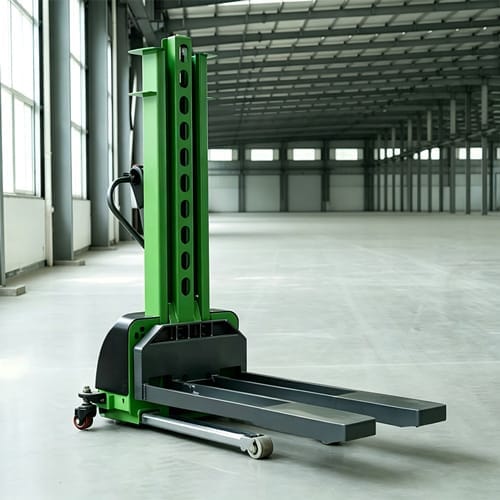
A stacker forklift combines two basic material handling functions: moving a load and lifting it to a higher position.
This makes stackers particularly useful when goods need to be transferred between storage areas and placed on pallets or elevated storage positions. For businesses operating in warehouses, workshops and other controlled environments, the compact design of many stacker models can also make them easier to operate where space is limited.
Maximizing Warehouse Space
One of the main reasons to use a stacker forklift is to make better use of vertical storage space.
Instead of keeping every pallet at floor level, warehouses can use suitable racking and lifting equipment to store goods at different heights. A stacker forklift provides the lifting capability needed for these operations.
The practical advantage is not simply “higher lifting.” The equipment must match the warehouse layout.
For example, buyers should consider:
- Rack beam height
- Available ceiling clearance
- Doorway height
- Pallet dimensions
- Required lifting height
- Available operating aisle
- Turning radius of the truck
A machine that is technically capable of reaching a certain height may still be unsuitable if its lowered mast cannot pass through a doorway or if the available aisle is too narrow for safe operation.
Reducing Manual Material Handling
Manual movement of palletized goods can become inefficient when an operation requires frequent lifting and repositioning.
Electric stackers can provide powered lifting and, depending on the model, powered travel as well. This reduces the physical effort required from the operator and can make repetitive warehouse handling more efficient.
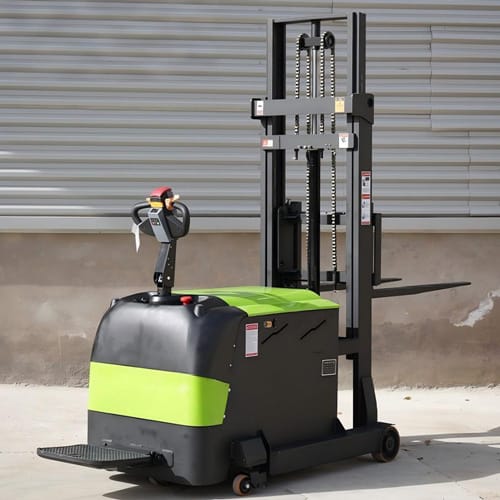
For example, the CSHF-B15 Walkie Electric Stacker uses electric power for both driving and lifting and is designed for compact operation in warehouses, workshops and narrow aisles. Its listed rated capacity is 1,500 kg, with a standard lift-height range of 2,000, 2,500 and 3,000 mm depending on configuration.
Improving Pallet Stacking Efficiency
For businesses that regularly stack palletized goods, the lifting system becomes an important part of the material handling process.
The right stacker should provide sufficient capacity at the required lifting height while remaining suitable for the pallet size and load center.
It is therefore important to understand that rated capacity, lift height and load center are connected specifications.
A buyer should not select equipment based only on the maximum load weight printed on a product page. The final configuration should be checked against the manufacturer’s load data and the actual operating conditions.
2. Stacker Forklift Types and How to Choose Them
There is no single stacker forklift configuration that is suitable for every warehouse.
CSTAR’s current product range includes several configurations designed around different handling requirements, from semi-electric machines to full-electric and all-terrain models.
The following categories provide a practical way to understand which type may be appropriate for your operation.
| Stacker Type | Typical Application | Main Benefit | Key Consideration |
|---|---|---|---|
| Manual / Semi-Electric | Low- to medium-frequency handling | Lower equipment complexity | Travel may require manual pushing |
| Walkie Electric | Routine indoor pallet handling | Powered travel and lifting | Operator walks behind the machine |
| Stand-on / Full-Electric | Higher-frequency warehouse operations | Fully powered handling | Requires suitable aisle and operating space |
| Double-Lift Electric | Specialized stacking and transport | Additional operational flexibility | Configuration must match the application |
| Counterbalance Legless | Non-standard pallets and overhanging loads | Less restriction from support legs | Load and stability requirements must be checked |
| All-Terrain Electric | Outdoor and uneven surfaces | Better ground adaptability | Larger footprint and application-specific limits |
2.1 Manual and Semi-Electric Stackers
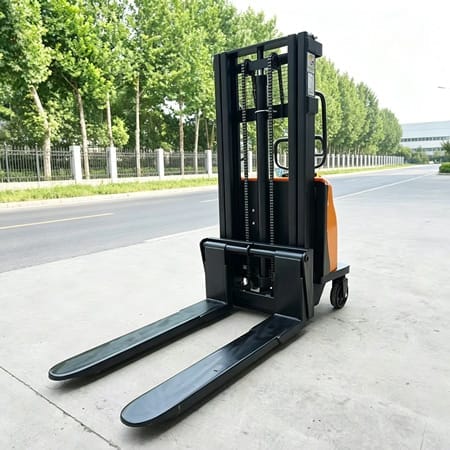
Semi-electric stackers are often considered by businesses that want powered lifting without moving fully to a powered travel system.
The CSHF-BB10 Semi-electric Stacker is one example. According to CSTAR’s product specifications, it has a 1,000 kg rated capacity, a standard 1,600 mm lift height, and a lead-acid battery. The available lift configurations on the product page extend from 1,600 mm to 3,500 mm, while rated capacity remains listed at 1,000 kg for those configurations.
Its operating principle is straightforward: electric lifting is used for load handling, while horizontal movement is manually controlled.
That makes this type of equipment worth considering for applications where:
- Pallet movement is relatively infrequent
- Travel distances are short
- Lifting assistance is the main requirement
- Initial equipment cost is an important consideration
- The warehouse or workshop has a relatively simple material flow
2.2 Walkie Electric Stackers
A walkie electric stacker provides powered travel and lifting while the operator walks with the machine.
This configuration is particularly useful for indoor pallet handling where maneuverability and compact dimensions are important.
The CSHF-B15 Walkie Electric Stacker has a listed rated capacity of 1,500 kg, a 500 mm load center and dimensions of 1,960 × 790 × 1,560 mm in the listed configuration. Its minimum turning radius is 1,500 mm, while travel speed is listed as up to 5 km/h loaded and 6 km/h unloaded.
These characteristics make a walkie stacker a practical option for routine warehouse handling where a conventional seated forklift may be unnecessarily large.
2.3 Stand-On and Full-Electric Stackers
For operations that require a higher degree of powered handling, a stand-on electric stacker can be a suitable step up from a basic walkie model.
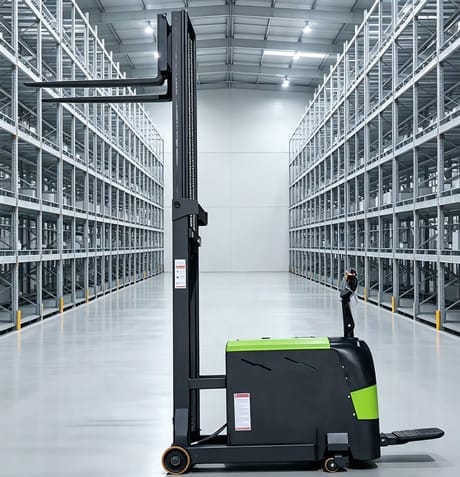
CSTAR’s CSHF-C20 is listed as a 2,000 kg full-electric counterbalance legless stacker with a 3,000 mm standard lift height. Its operating type is specified as Stand-on Type, with a 500 mm load center and an overall width of 1,020 mm.
The key design feature is its counterbalance legless configuration.
Traditional stackers with front support legs can place limitations on certain pallet and load configurations. A counterbalance design can be more suitable where the application involves single-sided pallets, non-standard goods or loads with overhang, provided the actual load and stability requirements are within the machine’s specifications. CSTAR specifically describes the C20 as being designed for applications including single-sided pallets, non-standard goods and heavy-duty materials.
The C20 therefore represents a different selection logic from a basic walkie stacker:
Choose it because of the load configuration and application requirements, not simply because it has a higher capacity.
2.4 Double-Lift Electric Stackers
Some material handling applications require a machine that can perform more than conventional floor-level transport and single-position lifting.
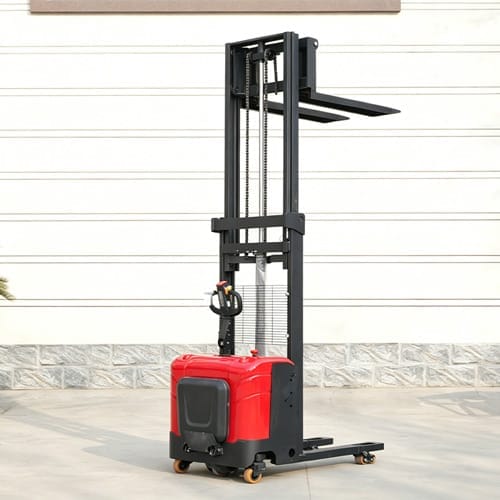
CSTAR’s CSHF-D20 Double-Lift Electric Stacker has a listed rated capacity of 2,000 kg, a lift height of 2,000 mm, and a full-electric stand-on configuration. The product uses a 48 V drive motor system and 48 V lifting pump, with electronic braking.
According to CSTAR’s product description, the model combines electric travel, electric lifting and electrically adjustable support legs, allowing it to serve both transportation and stacking applications.
For a buyer, the important point is to look beyond the model name and evaluate whether the truck’s support-leg design, ground clearance, fork dimensions and lifting configuration match the actual warehouse environment.
2.5 Counterbalance Legless Stackers for Non-Standard Loads
One of the advantages of a counterbalance legless design is that it can reduce the restrictions created by front support legs.
This can matter when the warehouse handles:
- Single-sided pallets
- Non-standard pallets
- Large loads
- Loads with controlled overhang
- Heavy materials with unusual dimensions
The CSHF-C20 is specifically designed around this application concept. CSTAR’s product description states that its leg-free design uses a rear-mounted counterweight and is intended for applications involving single-sided pallets, non-standard goods and heavy-duty materials.
However, buyers should still provide the supplier with actual load dimensions and load center information before selecting a machine.
A counterbalance design does not mean that every oversized or unstable load can be handled safely.
2.6 All-Terrain Electric Stackers
Standard warehouse stackers are generally selected for controlled indoor environments with suitable floor conditions.
The requirements change when a machine must work outdoors.
The CSHF-H20 2.0Ton All-terrain Electric Stacker is designed specifically around outdoor and uneven-surface applications. CSTAR lists a 2,000 kg rated load, a 2.0 m lifting height, widened off-road tires and a reinforced chassis with a shock-absorbing structure. The stated application environments include outdoor factory areas, construction yards, open-air warehouses and cargo yards.
The H20 is therefore not simply a conventional warehouse stacker with larger wheels. Its design is intended to address terrain conditions that may not be suitable for a standard indoor stacker.
3. Key Stacker Forklift Specifications Buyers Should Understand
The right stacker forklift should be selected from a complete set of operating requirements rather than from one headline specification.
The four most important areas are rated capacity, lift height, power system and mast configuration.
3.1 Rated Capacity
Rated capacity refers to the maximum load the truck is designed to handle under specified conditions.
CSTAR currently lists stacker models with rated capacities ranging from 1,000 kg to 2,000 kg and above across its product range. For example, the BB10 is rated at 1,000 kg, the B15 at 1,500 kg, and the C20 and D20 at 2,000 kg.
But rated capacity should never be considered separately from load center and lift height.
For example, the CSHF-B15 specifies a 500 mm load center, while the CSHF-C20 also specifies a 500 mm load center.
Before buying a stacker, provide your supplier with:
Maximum load weight + pallet size + load center + required lift height
This provides a much more reliable basis for equipment selection.
3.2 Lift Height
Lift height determines how high the forks can raise the load.
Different applications require very different lifting ranges.
For example:
| Application | Typical Selection Consideration |
|---|---|
| Floor-level handling | Low lifting requirement |
| Low pallet storage | Approximately 1.5–2.0 m |
| Medium-height storage | Approximately 2.0–3.0 m |
| Higher warehouse storage | May require 3.0 m or more |
These values are only a starting point. The actual requirement should be based on the storage rack, pallet dimensions and available overhead clearance.
CSTAR’s current models illustrate this variation: the BB10 is listed with lift options from 1,600 to 3,500 mm, the B15 offers 2,000/2,500/3,000 mm configurations, while the C20 is listed at 3,000 mm and the H20 at 2,000 mm.
3.3 Battery and Power System
Electric stackers can use different battery technologies and configurations.
The CSTAR models featured in this guide mainly use lead-acid battery systems. The B15, BB10, C20, D20 and H20 product pages list lead-acid battery power, while CSTAR’s wider stacker range also includes models using lithium-ion batteries.
The choice between battery technologies should be based on the operating pattern rather than simply assuming that one technology is universally better.
Important factors include:
- Daily operating hours
- Number of shifts
- Charging infrastructure
- Available charging time
- Maintenance requirements
- Initial equipment budget
- Expected equipment utilization
For lower-utilization applications, a conventional battery system may be a practical choice.
For more intensive operations, the buyer may want to compare lithium-ion and lead-acid options based on the total operating cost over the intended service period.
3.4 Mast Configuration
Mast design affects not only lifting height but also whether the truck can operate in buildings with limited overhead clearance.
Before selecting a mast, check:
- Maximum lift height
- Mast lowered height
- Building ceiling height
- Doorway height
- Required free-lift performance
- Rack clearance
For example, the CSHF-C20 has a listed standard lift height of 3,000 mm, a maximum overall height of 3,450 mm with the mast extended, and a mast-retracted height of 2,070 mm.
That information is more useful to a warehouse planner than simply seeing “3,000 mm lift.”
The question is not only:
How high can the forks lift?
It is also:
Can the machine physically enter and operate within my building?
4. Stacker Forklift vs. Traditional Forklift: What Are the Advantages?
A stacker forklift and a conventional counterbalance forklift are not direct replacements in every application.
A traditional forklift can be preferable for heavy-duty operations, outdoor work and applications requiring higher lifting capacity or specific attachment configurations.
A stacker, on the other hand, is particularly attractive for pallet handling and storage applications where compact dimensions and lifting capability are important.
| Factor | Stacker Forklift | Conventional Forklift |
|---|---|---|
| Indoor warehouse handling | Very suitable for many applications | Suitable |
| Compact warehouse areas | Often advantageous | Depends on truck size |
| Narrow operating areas | Many compact models are designed for this | May require more space |
| Pallet stacking | Suitable | Suitable |
| Outdoor rough terrain | Requires suitable all-terrain model | Often stronger fit |
| Heavy-duty loads | Model dependent | Wide range of heavy-duty options |
| Operator configuration | Walkie or stand-on | Commonly seated |
| Application flexibility | Depends on configuration | Broad attachment and capacity options |
4.1 Space Utilization and Aisle Width
One of the major reasons businesses consider stackers is operating space.
The B15, for example, has a listed overall width of 790 mm and a minimum turning radius of 1,500 mm.
The C20 has a listed overall width of 1,020 mm and a 1,020 mm outside width between outriggers.
These numbers show why it is important to compare the actual machine configuration rather than assuming every stacker has the same space requirements.
Before ordering, buyers should provide:
Pallet size + aisle width + rack layout + turning area + doorway size
The supplier can then confirm whether the selected model is appropriate.
4.2 Total Cost of Ownership
The purchase price is only one component of equipment cost.
A more complete evaluation considers Total Cost of Ownership (TCO).
TCO may include:
- Purchase price
- Electricity consumption
- Battery maintenance
- Battery replacement
- Routine maintenance
- Spare parts
- Tires and wear components
- Operator training
- Downtime
- Service and support
A lower-priced truck is not necessarily the most economical choice over several years.
For example, if a warehouse operates only a few hours per day, purchasing a highly specified machine may not provide the same economic benefit as it would in a high-utilization operation.
Conversely, if the truck is expected to operate frequently, factors such as battery technology, serviceability and spare-parts availability become more important.
4.3 Operation and Safety
Modern stackers can include electronic braking, control systems and other safety-related equipment depending on the model.
For example, the B15 and C20 specifications list electronic braking, while the D20 also lists electronic braking as part of its configuration.
However, equipment features alone do not guarantee safe operation.
Safe material handling also depends on:
- Correct load selection
- Proper load distribution
- Operator training
- Suitable floor conditions
- Appropriate aisle clearance
- Regular maintenance
- Following manufacturer operating instructions
- Compliance with local regulations
Buyers should also verify any operator licensing, training, registration and inspection requirements applicable in their country or region.
5. Stacker Forklift Applications and Customized Solutions
Stacker forklifts are used in a wide range of industrial and commercial environments, but the required configuration can change significantly between applications.
Cold Storage and Refrigerated Warehouses
Cold-storage environments can impose additional requirements on batteries, lubricants, electrical components and operating procedures.
Before purchasing equipment for a low-temperature environment, buyers should confirm that the selected machine and battery system are suitable for the intended temperature range.
This is particularly important for customers operating equipment continuously inside refrigerated facilities.
Pharmaceutical and Chemical Warehouses
Pharmaceutical facilities may place greater emphasis on controlled operating environments, cleanliness and organized material handling.
Chemical facilities may have additional requirements based on the substances being handled and the surrounding environment.
If the equipment will be used in a potentially hazardous location, buyers should confirm whether specialized or explosion-protected equipment is required.
Electronics and E-Commerce Warehouses
Electronics and e-commerce warehouses typically require organized storage and efficient internal movement of goods.
For these environments, buyers should pay particular attention to:
- Operating frequency
- Aisle width
- Pallet dimensions
- Battery capacity
- Charging arrangements
- Storage height
- Indoor floor conditions
A walkie electric stacker can be a practical option for routine pallet handling, while a stand-on or full-electric configuration may make more sense when operating intensity is higher.
Hardware and Manufacturing Workshops
Manufacturing facilities often need to move materials among raw-material storage, production lines, semi-finished goods areas and finished-product warehouses.
A stacker forklift can be useful when these operations involve palletized materials and vertical storage.
For heavier or non-standard loads, a counterbalance legless configuration such as the CSHF-C20 may be worth evaluating because its design is intended for single-sided pallets, non-standard goods and heavy-duty materials.
Outdoor Yards and Uneven Ground
Outdoor warehouse areas present a different set of challenges.
Uneven pavement, gravel, dirt surfaces and outdoor loading areas can require a different machine configuration from a standard indoor stacker.
CSTAR’s CSHF-H20 is specifically described as an all-terrain electric stacker with widened off-road tires, reinforced chassis and shock-absorbing structure for outdoor and uneven environments.
This type of application is where selecting equipment based purely on price can create problems. Ground conditions should be treated as a core part of the specification.
5.1 OEM and ODM Customized Stacker Forklift Solutions
Not every warehouse uses standard pallets or standard load dimensions.
Depending on the application, buyers may need customized:
- Fork length
- Fork width
- Support-leg dimensions
- Mast configuration
- Battery configuration
- Load capacity
- Accessories
- Colors and branding
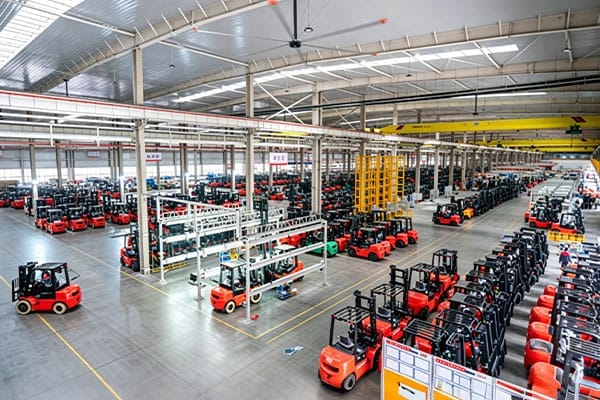
CSTAR states that it supports customization including logo, color and accessories on its product pages.
For an OEM or ODM project, however, the best approach is to provide the manufacturer with actual engineering requirements rather than simply requesting a “customized forklift.”
At minimum, provide:
Load weight + pallet dimensions + load center + lifting height + floor condition + aisle width + operating environment
This allows the supplier to determine which components or specifications may need to be changed.
6. How to Choose the Right Stacker Forklift
The easiest way to choose a stacker forklift is to define the operating requirements before comparing models.
Use the following checklist when requesting a quotation.
| Requirement | Information to Provide |
|---|---|
| Rated Capacity | Maximum actual load weight |
| Load Center | Load center distance |
| Lift Height | Required maximum lift |
| Pallet Size | Length × width |
| Aisle Width | Minimum operating aisle |
| Doorway Height | Lowest access point |
| Working Surface | Concrete, epoxy, gravel, dirt, etc. |
| Operating Environment | Indoor, outdoor, cold storage, etc. |
| Working Hours | Hours per day / shifts |
| Battery | Lead-acid or lithium-ion preference |
| Mast | Required mast/lift configuration |
| Special Loads | Single-sided, oversized or non-standard pallets |
| Customization | Forks, dimensions, branding or accessories |
Quick Stacker Forklift Selection Guide
For a simple comparison, consider the following decision path:
Need a basic lifting solution with a lower equipment budget?
Consider a semi-electric stacker, such as the CSHF-BB10.
The model is listed at 1,000 kg capacity and supports multiple lift-height configurations.
Need powered travel and lifting for routine indoor warehouse handling?
Consider a walkie electric stacker, such as the CSHF-B15.
It is listed at 1,500 kg capacity with compact dimensions and electric drive and lift functions.
Need higher capacity and a counterbalance legless configuration?
Consider the CSHF-C20.
It is listed at 2,000 kg capacity and 3,000 mm standard lift height, with a stand-on operating configuration and counterbalance legless design.
Need a double-lift configuration?
Consider the CSHF-D20 Double-Lift Electric Stacker.
It is listed at 2,000 kg capacity and uses full-electric travel and lifting functions.
Need to work on outdoor or uneven surfaces?
Consider an all-terrain electric stacker, such as the CSHF-H20.
It is listed at 2,000 kg capacity and 2,000 mm lifting height and is designed for outdoor factory areas, construction yards, open-air warehouses and uneven surfaces.
Conclusion: Making Your Final Choice
The best stacker forklift is not necessarily the most powerful or the most expensive model.
The right choice is the machine that matches your actual:
Load + pallet + lift height + aisle + floor + working hours + operating environment.
For low-frequency operations, a semi-electric stacker may provide the functions required without unnecessary complexity.
For routine indoor pallet handling, a walkie electric stacker can provide powered travel and lifting in a compact format.
For heavier or non-standard loads, a counterbalance legless stacker may provide a more suitable configuration.
For specialized handling requirements, a double-lift model may be worth considering.
And for outdoor operations involving uneven surfaces, an all-terrain electric stacker should be evaluated instead of assuming that a standard indoor model will be suitable.
CSTAR Machinery provides a range of stacker forklift solutions for warehouses, workshops, manufacturing facilities and outdoor material handling applications. The current range includes walkie electric, semi-electric, full-electric counterbalance legless, double-lift and all-terrain configurations.
Get the Right Stacker Forklift for Your Application
Explore our full range of stacker forklifts or contact our team for a customized material handling solution.
FAQ
What is a stacker forklift?
A stacker forklift is a material handling machine designed to move and lift palletized goods. Depending on the design, it may use manual propulsion, electric travel, electric lifting or a combination of these functions.
What is the difference between a stacker forklift and a pallet truck?
A pallet truck is mainly designed for moving pallets horizontally, while a stacker forklift adds a lifting function for placing pallets at elevated positions.
What capacity stacker forklift do I need?
Start with the maximum actual load weight, then consider the load center and required lifting height. A supplier should confirm the final rated capacity based on the complete application.
How high can a stacker forklift lift?
Lift height varies by model and configuration. CSTAR’s current range includes models around 1,300 mm, 1,600 mm, 2,000 mm and 3,000 mm lifting configurations, with some models offering multiple mast options.
Is an electric stacker suitable for narrow aisles?
Many electric stackers are designed with compact dimensions and maneuverability for indoor warehouse applications. However, aisle suitability must be confirmed using the actual truck dimensions, pallet size, turning radius and warehouse layout.
Should I choose lead-acid or lithium-ion?
The answer depends on operating hours, charging practices, maintenance expectations and budget. Neither battery type should automatically be considered the best option for every application.
Can a stacker forklift be customized?
Customization may be available depending on the model and application. CSTAR states that it supports customization such as logo, color and accessories.
Can a stacker forklift be used outdoors?
Some stackers are designed specifically for outdoor use. For example, CSTAR’s CSHF-H20 is an all-terrain electric stacker designed for outdoor factory areas, construction yards, open-air warehouses and uneven surfaces.