
Choosing between a lithium battery forklift and a lead acid forklift is becoming an important decision for warehouses, factories, logistics companies, and material handling distributors.
Both battery powered forklift types can provide reliable indoor and outdoor material handling, but they have different advantages in charging method, maintenance requirements, working hours, initial investment, and long-term operating costs.
The right choice depends on your working environment, daily operating schedule, load requirements, and budget plan. A forklift that works well for a single-shift warehouse may not be the best option for a multi-shift logistics operation.
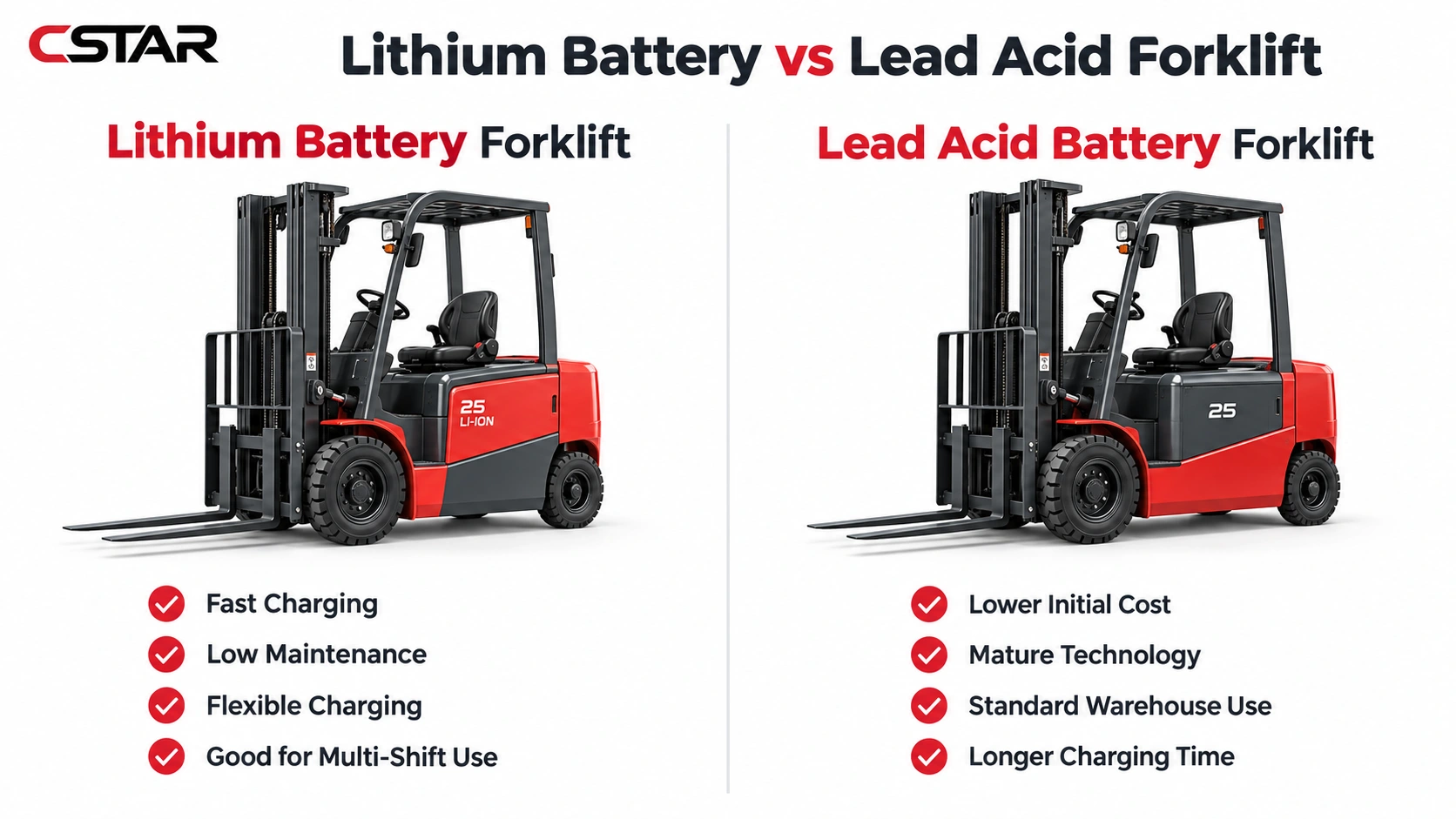
Image Suggestion: Lithium battery forklift vs lead acid forklift comparison infographic. Show two electric forklifts side by side with battery type labels, charging method, maintenance, and application differences.
Lithium Battery Forklift vs Lead Acid Forklift: Quick Comparison
Lithium battery forklifts and lead acid forklifts use the same basic electric forklift structure, but the battery system creates major differences in daily operation.
| Comparison Item | Lithium Battery Forklift | Lead Acid Battery Forklift |
|---|---|---|
| Battery Technology | Lithium-ion battery system | Traditional lead acid battery system |
| Charging Method | Fast charging and opportunity charging available | Usually requires longer charging periods |
| Maintenance Requirement | Low maintenance, no electrolyte checking | Requires regular battery inspection and maintenance |
| Working Schedule | Suitable for frequent operation and multiple shifts | Suitable for fixed working schedules |
| Initial Investment | Higher purchase cost | Lower initial equipment cost |
| Energy Efficiency | Higher charging efficiency | Lower charging efficiency compared with lithium systems |
| Typical Applications | Logistics centers, automated warehouses, continuous operations | Warehouses, factories, general material handling |
What Is a Lithium Battery Forklift?
A lithium battery forklift is an electric forklift powered by a lithium-ion battery pack instead of a traditional lead acid battery.
This technology has become increasingly popular in warehouse and industrial applications because it provides stable power output, flexible charging options, and reduced daily maintenance requirements.
Unlike traditional batteries, lithium battery systems do not require regular electrolyte checking or water filling. This makes them easier to manage for companies that want to reduce battery maintenance work.
Main Advantages of Lithium Battery Forklifts
- Flexible charging: Lithium batteries can support opportunity charging during breaks or short working intervals.
- Lower maintenance workload: Operators do not need to perform frequent electrolyte inspections or water maintenance.
- Stable performance: Lithium batteries can provide consistent power output during operation.
- Better for intensive usage: They are suitable for warehouses operating multiple shifts or requiring frequent forklift availability.
What Is a Lead Acid Battery Forklift?
A lead acid battery forklift uses traditional rechargeable lead acid batteries as the power source.
This technology has been widely used in electric forklifts for many years because of its mature design, lower purchase cost, and easy availability.
For companies with predictable working schedules, limited daily operating hours, or strict equipment budgets, lead acid electric forklifts remain a practical choice.
Main Advantages of Lead Acid Forklifts
- Lower initial cost: Lead acid battery forklifts usually require less investment when purchasing equipment.
- Proven technology: The battery system has been widely used in industrial applications for decades.
- Suitable for standard operations: They work well for warehouses with fixed operating hours and planned charging schedules.
- Easy replacement: Lead acid batteries are widely available in many markets.
Key Differences Between Lithium and Lead Acid Forklift Batteries
The biggest difference between lithium battery forklifts and lead acid forklifts is not only the battery itself, but how the equipment fits into daily operations.
| Factor | Why It Matters | Recommended Choice |
|---|---|---|
| Daily Working Hours | Long operating hours increase the importance of charging flexibility | Lithium battery forklift for continuous operations |
| Number of Shifts | Multiple shifts require reliable battery availability | Lithium battery forklift |
| Equipment Budget | Purchase cost may influence buying decisions | Lead acid forklift for lower initial investment |
| Maintenance Management | Battery maintenance affects labor cost | Lithium battery forklift for lower daily maintenance |
| Fixed Working Schedule | Predictable charging time is easier to manage | Lead acid forklift can be suitable |
Lithium Battery Forklift Charging and Maintenance Comparison
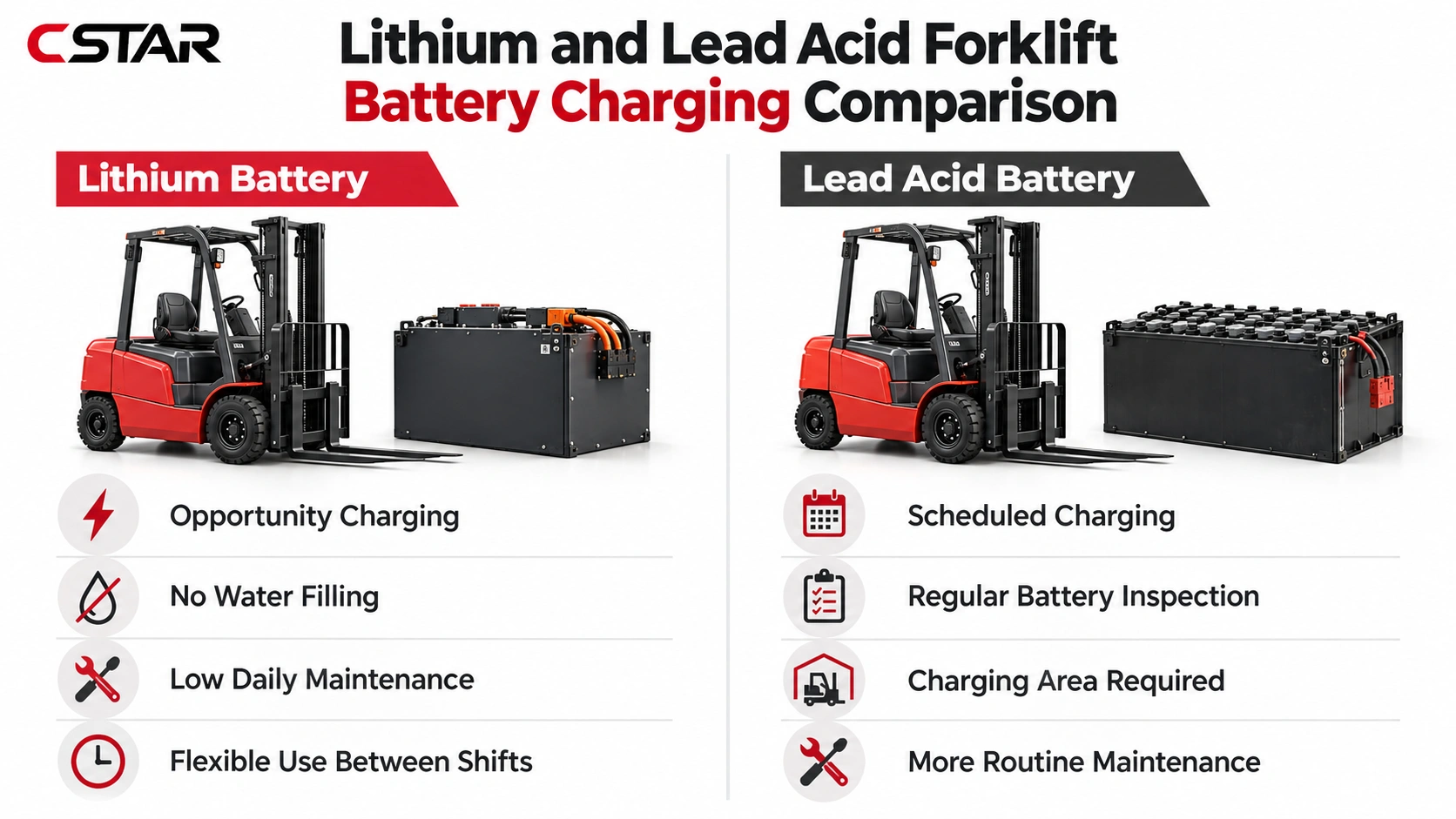
Battery management is one of the most important factors affecting electric forklift operating efficiency. The difference between lithium battery forklifts and lead acid battery forklifts becomes more obvious during daily charging and maintenance.
Lithium Battery Forklift Charging Characteristics
Lithium battery forklifts provide more flexibility because the battery can usually be charged during short breaks without following a strict full charging cycle.
For warehouses with changing workloads, peak seasons, or multiple operating periods during the day, this charging flexibility helps improve equipment availability.
- Opportunity charging: Operators can recharge the forklift during lunch breaks or idle periods.
- No battery room requirement: Many lithium battery systems do not require dedicated battery maintenance areas.
- Reduced downtime: Flexible charging helps reduce waiting time caused by long charging cycles.
Lead Acid Battery Forklift Charging Characteristics
Lead acid battery forklifts normally require planned charging schedules. The battery needs sufficient charging time after operation, and regular maintenance is required to keep performance stable.
- Scheduled charging: Charging usually needs to be arranged according to working hours.
- Battery maintenance: Operators may need to check battery condition and perform routine maintenance.
- Charging area management: Some applications require dedicated charging locations.
Lithium Battery Forklift vs Lead Acid Forklift: Maintenance Comparison
| Maintenance Item | Lithium Battery Forklift | Lead Acid Battery Forklift |
|---|---|---|
| Battery Water Maintenance | No regular water filling required | Requires electrolyte maintenance |
| Daily Inspection | Mainly check battery status and equipment condition | Requires additional battery inspection |
| Battery Management | Battery management system monitors battery condition | Requires manual management procedures |
| Operator Workload | Lower daily battery maintenance workload | Higher maintenance requirements |
Which Electric Forklift Battery Is Better for Different Working Conditions?
There is no universal answer when choosing between lithium battery and lead acid battery forklifts. The better option depends on how the forklift will be used.
Choose a Lithium Battery Forklift When:
- Your warehouse operates multiple shifts.
- The forklift needs to work continuously throughout the day.
- Reducing maintenance labor is important.
- Fast charging flexibility is valuable for your operation.
- The working environment requires clean and quiet equipment.
Choose a Lead Acid Battery Forklift When:
- The forklift operates mainly one shift per day.
- The working schedule is predictable.
- The initial equipment budget is the main consideration.
- Existing charging and maintenance systems are already available.
Lithium Battery Forklift or Lead Acid Forklift: Cost Considerations
When comparing electric forklifts, buyers should not only consider the purchase price. The total operating cost includes battery maintenance, charging efficiency, downtime, and expected service period.
| Cost Factor | Lithium Battery Forklift | Lead Acid Battery Forklift |
|---|---|---|
| Initial Purchase Cost | Usually higher because of lithium battery technology | Usually lower purchase investment |
| Maintenance Cost | Lower routine maintenance requirements | Requires more battery maintenance work |
| Operation Efficiency | Suitable for high utilization applications | Suitable for standard operation schedules |
| Long-term Planning | More suitable when equipment is used frequently | Suitable when purchase cost is the priority |
How to Choose the Right Electric Forklift for Your Business?
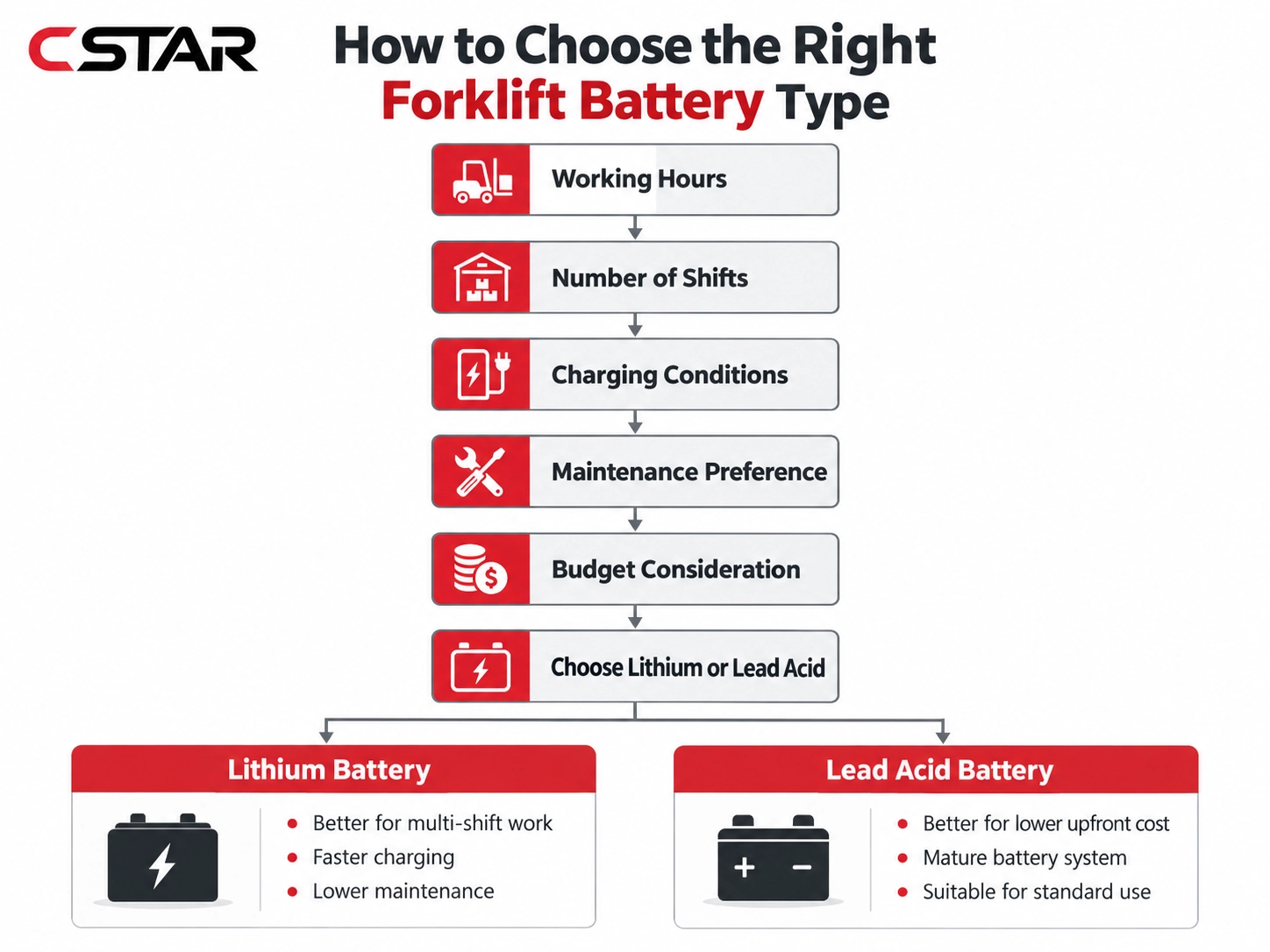
Before purchasing an electric forklift, buyers should evaluate several practical factors instead of choosing only based on battery type.
1. Check Daily Working Hours
If the forklift operates for many hours every day, battery charging flexibility becomes more important. Lithium battery forklifts are often preferred for intensive applications.
2. Consider Number of Working Shifts
Single-shift operations usually have enough time for scheduled charging. Multi-shift operations may benefit more from lithium battery technology.
3. Evaluate Charging Conditions
Companies should consider available charging areas, charging time, and whether the forklift needs to return to service quickly.
4. Compare Long-term Operating Requirements
A forklift is a long-term investment. Buyers should consider maintenance workload, equipment utilization, and future operating plans.
CSTAR Electric Forklift Solutions
CSTAR provides electric forklift solutions for different material handling applications, including compact warehouse models and higher-capacity industrial electric forklifts.
Customers can choose suitable configurations according to lifting capacity, working environment, battery requirements, and operation schedule.
Recommended CSTAR Electric Forklift Categories
- Electric Forklift – Complete range of battery-powered forklift solutions.
- 1.5 Ton Electric Forklift – Suitable for light and medium warehouse applications.
- 3 Ton Electric Forklift – Designed for heavier material handling requirements.
Frequently Asked Questions About Lithium Battery and Lead Acid Forklifts
Are lithium battery forklifts better than lead acid forklifts?
Lithium battery forklifts provide advantages in charging flexibility and maintenance reduction, while lead acid forklifts offer lower initial investment. The better choice depends on working conditions and operating requirements.
Can a lithium battery forklift replace a lead acid forklift?
Yes. Lithium battery forklifts can replace lead acid models in many warehouse and factory applications, especially where frequent operation and flexible charging are required.
Are lead acid forklifts still suitable for warehouses?
Yes. Lead acid forklifts remain a practical solution for warehouses with fixed schedules, normal workloads, and budget-focused purchasing requirements.
How many shifts are suitable for lithium battery forklifts?
Lithium battery forklifts are especially suitable for operations requiring long working hours or multiple shifts because flexible charging can help improve equipment availability.
What should I consider before buying an electric forklift?
Buyers should consider lifting capacity, working hours, charging conditions, maintenance requirements, and future operating plans before selecting a forklift battery type.
Conclusion
Lithium battery forklifts and lead acid forklifts both have their own advantages. Lithium technology focuses on charging flexibility, lower maintenance, and intensive operation, while lead acid technology provides a cost-effective solution for standard material handling tasks.
The best electric forklift choice depends on your warehouse environment, workload, charging conditions, and long-term operation goals.