
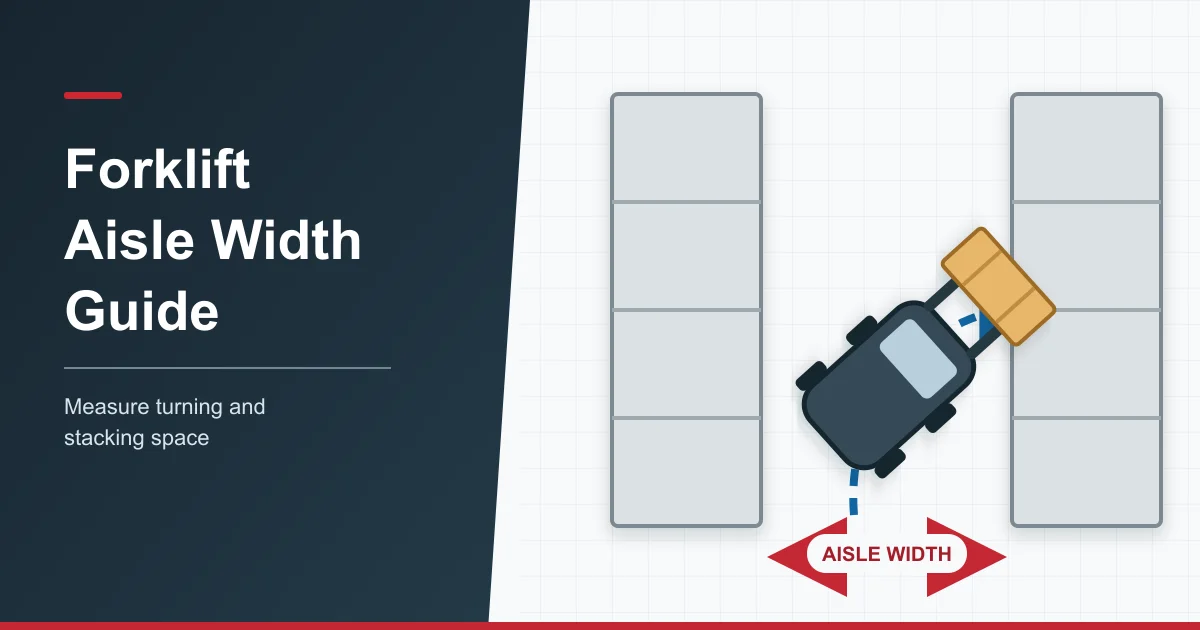
A forklift can travel smoothly in a straight line along an aisle, yet the space often becomes tight when the operator turns to place a pallet onto the rack. During this maneuver, the pallet moves closer to the upright on one side, while the rear of the forklift swings toward the opposite side. That “turning with a load” action is what usually decides whether a new rack row or a replacement truck will actually work.
To provide a general idea of scale, Toyota defines standard warehouse aisles as approximately 3.2 meters (10.5 feet) or wider, narrow aisles as roughly 2.6–3.2 meters (8.5–10.5 feet), and very narrow aisles as approximately 1.5–2.1 meters (5–7 feet). These classifications are highly useful during the planning stage. To judge whether a specific forklift model is suitable, compare the Ast for that truck and pallet orientation against the clear width you measured on site.
Forklift Aisle Width Starts with the Job
Think about everything a forklift has to do between picking up a pallet and setting it on the rack. It might drive through a doorway, swing into a cross aisle, and then make a 90-degree turn to drop the load. Each of those steps demands a different amount of clearance. Just because you’ve measured the doorway doesn’t mean you know how much space the truck needs next to the rack.
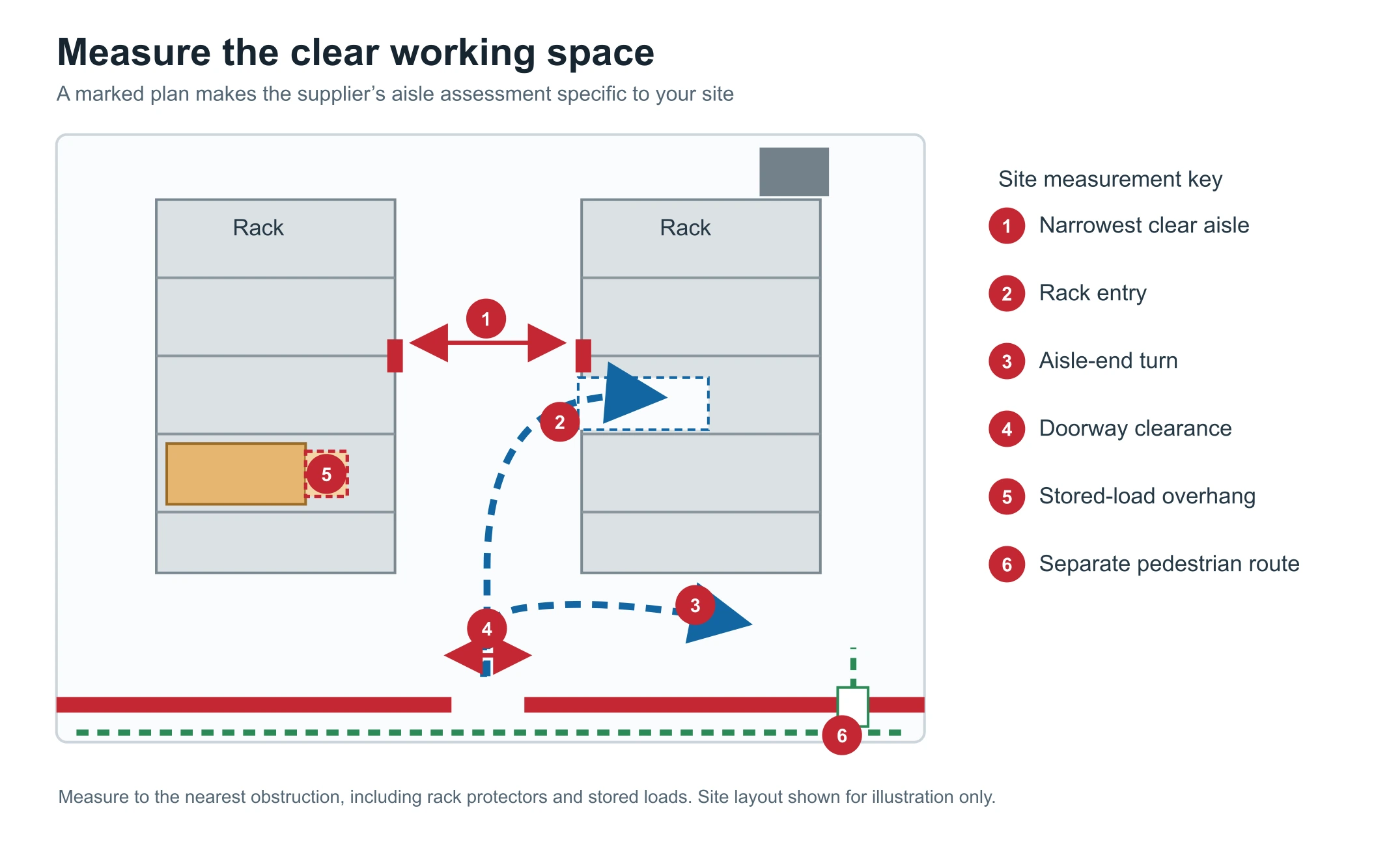
So measure the tightest spot for each maneuver. Start from whatever is closest to the truck — a rack protector, a column, a barrier, or a pallet sticking out past the shelf. Blueprints might give you the distance between rack uprights, but what actually matters is the space that’s left once those obstacles are factored in. Toyota’s guide to aisle widths makes the same point: when you’re measuring a site, don’t forget rack protection and pallet overhang.
Turning Radius vs. Right-Angle Stacking Aisle Width (Ast)
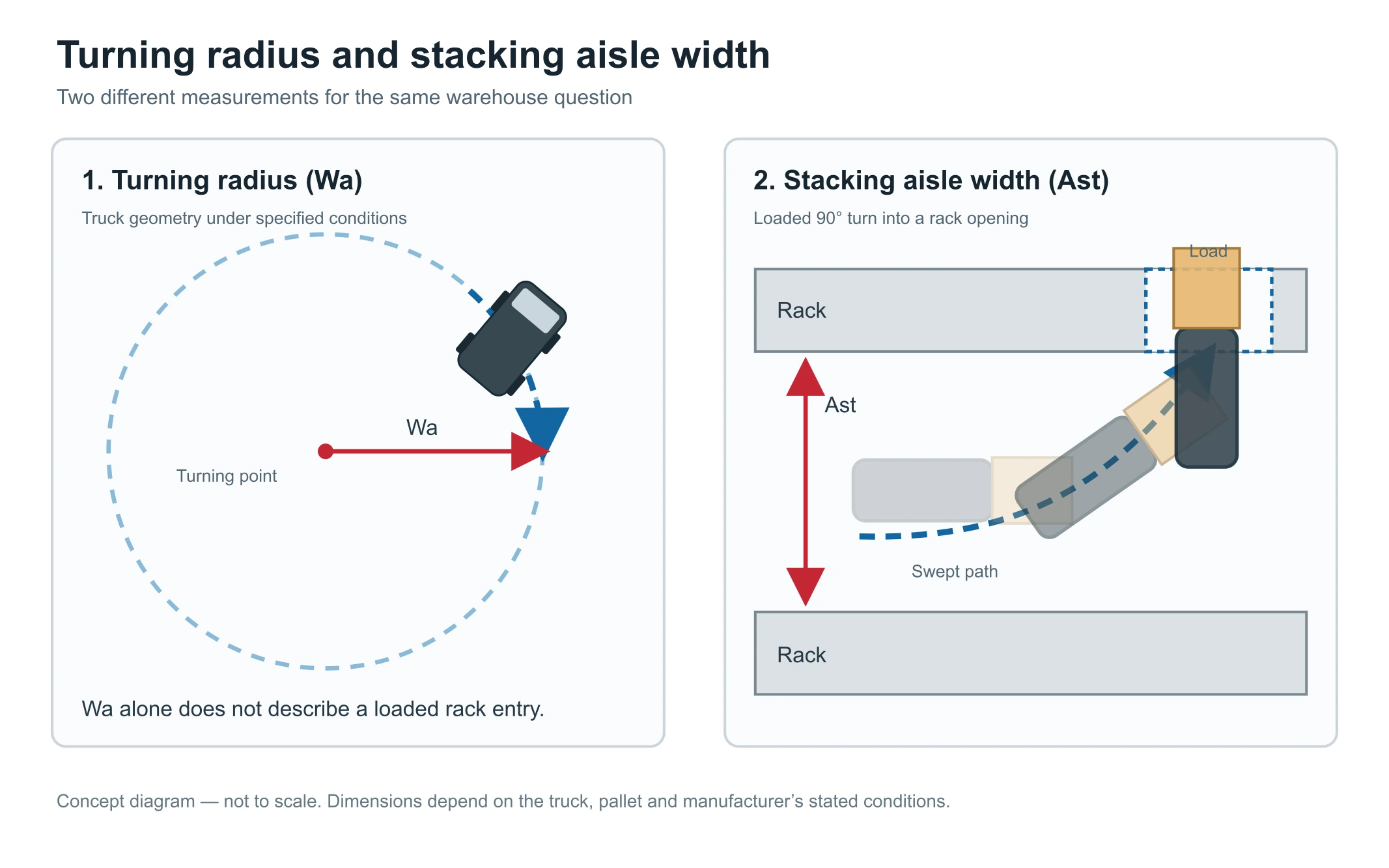
Once you have the site width, open the truck’s specification sheet. It may list overall width, turning radius and right-angle stacking aisle width — and each one answers a different question. Overall width tells you whether the truck fits through a straight passage. Turning radius, often marked Wa, shows how tightly the truck turns. The figure that matters most for placing a pallet at 90 degrees is Ast, the stacking aisle width stated for a particular load arrangement.
| Dimension | What it tells you | Where it helps |
|---|---|---|
| Overall truck width | Width of the truck as specified | Straight passage through a doorway or other opening; also account for the load and attachment |
| Turning radius (Wa) | How tightly the truck turns under the stated test conditions | Understanding vehicle geometry, alongside the manufacturer’s dimension drawing |
| Right-angle stacking aisle width (Ast) | Space required for the stated truck and load to make a 90-degree stacking movement | Checking rack access with the specified pallet size and entry direction |
| Clear site width | Space available between the nearest real obstructions | Comparing the proposed movement with your warehouse layout |
A specification sheet may give two Ast values for the same truck because it shows two pallet orientations. Linde’s electric forklift data sheet, for example, lists a 1,000 × 1,200 mm pallet across the forks separately from an 800 × 1,200 mm pallet along the forks. Find the entry that matches your load before comparing it with the aisle you measured.
The Ast figure covers the rack-entry maneuver. Doorways, aisle ends and pedestrian routes need separate checks.
Five Factors That Change the Space You Need
The published Ast gives you a starting point for a stated truck and load. From there, look at what your warehouse adds to the picture: the pallet’s entry direction, anything projecting beyond it, and the space the truck uses before and after the rack entry.
1. Pallet Size and Fork Entry Direction
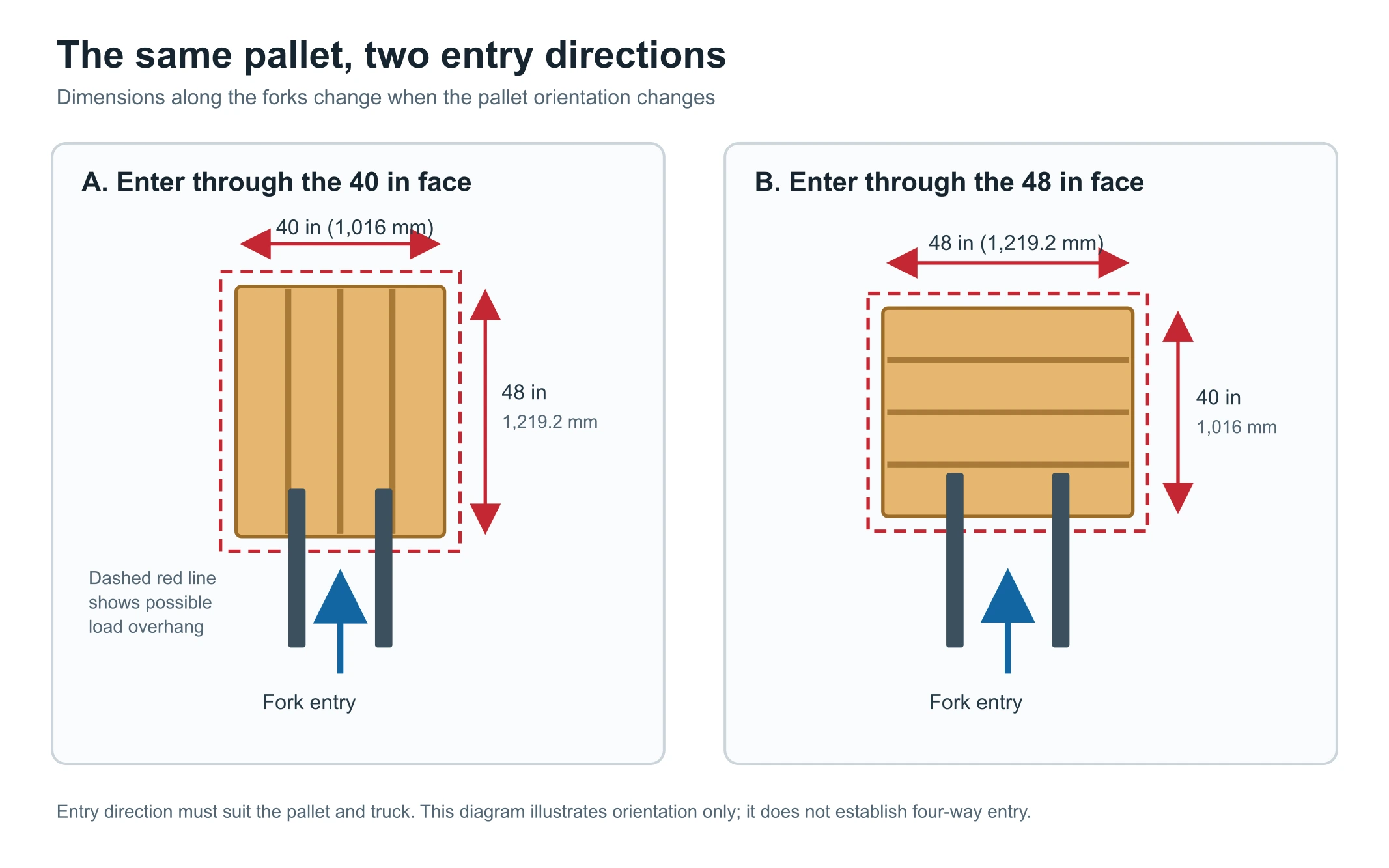
Take a pallet measuring 1,219 × 1,016 mm (48 × 40 in). If the forks enter through the 1,016 mm face, the load extends about 1,219 mm along the forks. Turn the pallet to enter through its 1,219 mm face, and that length along the forks becomes about 1,016 mm. The turn changes with the orientation.
Before using the second arrangement in a layout, check the actual pallet openings and the rack position. If the truck you are considering is a stacker with support legs and load wheels, those parts must also clear the pallet. Draw a fork-entry arrow beside the pallet dimensions so everyone quoting the job works from the same orientation.
2. Load Overhang and Attachments
The pallet may be 1,219 mm long, while the wrapped goods extend farther forward or to one side. Measure the loaded pallet as the operator will carry it, then mark any front and side overhang on the sketch — those projecting edges also move through the turn.
If the truck will use a clamp or another attachment, include that equipment in the drawing and in the capacity discussion. Its front reach and width can change both the available room and the way the load sits on the forks.
3. Chassis, Rear Swing and Operator Space
As the forks turn toward the rack, watch the other end of the truck. A counterbalance forklift’s rear may swing toward the opposite rack. On a walkie stacker, the tiller and operator need room to move; on a rider model, the platform changes the working outline.
Ask for the dimension drawing that shows the position the operator will actually use. A rider platform shown folded away may give a misleading impression of the working space. Our electric stacker vs forklift guide explains how these chassis and operator arrangements affect the wider equipment choice.
4. Rack Entry and Aisle-End Turns
The rack opening is often tighter than the aisle beside it. A protector at the upright can narrow the final approach, especially when the load projects past the pallet. Mark where the pallet must end up, not only where the truck begins its turn.
Then move to the end of the row. A U-turn into a cross aisle or a reversing maneuver out of a dead end follows a different path from a 90-degree rack entry. Show both loaded and unloaded movements on the plan so the supplier can review the awkward corner as well as the straight aisle.
5. Operating Clearance and Pedestrian Routes
After the truck and load clear the rack, think about how the aisle works during a shift. Ask the supplier what clearance is already included in its Ast figure, and what extra room your site needs for routine maneuvering. That keeps the truck calculation and the site’s operating margin separate.
Show pedestrian routes on the same drawing. The UK Health and Safety Executive recommends separating people and vehicles wherever possible. If you add a barrier or a marked walkway, measure the vehicle space that remains. A calculation allowance inside Ast is not a pedestrian lane.
How to Calculate Forklift Aisle Width
The easiest route is a specification sheet that already lists Ast for your chosen truck and pallet arrangement. If it shows a different load, send the supplier your dimensions and ask for the matching aisle requirement. When a sheet instead gives only a basic right-angle stacking dimension, you may still need to add the load length and clearance. In Toyota’s US method, that is exactly how the starting estimate is built. The following example shows how it works.
A Worked Example with a 1,219 × 1,016 mm Pallet
Toyota’s US planning method takes the truck’s Basic Right Angle Stack value, adds the length of the load along the forks, then adds 305 mm (12 in) of clearance. The method is published in inches; the table below puts millimeters first to match a metric warehouse drawing.
Suppose a truck has a hypothetical basic value of 2,032 mm (80 in). The forks enter a 1,219 × 1,016 mm pallet through its 1,016 mm face, so the pallet extends 1,219 mm (48 in) along the forks:
| Example input | Millimeters | Inches |
|---|---|---|
| Basic Right Angle Stack (assumed) | 2,032 | 80 |
| Load length along forks | 1,219.2 | 48 |
| Clearance in this method | 304.8 | 12 |
| Starting aisle estimate | 3,556 | 140 |
2,032 + 1,219.2 + 304.8 = 3,556 mm (140 in). This is an example of Toyota’s method using assumed truck data, not a CSTAR model dimension. It helps you see why the pallet belongs in the calculation. Bring the result and your marked layout to the supplier for the actual truck assessment.
If You Need to Read the Technical Formula
Some European data sheets use symbols instead of the phrase “Basic Right Angle Stack.” For one type of four-wheel counterbalance truck, the calculation can be written Ast = Wa + x + l6 + a. In plain language, that adds the truck’s turning radius, the distance from its front axle to the fork face, the load length along the forks, and the allowance specified by the manufacturer. Toyota’s European guide presents this formula only for the specific four-wheel counterbalance conditions it defines. Stackers, reach trucks and other truck geometries use different formulas.
You do not need to calculate every symbol yourself when the manufacturer provides a matching Ast figure. What matters when comparing quotations is whether a number already includes the pallet and its clearance. Adding the load length twice would overstate the aisle requirement.
How to Measure Your Warehouse Before Requesting a Quote
Give the supplier a marked floor plan to go with it. Number each tight location and attach a photograph, so “3,100 mm at the doorway” cannot be confused with “3,100 mm at the rack.”
| Location or item | Record on the drawing |
|---|---|
| Loaded pallet | Actual length and width, front and side overhang, weight, and fork-entry arrow |
| Rack aisle | Narrowest clear width, with protectors, columns and projecting stored goods shown |
| Rack position | Opening, support-leg access, placement height and any low-level obstruction |
| Aisle end and cross aisle | Clear dimensions and the intended turn or reversing movement |
| Doorway and approach | Clear width and height, plus the available space on each side of the opening |
| Working route | One-way or two-way use, crossings, pedestrian barriers and temporary staging areas |
| Truck arrangement | Mast, forks, attachments, operator position and platform position |
Keep that drawing with the quotation. If you change the pallet orientation or add an attachment later, update both. Otherwise, two suppliers could appear to quote different aisle needs simply because they assessed different loads.
Choosing Equipment When the Aisle Is Tight
Suppose the measured gap is smaller than the Ast given for a truck you were considering. Another model may turn in less space, but there is no reliable rule that ranks every walkie stacker, stand-on stacker and seated forklift in a fixed order. Wheelbase, steering design, support legs and platform position vary by model. Ask suppliers to assess the same pallet and the same rack position.
If a compact stacker is a possibility, our stacker buying guide covers pallet access and lifting needs. For counterbalance options, the electric forklift buying guide connects the layout with capacity, mast and workload.
The layout may offer another solution. Moving a staging area, revising an approved rack arrangement or using a pallet orientation the truck can handle could free working room. If those changes are unavailable, look at a different truck or handling system. Very narrow aisle equipment has its own operating requirements and needs a separate application review.
Before placing an order, ask the supplier to review the tight points and, where appropriate, demonstrate the proposed truck with the intended load. A controlled trial with trained operators can show whether the route works without forcing the truck against the rack.
Forklift Aisle Width FAQs
What is a standard forklift aisle width?
For an initial layout, Toyota describes standard aisles as roughly 3.2 m (10.5 ft) or wider, narrow aisles as about 2.6–3.2 m (8.5–10.5 ft), and very narrow aisles as about 1.5–2.1 m (5–7 ft). These are planning categories. The required width for your truck comes from its specification for the pallet and stacking movement you intend to use.
How much clearance should I add to Ast?
Ask the supplier what allowance its Ast figure already includes, then assess the room needed for your daily operation. Keep pedestrian routes separate from the truck’s stacking calculation.
Does forklift turning radius include the pallet?
Wa describes the truck’s turning radius under the stated test conditions. For a loaded turn into a rack, use the applicable Ast figure and confirm the pallet size and fork-entry direction.
Can I calculate aisle width from turning radius alone?
No. The pallet length, truck geometry and allowance used by the manufacturer also affect the result. A published Ast for your exact truck and pallet arrangement is the easier starting point.
What should I do if the aisle is too narrow?
Mark the point where the movement fails. The supplier and site team can then assess the obstruction, pallet orientation, rack layout and alternative trucks. Confirm pallet access and load capacity for any revised plan.
Conclusion: Check the Loaded Turn, Not Just the Straight Aisle
Aisle planning should be based on the loaded stacking maneuver, not the truck’s straight-line width. Match the measured site clearance, pallet orientation and nearby obstructions against the correct Ast figure for the proposed truck.
Discuss Your Warehouse Layout with CSTAR
Send CSTAR your warehouse layout, pallet dimensions, load weight, lift height and the tightest aisle or turn. We can review the application and discuss suitable stacker or electric forklift configurations.