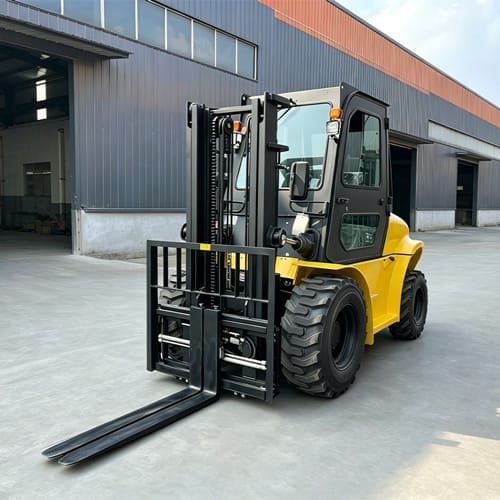
A rough terrain forklift is designed for material handling on specified outdoor ground conditions. Choosing between 2WD and 4WD starts with the working route: its firmness, traction, gradients and seasonal changes. The drive system matters, but it must be assessed alongside tires, ground clearance, load requirements and the complete truck configuration.
This guide focuses on straight-mast rough terrain forklifts, which raise the forks along a mast. Rough-terrain equipment can also include telescopic-boom and truck-mounted designs, so those terms describe overlapping equipment groups rather than mutually exclusive categories. Two published CSTAR models provide practical examples of comparing a 2WD and a 4WD specification sheet.
What Is a Rough Terrain Forklift?
A rough terrain forklift is built for outdoor ground that is unpaved or uneven, such as construction sites, building-material yards, farms and open storage areas. The label belongs to the whole design: the chassis, tires, ground clearance, drivetrain and the conditions the manufacturer specifies for its use. Diesel power and pneumatic tires are not enough on their own, because both also appear on ordinary industrial diesel trucks.
When comparing a rough terrain forklift with a standard industrial forklift, check the complete chassis and intended operating conditions. A conventional diesel forklift may suit a maintained outdoor yard without being a rough-terrain model. The CSQ-30T page identifies its rough-terrain chassis, tire arrangement and ground clearance as relevant differences. For a wider view of how truck designs match jobs, see our guide to the types of forklifts.
The market also uses the term “all-terrain forklift.” In the US, OSHA groups rough terrain forklift trucks under Class VII and explains that suitability still depends on the particular terrain. Its description of the classes has the detail.
Straight-Mast Forklift vs Telehandler
Two machines often turn up in the same search results, and they lift in different ways.
- Straight-mast forklift. The carriage and forks travel up and down a vertical mast. Capacity is read against a load center and a lift height.
- Telehandler. A telescopic boom changes both the height and the forward reach of the load, so capacity is read from a load chart for each boom position.
Truck-mounted describes how a forklift is transported to the job site. Some truck-mounted machines are rough-terrain models, and others are not. The comparisons below focus on straight-mast rough terrain trucks.
What Is the Difference Between 2WD and 4WD Rough Terrain Forklifts?
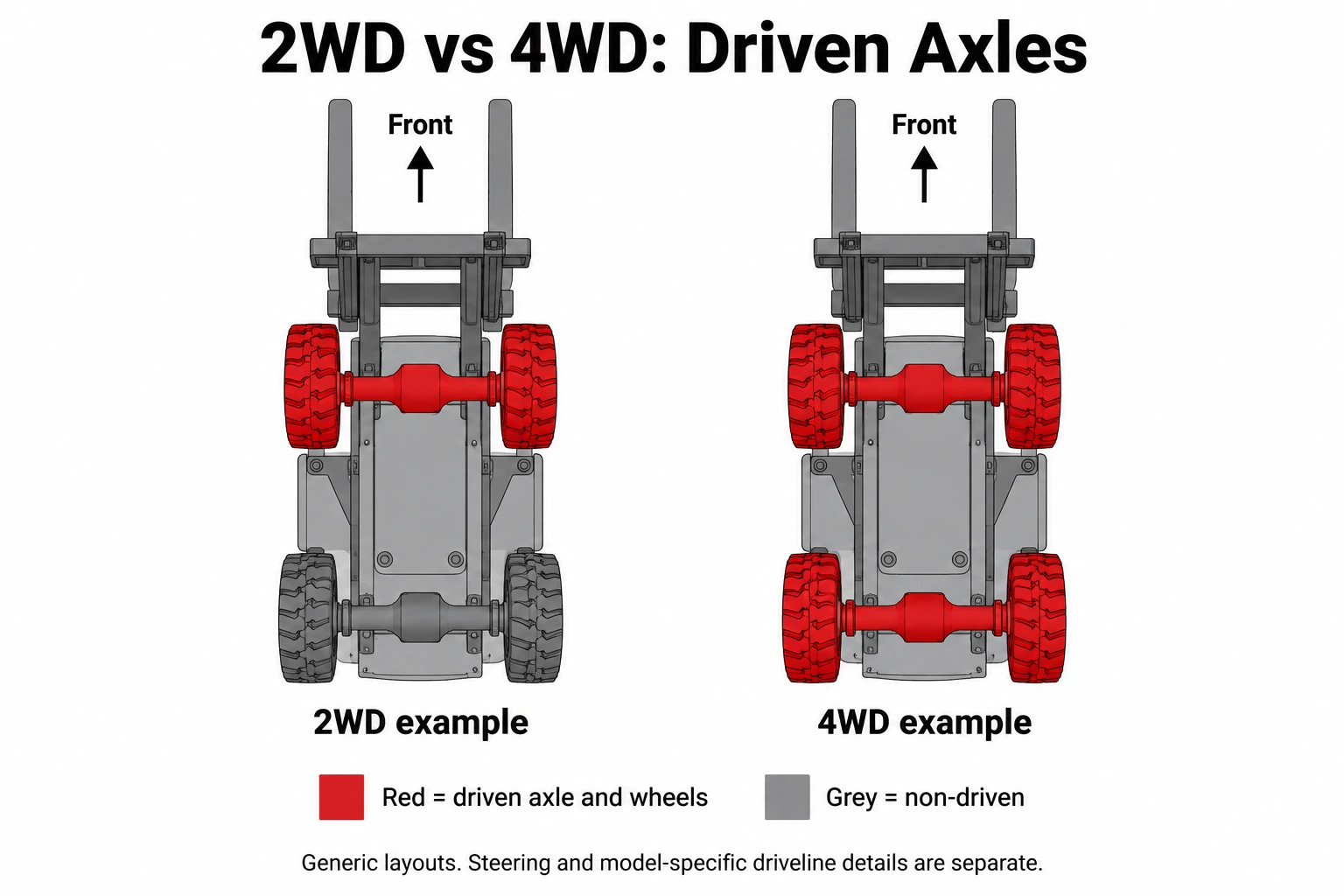
2WD and 4WD describe which wheels receive engine power. They do not describe how the truck steers, how high it sits or how much it can lift. Compare the drive layout separately from steering, ground clearance and the approved lifting configuration.
How 2WD Works
On a 2WD rough terrain forklift, power reaches one driven axle. The grip the truck has then depends on the load carried by the driven wheels, the tires and the adhesion of the ground. Which axle is driven is stated in the model documents and should not be assumed from the drive system.
How 4WD Works
On a 4WD rough terrain forklift, power can reach both the front and the rear axle. With more wheels driven, the truck can make more use of the grip the ground offers, under suitable conditions. Whether the drive is engaged all the time, selectable, or fitted with a differential lock or limited-slip arrangement depends on the model. The CSQ-35F page, for instance, labels the truck 4WD and gives its transmission, but it does not say how the drive is engaged or what differential arrangement it uses. Those are questions for the supplier whenever a 4×4 forklift is on the shortlist.
Drive Wheels Are Not the Same as Steering Wheels
2WD and 4WD say which wheels are driven. Two-wheel steering, four-wheel steering and articulated steering are separate design choices, and they decide how the truck turns in a tight space. A 4WD truck is not automatically a four-wheel-steer truck, so read the steering description and the turning radius next to the drive system.
| Comparison point | What to understand |
|---|---|
| Power delivery | 2WD drives one axle, while 4WD can drive the front and rear axles. |
| Ground grip | Available traction depends on the drive layout, tire contact and ground conditions together. |
| Steering | Listed separately. Check the steering design and the turning radius. |
| Maintenance | A 4WD layout generally adds driveline components, so compare the service items listed for the actual models. |
| Fuel use and price | Compare quotations for the same job on real models. Drive system alone does not give a fixed difference. |
| Load capacity | Read the rated capacity and load center for the model. They come from the model, whatever the drive system. |
For a useful comparison, request fuel and climbing figures with their load and test conditions. Compare the same task rather than assigning a fixed performance difference to the drive layout.
Which Ground Conditions Should You Assess First?
Describe the ground before you compare trucks. A site description that covers surface, bearing, gradient and seasonal change narrows the choice faster than a preference for one drive type.
Firm, Maintained Outdoor Yards
For maintained concrete, asphalt or other load-bearing routes, first check the actual condition, level changes and gradients. A standard industrial forklift may meet the job. Where a rough-terrain chassis is needed but the route remains firm and offers consistent traction, begin by comparing a suitable 2WD model with the required load and clearance. Outdoor use alone does not establish a need for 4WD.
Compacted Gravel and Uneven Routes
Record how loose the gravel is, where the potholes and ruts are, and where the surface changes level, such as at a gate threshold or the foot of a ramp. A construction site forklift often meets all of these in a single shift, with loose fill, ruts left by vehicle traffic and level changes at temporary ramps. Keep two problems apart. A rough surface affects clearance and tires, while ground that cannot bear the truck’s weight affects whether a truck should work there at all. For a forklift for uneven ground, clearance, tires and body dimensions have to be checked together.
Wet, Soft or Seasonally Changing Ground
Assess the route in its usual seasonal conditions, including after rain. Where recurring loss of traction is a concern on ground confirmed suitable to carry the truck and load, include a 4WD model in the comparison. Check its actual driveline, tires and operating limits. Soft spots, sinking or poor drainage also call for ground assessment and possible route improvement; extra driven wheels do not increase the ground’s bearing capacity.
Mixed Indoor and Outdoor Routes
For routes entering a building, check doorway dimensions, floor loading, tires and the complete working outline. Diesel operation also requires assessment of ventilation, exhaust exposure and applicable site rules; physical access alone does not establish indoor suitability.
| Ground condition | What to record | What it feeds into |
|---|---|---|
| Firm, maintained yard | Surface type, condition and gradients | Whether a rough terrain design is needed at all |
| Gravel and uneven route | Looseness, potholes, ruts and level changes | Ground clearance, tires and body dimensions |
| Wet or soft ground | Drainage, soft spots, sinking history and wet-weather use | Drive-form candidates, and whether the ground needs repair |
| Mixed indoor and outdoor | Doorways, floor capacity and indoor space | Dimensions, tires and engine exhaust arrangement |
Ground Clearance, Tires and Gradeability Explained
Ground clearance, tire configuration and gradeability describe different aspects of site access. Read them together with the dimension drawing and operating instructions.
Mast Clearance vs Midpoint Clearance
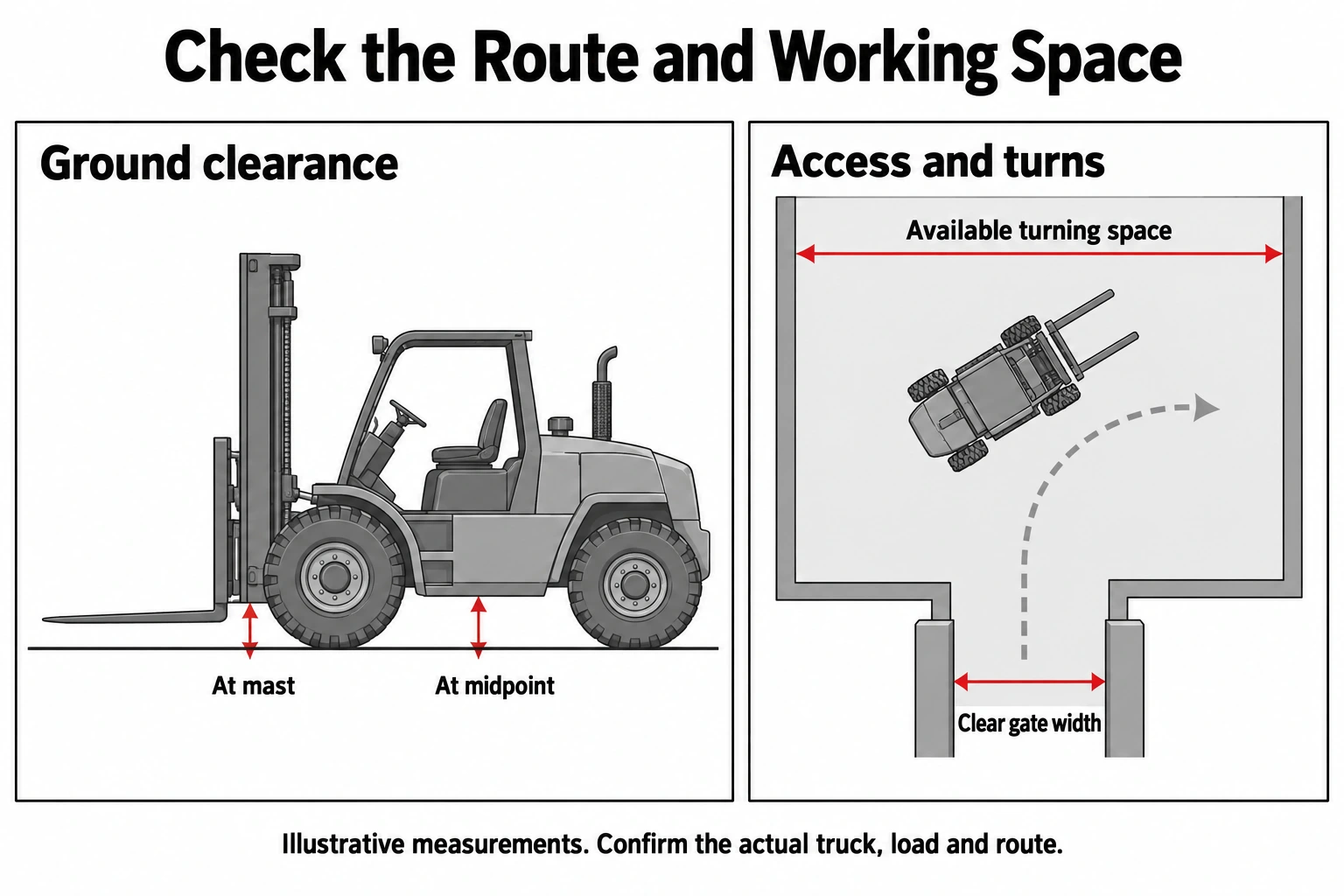
Rough terrain forklift ground clearance is often listed as two figures. The CSQ-30T lists 220 mm at the mast and 310 mm at the midpoint, and the CSQ-35F lists 200 mm and 240 mm. These dimensions identify different locations beneath the truck. Compare both with the route profile and the manufacturer’s measurement conditions. A lower mast-clearance figure does not identify the limiting point for every obstacle: wheel position, overhang and approach direction also matter. Midpoint clearance and wheelbase are relevant when reviewing a crest or surface transition. Use the dimension drawing to assess the complete geometry.
Wheelbase, overhangs and tire size also shape how a truck meets a surface feature, which is why a single clearance number cannot settle how the whole truck will handle a route.
Tires and Traction
Read the tire size, the tread pattern, whether the tire is pneumatic or solid, its condition, and any requirements the manufacturer sets. The two CSTAR pages show how much this entry varies: the CSQ-30T lists a 12-16.5-12-TL (L2B) front tire and a 27×10.5-15PR rear tire, while the CSQ-35F lists a 14-17.5-16PR front tire and a 10.0/75-15.3IMP rear tire. Match tire construction and tread to the route, and obtain approved inflation and replacement specifications from the manufacturer. Nominal tire size alone does not establish available grip.
Gradeability Is Not an Operating Slope Approval
Slopes are quoted in percent or in degrees, and the two are different units. Grade in percent is the vertical rise divided by the horizontal distance, multiplied by 100. A 16% grade rises 16 units over every 100 units of horizontal distance, which is an angle of about 9 degrees, and a 100% grade is 45 degrees.
Gradeability in a specification table is a climbing figure under the manufacturer’s test conditions. It is not the same as braking control on a descent, stability on a side slope, or stability while lifting on a slope. Look for whether the figure applies to a loaded or an unloaded truck, and what the test conditions were. Both CSTAR pages list gradeability as 16%, and their tables do not state the load or test conditions behind it. Neither figure should be read as a daily operating slope.
For operating limits, the manufacturer’s recommendation governs. OSHA’s guidance on ramps and grades tells operators not to travel on slopes or in conditions that exceed that recommendation. For buying, that means asking the supplier what slope the model is approved to work on, in which load condition, and in which direction of travel.
Match Capacity, Load Center and Lift Height to the Job
Reaching the pickup point and lifting the load are separate checks. The approved capacity must match the load, mast and attachment configuration, while the route and lifting area must meet the operating conditions for the truck.
A rated capacity belongs to a load center. The CSQ-30T is rated at 3,000 kg and the CSQ-35F at 3,500 kg, both at a 500 mm load center, with a listed lift height of 3,000 mm. A load extending farther along the forks can place its center of gravity farther forward. A wider load carried across the forks may instead create side overhang or lateral imbalance, while an irregular load needs its actual center of gravity identified. Attachments add mass and can change the load position. Select using the approved rating for that complete arrangement, not the drive label.
For placement at height, check the capacity information for the mast and configuration at that height. Also separate the route from the lifting position. A truck that can drive a route may still be a poor fit for lifting at the end of it, if the ground at the placing point is soft or sloping. How Much Can a Forklift Lift? explains load center and lifting capacity in full.
Published Examples: CSTAR 2WD and 4WD Rough Terrain Forklifts
A buyer with two specification sheets in hand needs to know which lines compare and which do not. These two models show how that reading works.
| Published parameter | CSQ-30T | CSQ-35F |
|---|---|---|
| Drive system stated on the page | 2WD | 4WD |
| Rated capacity | 3,000 kg | 3,500 kg |
| Load center | 500 mm | 500 mm |
| Lift height listed on the page | 3,000 mm | 3,000 mm |
| Width | 1,550 mm | 1,630 mm |
| Turning radius | 2,910 mm | 3,450 mm |
| Ground clearance, mast / midpoint | 220 / 310 mm | 200 / 240 mm |
| Service weight listed on the page | 4,800 kg | 5,850 kg |
| Gradeability listed on the page | 16% | 16% |
Source: the linked CSTAR product pages, checked on 19 October 2026. Values describe the published configurations.
Three points follow from the table.
Compare the complete configurations. The two trucks differ in more than driven wheels. They carry different rated capacities and different service weights, and their pages list different wheelbases (1,850 mm and 1,990 mm), engine outputs (36.8 kW and 45 kW), transmissions (one forward and one reverse gear against two of each) and tire specifications. Those design differences must be considered alongside the drive layout.
The published clearance figures differ by model. On these two models the 4WD truck lists the lower clearance figures at both points, 200 and 240 mm against 220 and 310 mm. Clearance has to be read model by model.
Both pages list 16% gradeability. A comparison of climbing performance needs the load condition, surface and test method behind each value. The matching entries alone do not establish identical traction or approved operating limits.
The 4WD truck also lists the larger width and turning radius, which matter at gates and tight corners. Use the listed dimensions for the actual access check rather than attributing the difference to 4WD alone.
How Site Access and Working Space Affect Selection
A truck can have the right ground ability and still fail at the gate. Once the surface is understood, check that the truck can get in, turn and be loaded where it has to work.
Start with the gates, the site roads, the loading areas and the space around pallets or stacks. Compare the truck’s width, wheelbase, turning radius, tail swing and any load overhang with those spaces. Both CSTAR pages list dimensions without forks. Request the overall length with the selected forks and attachments, together with the loaded outline, rather than assuming that adding dimensions from different reference points gives the correct working envelope. Height matters as well: check the lowered height of the mast and the overhead guard height, which the pages list as 2,210 mm for the CSQ-30T and 2,250 mm for the CSQ-35F, against canopies, doorways and any overhead obstruction.
Turning radius describes how the truck turns. It is not the aisle width needed to stack a load at right angles, which depends on the pallet and the configuration. The Forklift Aisle Width Guide covers that distinction and how to measure it.
If the truck will be loaded onto a vehicle for transport, confirm the shipping dimensions and weight and how it will be loaded. When floor or ramp loading has to be assessed, ask the supplier for axle or wheel loads for the configuration, and do not estimate them from service weight. How Much Does a Forklift Weigh? explains why the two figures answer different questions.
Comparing Purchase Price, Fuel Use and Maintenance
Cost comparisons between 2WD and 4WD fall apart when the trucks being compared do different jobs. Three steps keep them honest.
Compare Equivalent Quotations
Quote both trucks for the same task and a similar capacity need. State the mast, engine, tires, cab and attachments on each, and compare the delivery scope, the warranty and the parts support. Our forklift price guide covers how quotations are built.
Use a Defined Duty Cycle
Fuel use follows the work: hours per day, load weights, travel distance, the number of lifts, idling time and the ground. Without a reliable test or your own records, any fuel figure is a guess, and extra driven components are not a fixed percentage of extra fuel.
Check Service Requirements
Read the service items for the actual drivetrain of each model. Then look at local service, parts availability and the cost of downtime. A payback period only means something with a stated duty cycle and cost basis behind it, so leave it out of a comparison until you have both.
A Practical Rough Terrain Forklift Selection Checklist
Collect this information before asking for a quotation, so that each supplier proposes a truck for the same job.
| Information | What the buyer provides |
|---|---|
| Load | Maximum weight, dimensions, center of gravity and pallet type |
| Lifting | Target height, attachments and the actual placing position |
| Ground | Surface type, potholes, soft spots and changes after rain |
| Slopes | Gradient along and across the route, transition points and route photos |
| Space | Narrowest gate, road widths, turning areas and height limits |
| Workload | Hours per day, load cycles and travel distance |
| Configuration | Drive system, tires, transmission, mast and attachments |
| Delivery | Destination, engine documentation, transport and service requirements |
Send the load details, route measurements and site photographs so the proposed truck configuration can be reviewed against the actual job. CSTAR’s rough terrain and standard diesel models are listed on the diesel forklift category page.
Rough Terrain Forklift FAQs
Do all rough terrain forklifts have four-wheel drive?
No. The CSQ-30T is listed as a 2WD rough terrain forklift, while the CSQ-35F is listed as 4WD. Check the drive configuration of the specific model.
Can a standard diesel forklift be used on uneven ground?
Compare the actual surface with the manufacturer’s stated operating conditions. Ruts, loose material and abrupt level changes may call for a rough-terrain design or route improvement. Provide measurements and photographs; complex ground conditions may also require an on-site assessment.
Does 4WD increase forklift lifting capacity?
A 4WD designation does not establish lifting capacity. Use the model-specific approved rating at the stated load center, height and attachment configuration. A different 4WD model may have a higher rating because it is a different complete truck.
Is gradeability the same as the permitted operating slope?
No. Gradeability is a climbing figure under the manufacturer’s test conditions. The slope a truck may work on is set by the manufacturer’s operating limits, and it also depends on load, direction of travel and ground conditions.
What is the difference between a rough terrain forklift and a telehandler?
Rough terrain forklifts can include straight-mast and variable-reach designs. The straight-mast trucks discussed here raise their forks along a mast. A telehandler uses a telescopic boom to vary height and forward reach, with capacity read from its chart for the relevant configuration and boom position.
What information is needed to compare 2WD and 4WD models?
Compare the same load, lift height and ground description, then the full configuration of each model: tires, steering, transmission and engine. Ask the supplier how the drive is engaged and for the manufacturer’s operating limits, because the drive system on its own does not describe either.