

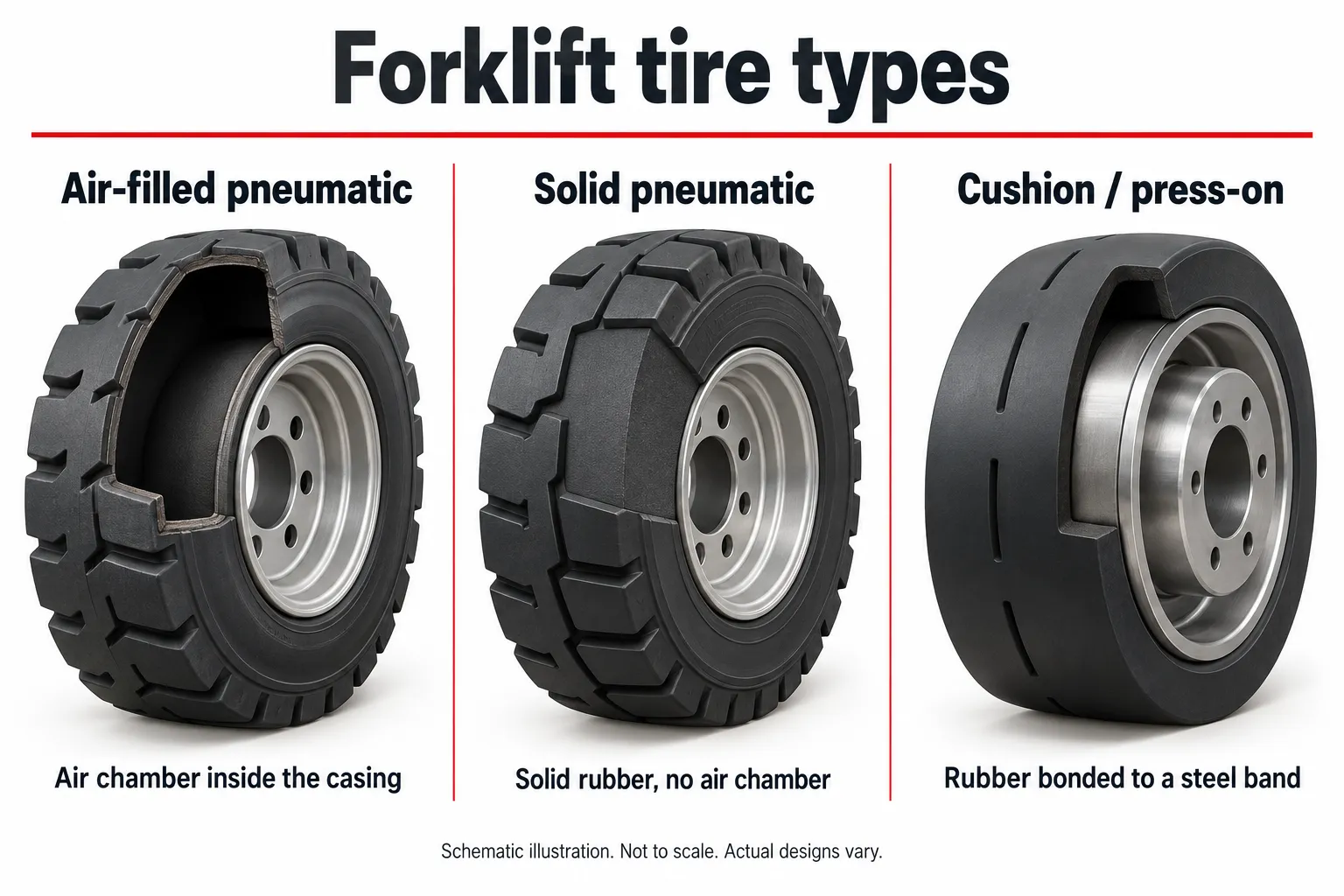
The main forklift tire types are air-filled pneumatic, solid pneumatic and cushion tires. Air-filled tires contain compressed air. Solid pneumatic tires have a solid rubber construction without an air chamber. Cushion tires, also called press-on tires, have rubber bonded to a steel band that is pressed onto the wheel.
Solid pneumatic and cushion tires can both be made of solid rubber, but they use different mounting arrangements. When ordering, specify the construction and full size marking rather than asking only for “solid forklift tires.”
This guide covers counterbalance forklift tires, including non-marking options, size markings and replacement checks. Tire removal, mounting and servicing should be handled by trained technicians using the appropriate equipment.
What Are the Main Forklift Tire Types?
Toyota’s forklift tire options guide distinguishes air-filled pneumatic, solid pneumatic and cushion tires. Construction determines how the tire supports the load and how it fits the wheel.
Air-Filled Pneumatic Tires
Air-filled pneumatic tires support the load through compressed air inside a rubber casing. They are commonly considered for uneven outdoor routes where shock absorption and traction matter. Selection still depends on the truck, tire specification and actual ground conditions.
Check the load rating, specified inflation pressure and exposure to punctures. For wet or loose surfaces, assess the particular tread and operating conditions instead of assuming every pneumatic tire provides the same grip.
Solid Pneumatic Tires
Solid pneumatic forklift tires resemble air-filled pneumatic tires but have no air chamber. They require no inflation and cannot lose pressure through a puncture. Tire manufacturers also use the term “resilient tires” for this construction.
They are commonly used on mixed indoor and outdoor routes, including sites where sharp debris makes punctures a concern. Solid rubber can still suffer cuts, tears and wear. Compare ride comfort, tread, operating limits and price at the individual product level.
Cushion Tires, Also Called Press-On Tires
A rubber cushion tire is molded onto a steel band, which is pressed onto the wheel. This mounting arrangement distinguishes it from a solid pneumatic tire.
Cushion-tire forklifts are commonly used on smooth warehouse floors and suitable paved surfaces. Their maneuverability comes from the complete truck configuration. Fitting a different tire alone does not establish a smaller turning radius.
Solid Pneumatic vs. Cushion Tires: Why the Difference Matters
“Solid” Describes Too Little for an Order
A request for “solid forklift tires” can refer to either solid pneumatic or cushion tires. To identify the correct replacement, provide:
- The tire construction
- The complete size marking
- The original wheel, rim or steel-band details
- The forklift model and configuration
- The load and operating conditions
Similar outside dimensions do not make two tires interchangeable. The mounting arrangement and approved wheel combination must also match.
Compare the Complete Truck Configuration
Toyota’s comparison of pneumatic and cushion forklifts considers different truck configurations and operating environments. Apply the same approach when comparing quotations: review the tire alongside the wheel, axle, chassis and manufacturer-approved specification.
- Compare turning radius using the truck’s specification sheet.
- Assess rough-terrain suitability using the complete truck and site conditions.
- Confirm tire load ratings and the truck’s rated capacity separately.
Compare Forklift Tires by Working Conditions
Use the table to narrow the options, then check the specific tire and truck against the route.
| Tire type | Construction | Common applications | Main checks |
|---|---|---|---|
| Air-filled pneumatic | Rubber casing containing compressed air | Outdoor routes where the truck and tires are suitable for uneven surfaces | Inflation pressure, load rating, tread, ground conditions and puncture exposure |
| Solid pneumatic | Solid rubber construction without an air chamber | Mixed indoor and outdoor routes; sites with puncture exposure | Approved rim fitment, load rating, ride requirements, wear and damage |
| Cushion / press-on | Rubber bonded to a steel band pressed onto the wheel | Smooth warehouse floors and suitable paved surfaces | Band and wheel dimensions, floor condition, joints and thresholds |
Smooth Warehouse Floors and Paved Yards
Inspect the entire route, including cracked concrete, expansion joints, thresholds and transitions between indoor and outdoor areas. Record how often the forklift turns, brakes and travels with a load. Include any requirements for floor marking, cleanliness or noise when requesting a tire recommendation.
Debris, Sharp Objects and Puncture Exposure
Nails, metal offcuts, glass and construction waste increase puncture exposure. Solid tires avoid air loss, although their rubber can still be cut, torn or worn away. Consider inspection arrangements, replacement availability and the downtime caused by tire damage.
Loose, Uneven or Soft Ground
For loose or uneven ground, assess the chassis, ground clearance, drive configuration, load and route together. Tires alone cannot make a standard forklift suitable for rough-terrain work. Our 2WD and 4WD rough terrain forklift guide explains the broader equipment checks.
What Are Non-Marking Forklift Tires?
Non-marking forklift tires use compounds designed to reduce floor marking, particularly black marks associated with conventional tires. Non-marking describes a compound characteristic rather than a separate tire construction. Both press-on and resilient tires are available in non-marking versions.
These options are considered where floor cleanliness or contamination control matters, including food and pharmaceutical operations. Selection should cover the site’s actual cleanliness and electrical requirements.
- Colour alone does not establish non-marking performance. Camso’s non-marking tire guide explains that these tires do not have to be white or grey.
- Compound formulation affects electrical behaviour. Camso’s explanation of static charges in forklift operations describes how silica-based non-marking compounds can allow static charge to accumulate.
- Where static control is required, check the specific tire’s electrical properties and the truck manufacturer’s requirements. Anti-static options are available, but their suitability must be confirmed for the application.
- Non-marking does not establish dust-free operation or suitability for every controlled environment. Confirm the required performance with the tire supplier.
How to Read Forklift Tire Size and Specification Information
Start with the Existing Tire Markings
For replacement tires, provide clear photographs of the full sidewall markings, the tire and wheel assembly, the front and rear wheel arrangements, and the truck’s data plate. Preserve the complete marking rather than shortening it to the first size number.
Confirm What Each Dimension Means
Forklift tire sizes use several naming conventions. MAXAM’s guide to reading forklift tire sizes explains these examples:
- For a press-on tire, 21 × 7 × 15 identifies a nominal outside diameter of 21 inches, a steel-band width of 7 inches and a nominal inside diameter of 15 inches. The metric marking 533 × 178 × 381 refers to the same nominal tire size.
- For a low-profile pneumatic or solid pneumatic size such as 23 × 9-10, the numbers identify a nominal outside diameter of 23 inches, section width of 9 inches and wheel diameter of 10 inches.
- In a metric low-profile marking such as 200/50-10, the section width is 200 mm, the aspect ratio is 50%, and the wheel diameter is 10 inches.
These are nominal size markings, not a complete fitment specification. Confirm the rim or hub dimensions, mounting arrangement and load requirements with the supplier before ordering.
Check Front and Rear Requirements Separately
Record front and rear tire specifications separately. They may differ in size, wheel arrangement or other requirements. For each position, provide the full marking and a photograph of the fitted assembly.
Can You Change a Forklift from Pneumatic to Solid or Cushion Tires?
Replacing worn tires with an approved equivalent is different from changing tire type, size or wheel arrangement. For a new forklift, select from the configurations offered by the manufacturer. For a truck already in service, confirm compatibility before changing the configuration.
Review the following with the forklift manufacturer or its authorized technical representative:
- The approved tire and wheel combination for that truck
- Tire size, load rating and operating limits
- Any effect on truck height, clearances, rated capacity or safe operation
- Required approvals and updates to the truck’s documentation
An air-filled-to-solid-pneumatic conversion and a pneumatic-to-cushion conversion involve different fitment questions. Cushion tires use a press-on band arrangement, so a similar outside diameter is insufficient to establish compatibility.
In the United States, OSHA’s warehousing guidance requires prior written manufacturer approval for modifications or additions affecting capacity or safe operation. Apply the requirements relevant to your location. Our forklift lifting capacity guide explains why rated capacity must be checked against the actual truck configuration.
What Changes Forklift Tire Life and Maintenance Needs?
Tire life varies with floor condition, carried load, operating intensity, travel distance, turning, braking, temperature and maintenance. Record these conditions when comparing tire options or investigating repeated damage.
Follow the tire and forklift manufacturers’ instructions for inflation pressure, inspection and replacement limits. Solid tires require inspection even though they need no inflation. For routine truck checks, see our forklift maintenance checklist.
Forklift Tire Selection and Ordering Checklist
Use this checklist for a replacement-tire enquiry or a new-truck specification. Complete the fields that apply.
| Information to provide | Your details |
|---|---|
| Forklift brand, model and serial number, if replacing tires | |
| New-truck configuration or replacement tires | |
| Existing tire construction and full markings | |
| Front and rear tire specifications | |
| Rim, hub or wheel-band information | |
| Tire and wheel photographs, if replacing tires | |
| Maximum carried load and handling conditions | |
| Floor condition and outdoor route photographs | |
| Sharp debris and puncture exposure | |
| Daily operating hours and travel pattern | |
| Non-marking, electrical or other special requirements | |
| Destination country and quantity |
For a new truck, start with the load, route and site requirements. For replacement tires, add the existing markings, assembly photographs and truck identification.
Frequently Asked Questions
Are solid pneumatic tires the same as cushion tires?
No. Solid pneumatic tires and cushion tires use different mounting arrangements. Cushion tires have rubber bonded to a steel band that is pressed onto the wheel. Confirm construction and fitment as well as nominal size.
Are pneumatic forklift tires always air-filled?
Forklift suppliers use both “air-filled pneumatic” and “solid pneumatic.” If a quotation says only “pneumatic,” ask which construction is included.
Are solid forklift tires suitable for outdoor use?
Solid pneumatic tires are commonly used on mixed indoor and outdoor routes. Suitability depends on the specific tire, approved truck configuration and ground conditions. Cushion tires are generally associated with smooth floors and suitable paved surfaces.
Do non-marking tires provide the same performance as standard tires?
Compare the individual products. Non-marking identifies a floor-marking characteristic; it does not establish equal wear, ride comfort or electrical performance. Check the manufacturer’s data for the conditions that matter at your site.
Can I replace my forklift tires with a different type?
Confirm the approved tire-and-wheel combination with the forklift manufacturer before changing type, size or mounting arrangement. An approved equivalent replacement is different from a configuration change. Have qualified technicians perform the work.
How long do forklift tires last?
Service life varies with the tire, load, floor, operating pattern and maintenance. Use inspection records and the manufacturer’s replacement criteria rather than a universal number of months or operating hours.
Getting Your Tire Configuration Checked
To discuss a forklift tire configuration, contact CSTAR Machinery with the truck model, tire markings and photographs of the working surface. Include the load and travel pattern so the discussion starts with the conditions the equipment will actually face.