
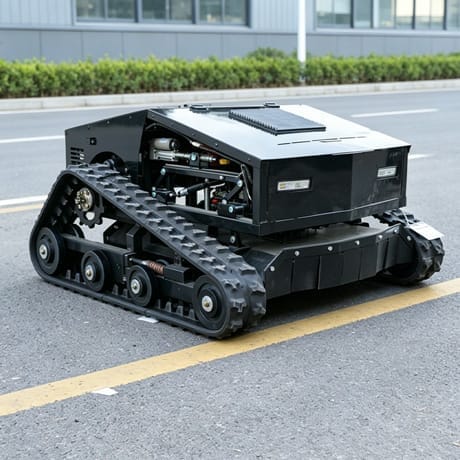
Choose a remote control lawn mower by matching its cutting system, overall dimensions, permitted working slope and control functions to your site. In orchard rows, access width and turning space can decide the shortlist. On embankments, operating limits and ground conditions come first. For contractors, transport weight, service access and the cost of each completed job also matter.
This guide covers operator-controlled wheeled and tracked machines in CSTAR’s wheel and crawler lawn mower range. An operator directs the machine with a handheld transmitter and keeps its work area in view. Autonomous navigation, obstacle avoidance and unattended mowing are separate functions that require their own specifications.
Three useful checks before you request a price:
- For narrow access, compare overall width: CSJ-LB600 lists an 800 mm body width despite its larger cutting pass than the 930 mm-wide CSJ-QL500S.
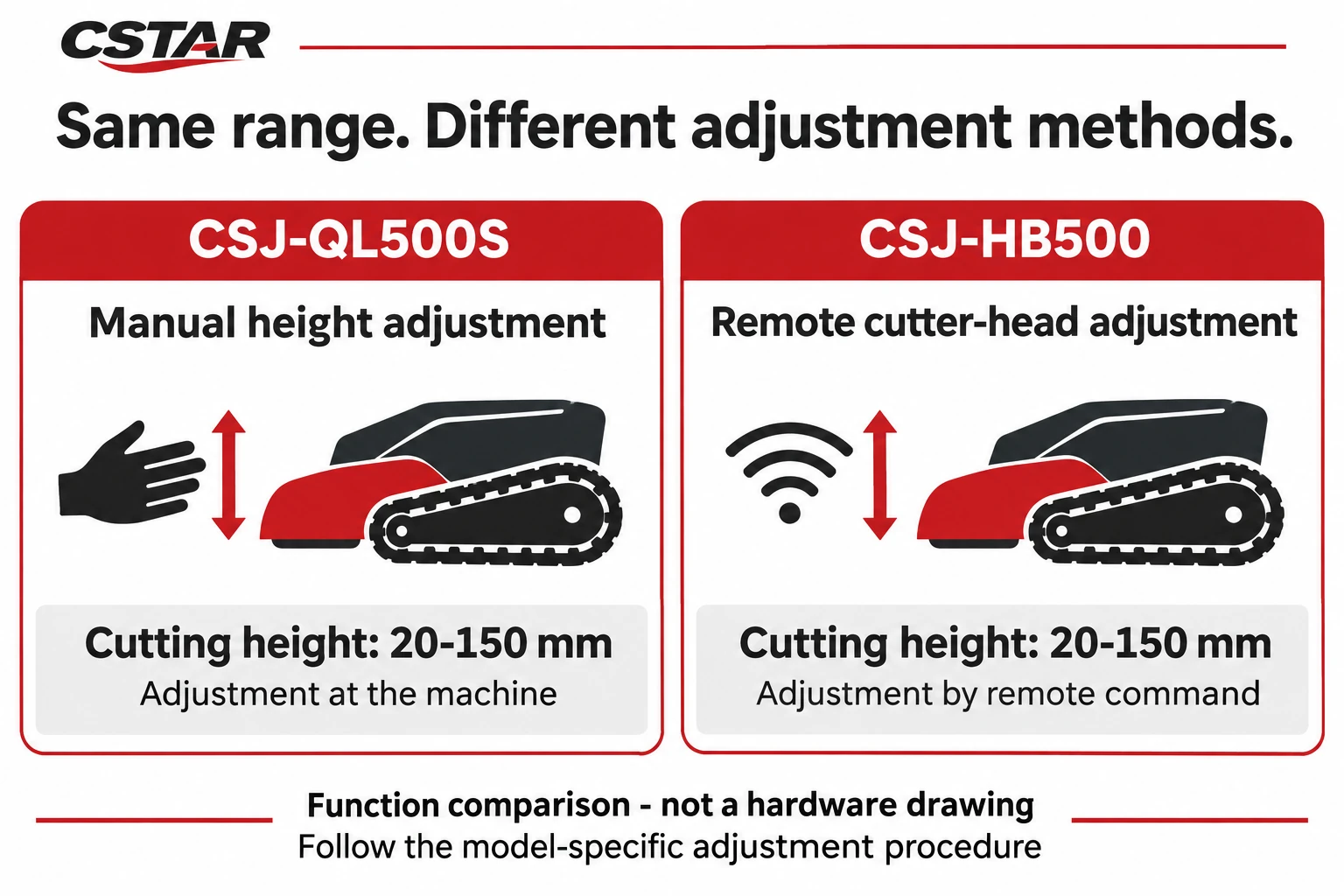
- For frequent height changes, compare the adjustment method: QL500S uses manual adjustment; HB500 lists remote cutter-head lift and lowering.
- For open areas, compare completed area per working hour, including turns and repeat passes, alongside deck width.
Start with the Site and the Vegetation
A mower that performs well on an open embankment can still fail to fit through an orchard gate or bog down in soft irrigation channels. Recording both ground layout and plant material gives suppliers the baseline needed to recommend a workable configuration.
Record the Ground and Access Conditions
Measure the working plot alongside every passage the machine must use to reach it. Record total area, the narrowest gate or doorway, net spacing between orchard rows or solar posts, headland room for turning at the end of a pass, and low overhead clearances beneath tree canopies, trellises, or racking.
Next, note the surface profile: slope gradients, whether the mower must travel up-and-down or across the grade, ditch edges, soft or waterlogged soil, and fixed obstacles such as rocks, stumps, irrigation risers, or guy wires. Include the route from your storage area or trailer to the work zone—ramp angles, vehicle bed dimensions, and loading capacity are part of the site check.
Describe What You Need to Cut
Specify the standing height, stem thickness, density, and moisture level of the vegetation, and note whether the plot contains woody shoots, vines, stones, or hidden debris. Maintained turf cut on a regular schedule places very different loads on the deck and engine than seasonal weeds or matted orchard cover crops.
Record both the standing vegetation height and the finish you need after mowing. The published cutting-height range describes the deck’s cutting position and intended remaining grass height; maximum incoming vegetation height is a separate capability. Share close-up photos of stems and a wider view of the plot.
Which Cutting System Fits Your Vegetation?
Ask whether the quoted deck uses a rotary blade assembly or a flail rotor, and request an underside photo or drawing showing the actual cutting tools. Rotary systems cut with blades sweeping around a vertical axis; flail systems use multiple cutters on a horizontal rotor. Deck design, blade type and available power determine the material a mower can process.
For regularly maintained grass, compare the finish and distribution of clippings. For tall, tangled growth, compare missed stems, repeat passes and clogging. If the job includes woody shoots, obtain a stated cutting-material limit for the specific deck. A tracked undercarriage alone says nothing about brush-cutting capacity.
Manufacturers distinguish these configurations: AS-Motor publishes separate remote rotary mower and remote flail mower specifications. Their vegetation and slope ratings apply to those machines, not to CSTAR models.
Tracks or Wheels?
Compare the actual undercarriage, steering behavior and ground contact for your surface. On maintained turf, inspect scuffing during turns; on rough ground, check traction, rutting and clearance. In CSTAR’s range, CSJ-LB500 and CSJ-LB600 are wheeled models. The QL500S, HB500, LJ800 and HS1000 included in this guide are tracked. Assess slope and ground suitability against the exact model’s operating instructions.
For a focused comparison of three models with the same 500 mm cutting width, read Tracked vs Wheeled Remote Control Lawn Mowers. It compares the LB500, QL500S and HB500 by dimensions, weight and height adjustment.
| Work scenario | Dimensions or features to verify first | Site details to share with the supplier |
|---|---|---|
| Orchard rows and vineyards | Overall machine width, machine height under low branches, headland turning space, and cutting-height adjustment | Net row spacing, lowest branch or wire height, end-of-row turning width, and cover-crop photos |
| Embankments and sloped ground | Tire or track footprint, machine weight, center of gravity, engine lubrication limits, and braking/hold behavior | Measured slope angle (° or %), slope direction, soil firmness, surface moisture, and top/bottom turn areas |
| Fenced compounds and solar sites | Overall width for gate entry, low-profile clearance under panels, and remote signal visibility around metal posts | Narrowest gate width, clearance beneath structures, post spacing, and obstacle layout |
| Multi-site contractor work | Machine weight, overall length/width for trailer loading, and cutting-height range across varied plots | Transport vehicle bed size, ramp capacity, typical plot sizes, and range of grass conditions |
Check What the Remote Controller Actually Operates
Request a function-by-function controller demonstration. These are separate items on the quotation:
- Travel and steering: Forward, reverse, speed control and steering for the quoted wheeled or tracked configuration.
- Engine start and stop: Whether the combustion engine can be started and shut down from the remote handset or requires manual ignition at the machine.
- Blade engagement: How the cutting blades are engaged and disengaged, and whether blade control is independent of travel drive.
- Cutting-deck height adjustment: Whether raising and lowering the cutter head is performed via the remote controller or adjusted manually on the chassis.
Ask which system each start/stop control operates: engine, travel, cutting blades or the complete machine. A listed radio distance also needs its test conditions. The working position must provide the visibility, separation and communication required by the operator’s manual; a long transmission range does not authorize mowing out of sight.
Obtain the exact model’s operator manual and the specified response to an emergency stop, interrupted radio link and low transmitter battery. Confirm what stops, what remains powered, how the mower holds on an incline and how a restart is controlled. Any demonstration of these functions should follow the manufacturer’s procedure in a controlled test area.
Compare Cutting Width with Complete Machine Width
Use the specification table to identify cutting width. A number in a model name may refer to deck size, but gate and trailer fit depend on the complete machine dimensions.
Use Cutting Width to Compare the Cutting Pass
Cutting width measures the swath of grass the blades cut in a single straight pass. It helps you estimate how many passes are needed across an open bay, but it does not tell you the external width of the machine housing, tracks, or side guards, nor does it establish hourly site output on its own.
Use Overall Width for Gates, Rows and Transport
Always check overall machine width, overall length, and overall height as separate figures. A wider cutting width does not automatically result in a wider machine body. For example, on CSTAR’s published product pages, the CSJ-QL500S lists a 500 mm cutting width with a 930 mm overall machine width, whereas the CSJ-LB600 lists a wider 600 mm cutting width within a narrower 800 mm overall machine width.
In a hypothetical 900 mm-wide gateway, the 930 mm-wide QL500S exceeds the opening. The 800 mm-wide LB600 leaves a nominal 100 mm width difference, but its route still needs enough working clearance for guards, steering and uneven ground. Check the full route and turning area as well as the straight opening.

Choose the Cutting-Height Range and Adjustment Method
Two specifications govern cutting height: the millimeter range of the finished cut and the mechanism used to change that setting during the workday.
Match the Height Range to the Required Finish
Verify that the mower’s adjustable height range covers the stubble height required for your ground cover. On rough orchard floors or stony banks, operators often set the deck higher to reduce scalping and blade strikes; on maintained turf, a lower setting may be needed. Remember that a 20–150 mm or 20–100 mm cutting-height range indicates where the blade sits relative to the ground—it does not mean the mower is limited to 150 mm grass, nor does it guarantee single-pass cutting in tall, dense stands.
Manual or Remote Height Adjustment?
Models with the exact same cutting-height range can use different adjustment methods. Within CSTAR’s 500 mm class, both the CSJ-QL500S and the CSJ-HB500 specify a 20–150 mm cutting-height range. However, the CSJ-QL500S uses manual height adjustment on the machine, while the CSJ-HB500 lists remote cutting-head lift and lowering.
Manual adjustment can suit plots maintained at one setting. Remote adjustment is useful when the required height changes between areas, because the operator can send the command from the handset. Follow the model’s procedure for when adjustment is permitted. Raising the deck changes its position; the chassis and tracks still need adequate ground clearance.
Assess Slopes, Traction and Operating Limits Together
When evaluating a remote control slope mower, start by checking how gradient figures are expressed. Slope angle in degrees (°) and slope grade in percentage (%) are different scales—for example, a 100% grade equals 45°, while a 30° angle equals roughly a 58% grade. Make sure your site measurements and the supplier’s specification table use the same unit.
Ask what a published maximum angle describes: climbing, continuous mowing, or travel in a specified direction. Obtain the permitted working angles for the quoted mower and engine, including any different limits for uphill, downhill and cross-slope operation. Wet grass, loose soil, ruts and turning can change traction and stability. Compare the complete machine and operating instructions, not track presence alone.
The BALI safety guide for remote-control mowers on slopes calls for site-specific assessment, adherence to the model’s handbook and manufacturer-specified separation distances. It also says operators must stay out of the area directly above or below an operating machine. Clear throwable debris before mowing, control access by other people, and plan the operating position and recovery procedure before starting.
Understand the Engine, Battery and Power-Supply Arrangement
Identify what powers each function. An engine and a 24 V battery can serve different parts of the same mower, so battery voltage alone is not enough to classify it as battery-electric.
- Cutting drive: Record the blade power source, transmission and engine or motor model.
- Travel drive: Confirm the wheel- or track-drive arrangement and its power source.
- Onboard battery: Record voltage, capacity, battery type and which functions it supplies.
- Charging: Establish whether charging is external, onboard, or both, and which operating conditions the charging system supports.
For a quotation labeled “self-generating” or “self-powered,” request a description of the charging arrangement and any external charging still required. These labels alone do not establish how long the mower can work or which functions remain available with the engine stopped.
Compare fuel runtime, battery endurance and area output separately. Ask which functions were running, the vegetation and terrain, and whether stops were included in any duration claim. For gasoline or diesel configurations, record the complete engine model, local service options and documentation required for the destination market.
Compare CSTAR Models on the Same Basis
The following figures were checked against CSTAR’s product pages on November 17, 2026. Each model link provides the underlying specification. Compare them as published dimensions and settings, with the final ordered configuration recorded on the quotation.
| Model | Chassis | Cutting width (mm) | Overall width (mm) | Machine weight (kg) | Cutting height (mm) |
|---|---|---|---|---|---|
| CSJ-QL500S | Tracked | 500 | 930 | 130 | 20–150 |
| CSJ-LB600 | Wheeled | 600 | 800 | 120 | 20–150 |
| CSJ-HB500 | Tracked | 500 | 900 | 180 | 20–150 |
| CSJ-LJ800 | Tracked | 800 | 1080 | 340 | 20–150 |
| CSJ-HS1000 | Tracked | 1000 | 1250 | 300 | 20–100 |
The table gives three practical ways to narrow a shortlist:
- Start with adjustment method for fixed-width work. QL500S and HB500 share a 500 mm cut and 20–150 mm height range. QL500S uses manual adjustment and weighs 130 kg; HB500 lists remote cutter-head lift and weighs 180 kg. Decide whether remote adjustment is useful to the work before comparing the price difference.
- Start with access dimensions for narrow routes. LB600 combines a 600 mm cut with an 800 mm overall width and 120 kg machine weight. It is narrower and lighter than both 500 mm models in this table, so cutting width alone would give the wrong access shortlist.
- Start with usable pass width for open plots. LJ800 lists an 800 mm cut, 1,080 mm body width and 340 kg weight. HS1000 lists a 1,000 mm cut, 1,250 mm body width and 300 kg weight, with a different 20–100 mm height range. Across these platforms, a wider cut is not automatically a heavier machine or a larger height range.
Compare Remote Control Lawn Mower Prices and Output
Compare what it costs to finish your plot to the required standard. Deck width, purchase price and a catalog area rate each describe only part of that decision.
Separate Theoretical Coverage from Site Output
Theoretical area rate (m²/h) = cutting width (m) × travel speed (km/h) × 1,000. For a hypothetical 0.6 m pass at 3 km/h, the result is 1,800 m²/h before overlap, turns or stops. This is a calculation example, not a CSTAR performance test.
For a useful site comparison, divide the area finished to the agreed standard by the elapsed working time. Include repeat passes, turning, obstacle work, height changes and refueling within the same measurement boundary. Record vegetation height, surface moisture, slope, speed and remaining grass height alongside the result.
A wider deck helps when the route lets it use that width. In narrow rows, the key question can be whether it completes the required strip in one pass and still turns at the end. Ask for the conditions behind any published m²/h figure.
Compare Like-for-Like Quotations
A remote control lawn mower price becomes comparable when quotations cover the same engine model, deck and blade specification, cutting width, height-adjustment method, charging system and controller functions. Align quantity, packing, warranty coverage, spare parts and the named delivery place under the agreed Incoterms.
Separate the machine price from freight, insurance where applicable, import charges and local delivery. Use packed dimensions and gross weight for shipping estimates. For example, CSJ-LJ800 lists a 340 kg machine weight and 430 kg packed weight; CSJ-HS1000 lists 300 kg and 360 kg respectively. Loading equipment and transport capacity need the appropriate figure for the load actually handled.
For running-cost comparisons, record fuel or electricity, operator time, scheduled servicing and wear parts against completed work. Operating cost per 1,000 m² = operating cost for the measured job ÷ completed m² × 1,000. Keep purchase financing or depreciation separate unless every quote comparison includes it on the same basis.
Check Maintenance Access and Spare-Parts Support
Before buying, check how routine cleaning and servicing will be done. Ask for the maintenance schedule and parts diagram for the actual engine, deck and drive arrangement. A mower can suit the plot yet be inconvenient to keep in service if filters, blades or electrical components are difficult to reach or identify.
- Cutting parts: Obtain blade, fastener and mounting specifications, inspection criteria and the approved replacement procedure.
- Undercarriage: For wheeled models, confirm tire and wheel specifications and the required inspections. For tracked models, confirm track dimensions, tensioning instructions and access to rollers and drive components.
- Engine and transmission: Request the specified fluids, filters, service intervals and any belts or other wear parts used on that configuration.
- Remote system: Ask about replacement handset and receiver availability, pairing instructions and fault diagnosis.
- Support terms: Record warranty exclusions, parts prices, dispatch arrangements and who performs local repairs.
Follow the operator manual’s shutdown, energy-isolation and blade-stop procedure before inspection or cleaning. A stopped engine or inactive handset alone is not a complete maintenance isolation procedure.
Request Evidence for Your Shortlist
Ask for a demonstration of the selected configuration in vegetation resembling your site. Record the engine and deck, initial vegetation height, selected cutting height, area completed, elapsed time and finish. Include turning and access behavior, not just a straight pass. Have emergency-stop and signal-loss behavior demonstrated under the manufacturer’s controlled procedure, rather than deliberately interrupting a mower on a bank.
Before dispatch, agree which configuration details, dimensions, controller functions, manuals and supplied spares will be checked. This gives the buyer and supplier a shared acceptance record without treating a generic promotional video as a test of the ordered machine.
Remote Control Lawn Mower Pre-Purchase Checklist
Use the checklist below to organize your site data and technical requirements before requesting quotations.
| Checklist item | Details to record and confirm |
|---|---|
| 1. Area and mowing frequency | Total area to maintain, number of separate plots, and how often each plot is cut per season |
| 2. Vegetation profile | Standing height, density, moisture level, presence of woody stems or stones, and recent site photos |
| 3. Access and clearance dimensions | Narrowest gate or doorway, net row spacing, headland turning width, and lowest overhead branch or structure |
| 4. Slope and surface conditions | Measured slope angle (° or %), mowing direction on the grade, ditch edges, and wet or soft soil zones |
| 5. Cutting width and height setup | Confirmed deck and blade type, preferred cutting width, target remaining grass height, and manual vs. remote height adjustment |
| 6. Remote control functions | Itemized confirmation of remote travel, engine start/stop, blade engagement, and deck lift |
| 7. Engine and power arrangement | Gasoline or diesel preference, complete engine model code, onboard battery voltage, and charging method |
| 8. Loading and transport | Trailer or van door opening dimensions, ramp gradient, and payload capacity for the mower’s weight |
| 9. Safety and market documentation | Operator manual, deck guards and shielding, required operator protection, emergency-stop and signal-loss behavior, and destination-market documents |
| 10. Commercial terms and spares | Order quantity, destination port or address, agreed Incoterms, and initial spare blades, tires or tracks, and other wear parts |
Request a configuration-based mower quotation from CSTAR. Share your vegetation photos, access dimensions, measured slopes, quantity and destination. Include remote height adjustment or other functions you need so the quotation can identify the equipment and support package clearly.
Frequently Asked Questions
What is the difference between a remote control mower and a robotic mower?
A remote control lawn mower needs an operator to direct its movement and cutting functions with a transmitter. An autonomous robotic mower navigates using its own control system. Compare the actual navigation and supervision requirements on the specification, because “remote,” “robotic” and “autonomous” are sometimes used loosely in sales listings.
Is cutting width the same as overall machine width?
No. Cutting width measures the blade path, whereas overall width includes the outer deck housing, frame, wheels or tracks. For example, CSTAR’s CSJ-QL500S has a 500 mm cutting width and a 930 mm overall width, while the CSJ-LB600 has a 600 mm cutting width and an 800 mm overall width.
Does a remote control lawn mower also have remote cutting-height adjustment?
Not on every model. Some remote control mowers adjust cutting height manually on the chassis (such as the CSJ-QL500S), while others include remote cutter-head lift and lowering (such as the CSJ-HB500). Confirm the adjustment method on the specification sheet if your routes require frequent height changes.
Can a crawler lawn mower work on slopes?
A crawler mower can be suitable for slopes within its model-specific operating limits. Confirm permitted mowing angles and directions, traction, engine requirements and stopping behavior for the site. Wet grass, soft ground and edges can make a slope unsuitable even when its measured angle is below a catalog maximum.
Is a 1000 mm mower always more productive than a 500 mm model?
A wider deck can cover more ground per straight pass, but completed output also depends on speed, vegetation, overlap, turns and repeat cutting. HS1000 needs space for its 1,250 mm overall width. Compare timed work on a representative plot once access and operating suitability are established.
How long can a remote control lawn mower run?
Runtime depends on the engine or battery arrangement, load and operating conditions. Ask for fuel runtime and battery endurance separately, including which functions were active during measurement. For a self-generating configuration, confirm what the charging system supplies and any external charging requirement.
What information is needed for a remote control lawn mower quotation?
Share vegetation photos, plot size, mowing frequency, narrowest access width, measured slopes and required finish. Add the remote functions, engine preference, order quantity and destination. Request an itemized quotation covering the selected configuration, packing, spares, warranty terms and agreed delivery basis.
What affects the price of a remote control lawn mower?
Compare engine and cutting-system specifications, deck width, height adjustment, drive and charging systems, controller functions and support scope. Freight depends on packed size, weight and route. A useful price comparison identifies exactly what is included and the cost to deliver it to the agreed destination.