
A remote control lawn mower budget has two parts: the delivered purchase cost and the expense of completing your mowing work. Start with the exact machine configuration, identify which delivery and accessory costs the quotation includes, then calculate running costs separately.
The most useful remote control lawn mower price is attached to a defined build and delivery scope. This guide explains which configuration differences to compare, how to budget for delivery without counting charges twice, and how to measure operating expense on your own site.
What Should Your Remote Control Mower Budget Cover?
Build your purchase budget around the selected machine, its delivery to the agreed destination, and the items needed to put it into service. Ask for each inclusion and separately charged item to be identified on the quotation.
- Machine configuration: Record the model, engine, cutting system, chassis, height-adjustment method and remote functions.
- Packing and transport: Identify crating, origin handling, international carriage and the delivery point covered by the offer.
- Destination costs: Check the clearance, import charges, local delivery and unloading that remain outside the supplier’s scope.
- Initial accessories and spares: List the charger, manuals, tools and replacement parts you want supplied. Confirm which are included.
Keep the delivered purchase budget separate from fuel, operator time and ongoing maintenance. This makes it easier to see both what you pay to receive the mower and what you spend using it.

What Changes the Cost of a Remote Control Lawn Mower?
Look for the configuration difference behind each quoted amount. Two machines with the same cutting width can have different control functions, power arrangements and supplied equipment.
- Engine and cutting system: Compare the exact engine, cutting-tool arrangement, deck and drive components. Ask how the quoted build matches your vegetation and required finish; engine output alone does not establish cutting ability or durability.
- Undercarriage: Wheels, tracks and their drive components create different configurations and replacement-parts requirements. Compare complete machines rather than assuming that every tracked model costs more or performs better on your ground.
- Cutting-height adjustment: Manual adjustment and powered remote adjustment require different equipment. Remote adjustment can be useful when the required cutting height changes between parts of a site; it does not establish obstacle-crossing capability.
- Remote functions: List travel, engine start/stop, blade engagement and cutter-head lift separately. A remote-control label does not confirm that all four functions are included.
- Charging and support package: Identify what the onboard charging system supplies and whether external charging is also needed. Compare included chargers, manuals, tools, spare parts and support terms rather than relying on a self-generating label.
How Do CSTAR Mower Configurations Compare?
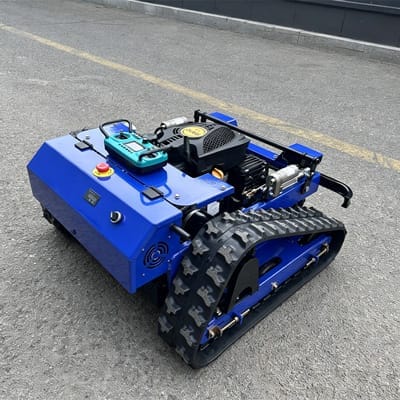
Across CSTAR’s lineup, the CSJ-LB500 and CSJ-LB600 use wheeled chassis, while the remaining models—including the CSJ-QL500S and CSJ-HB500—use crawler tracks. Comparing these four representative models shows how dimensions, weight, and control features align with different purchasing priorities.
| Model & chassis | Cutting width / Overall width | Published height and control details | Reference quote configuration | Purchasing priority to compare first |
|---|---|---|---|---|
| CSJ-LB500 (Wheeled) | 500 mm cut / 880 mm overall width (105 kg) | Non-self-generating version: 70 mm listed cutting height and remote start/stop; adjustment method not specified | Non-self-generating wheeled version; specify charging equipment in the quotation | Lowest listed machine weight among these four configurations: 105 kg. Check the selected version’s packed weight for transport. |
| CSJ-LB600 (Wheeled) | 600 mm cut / 800 mm overall width (120 kg) | 20–150 mm cutting-height range; itemize the required remote functions in the quotation | 600 mm wheeled build within an 800 mm overall width | 600 mm cutting width with an 800 mm overall body width; allow additional route and steering clearance |
| CSJ-QL500S (Tracked) | 500 mm cut / 930 mm overall width (130 kg) | 20–150 mm cutting height with manual adjustment; remote start/stop listed | 500 mm crawler build with manual height setting | Tracked undercarriage and 20–150 mm range when sites run at one consistent cut height |
| CSJ-HB500 (Tracked) | 500 mm cut / 900 mm overall width (180 kg) | 20–150 mm cutting height with remote cutter-head lift and lowering | 500 mm crawler build with powered remote deck height control | Work areas requiring different cutting-height settings; check the permitted adjustment procedure |
For a deeper breakdown of chassis behavior, slope considerations, and gate measurements, review our Remote Control Lawn Mower Buying Guide and our side-by-side tracked vs wheeled remote control lawn mower comparison.
What Should You Include in the Delivered Purchase Budget?
Your delivered budget starts with the supplier’s quotation. Add only the items it leaves outside scope. Use the same quantity, configuration, packing and named destination when requesting transport estimates:
- Machine and confirmed options: The mower and every agreed option, with the transmitter, charger and other supplied items identified individually.
- Export packing and international transport: Crating, origin handling, main carriage and any cargo insurance. Confirm the allocation under the named delivery term and the actual freight offer.
- Customs clearance, import duties, taxes, and local delivery: Check the destination handling, clearance, import charges and local delivery that your supplier or forwarder has not already included.
- Unloading arrangements at destination: Plan unloading using the selected configuration’s gross packed weight, crate dimensions and the unloading equipment’s rated capacity. Machine weight alone is not the shipping load.
- Initial wear-parts kit: Select compatible blades, fasteners, belts, service filters or running-gear parts from the model’s parts list. Ask whether they can share the shipment and how they affect packed size, weight and freight.
| Budget line | What is covered | How to prevent double counting |
|---|---|---|
| Item A: Base machine & crating | The agreed mower configuration and any quoted transmitter, tools and export crate | Verify if export crating is inside the unit price or billed as a separate line |
| Item B: Initial spare parts | The initial parts package and its actual packing arrangement | Check whether the parts alter packed volume, gross weight or the freight charge |
| Item C: International freight & insurance | Origin handling, main carriage and insurance that are outside the equipment quotation | Do not add charges already included; for a CIF offer, check the included main carriage and insurance before adding freight |
| Item D: Destination customs & taxes | Destination terminal fees, customs clearance, import duty, and local taxes | Check your forwarder’s quote so destination port fees are not counted twice |
| Item E: Local delivery & offloading | Final truck delivery from port/terminal and forklift or liftgate offloading | Confirm whether your local trucking quote includes liftgate or crane service |
| Total Delivered Budget | Add only the separately payable items from A to E. Use the same currency and order scope; obtain freight estimates for the actual packed dimensions and gross weight. | |
For the delivery terminology, see the ICC Incoterms rules overview. Record the chosen term and named place in the order.
How Much Does It Cost to Operate the Mower?
Measure the expense of finishing a representative plot to the required standard. Track the cost inputs below and use one consistent boundary for time and completed area:
- Fuel and charging electricity: Fuel used and any external charging electricity consumed by the actual configuration. Keep the measurement period consistent.
- Operator labor hours: Count the agreed job activities, such as setup, mowing, refueling and cleaning, once in the operator’s total time.
- Blades and consumable wear parts: Allocate replacement blades, fasteners and other fitted wear parts by their recorded service life; do not charge the full spare-parts purchase to every job.
- Scheduled maintenance: Allocate the servicing required by the actual engine, cutting system and chassis over their service intervals.
- Time and area record: Include turns, repeat passes and stops within the chosen job boundary. Use elapsed time to calculate labor rather than adding it as another cost.
Operating cost per 1,000 m² = (Total job operating expense ÷ Completed area in m²) × 1,000
Record the vegetation, ground conditions, cut setting and finished area alongside the expense. This gives you a site-specific comparison. If you also include depreciation, financing or transport to the work site, list them separately and apply the same basis to every alternative.
How Can You Compare Two Supplier Quotations Fairly?
When two suppliers quote different prices for a “500 mm remote control mower,” normalize five items before deciding which offer represents better value:
- Identical configuration baseline: Same chassis type, engine specification, cutting-height adjustment (manual vs. remote), and charging setup (self-generating vs. non-self-generating).
- Identical order quantity: Single-unit sample pricing versus multi-unit container or dealer pricing.
- Identical delivery point and Incoterms: Comparing EXW factory against EXW factory, or FOB port against FOB port.
- Identical accessories and crating scope: Confirming whether spare blades, charger, tool kit, and export crating are built into both totals.
- Clear warranty, spare-parts, and payment terms: Written warranty coverage, parts availability, and deposit/balance milestones.

| Quotation line | Quote A | Quote B |
|---|---|---|
| Chassis & deck lift | 500 mm tracked mower with manual height adjustment | 500 mm tracked mower with remote cutter-head lift and lowering |
| Charging setup | External charging arrangement specified | Onboard charging included; specify what it supplies |
| Export packing & spares | Bare machine; crating and spare blades billed extra | Export crate, spare blade set, and filter kit included |
| Trade term | EXW named place; confirm the buyer’s remaining collection and transport costs | FOB named port of shipment; identify the remaining freight and destination costs |
These are hypothetical offers, not quotations for the CSTAR models above. Request matched configurations and a common delivery scope, then compare the revised totals. The result may differ from the initial headline comparison.
Request a Configuration-Based Mower Quote
To receive an itemized quotation matched to your site rather than a generic price list, share four details with CSTAR:
- Recent site photos showing ground surface, slope profile, vegetation height, and approximate working area
- Narrowest gate or row opening along with your transport vehicle’s loading dimensions and weight limit
- Required remote control functions (such as remote engine start/stop or remote cutter-head lift)
- Order quantity and your destination port or delivery address
You can browse candidate models across CSTAR’s wheel and crawler lawn mowers range, or contact CSTAR directly with your site parameters for a configuration quote.
Frequently Asked Questions
Does the mower price include shipping?
Check the agreed delivery term, named place and itemized scope. An EXW collection offer and a CIF destination-port offer cover different parts of the journey. Neither the product name nor a headline amount tells you whether local delivery, unloading or import charges are included.
Does remote control include cutting-height adjustment?
Not on every model. QL500S lists manual cutting-height adjustment, while HB500 lists remote cutter-head lifting and lowering. Specify travel, starting, blade engagement and height adjustment separately when requesting a quotation.
Is a wider mower always more expensive?
No. Cutting width is one part of the configuration. Engine, chassis, adjustment method, control functions and the supplied package also affect the offer. Compare actual matched quotations rather than assuming a wider deck must cost more.
What spare parts should I include in the first order?
Start with compatible blades and fasteners, then the service filters, belts and running-gear parts used by your selected model. Ask for part numbers, quantities, dispatch options and the effect on packed size and freight. Parts packed with the mower are not automatically freight-free.
What information is needed for an accurate quotation?
Provide your vegetation height and site photos, narrowest gate or row width, slope conditions, required remote functions (such as remote deck lift), order quantity, and destination port or delivery address. Those details allow the supplier to quote the exact model configuration and delivery scope your budget needs.