
A remote control lawn mower is directed by an operator using a handheld transmitter. An autonomous lawn mower uses a navigation and control system to carry out part or all of the mowing route. The buying decision depends on how you want the work to be directed, how often the site changes, and how much setup and operator time each system needs.
CSTAR offers Standard, Industrial and Advanced Industrial remote controller options, as well as GPS-equipped mower configurations. The main difference between the three controller options is control range. Compare the controller package and any navigation functions separately when selecting from our wheel and crawler lawn mower range.
| Comparison point | Remote control lawn mower | Autonomous mowing system |
|---|---|---|
| Operation method | Operator directs travel, steering, and equipped mowing actions via a handheld controller | Navigation and control system directs travel within its configured work area or route |
| Operator involvement | Operator actively directs the mower and monitors the working area | Site setup, monitoring, exception handling and intervention as specified for the system |
| Initial setup | Site preparation, pre-start inspection and transmitter checks | Pre-start checks plus the boundary, mapping or navigation setup required by the model |
| Moving between sites | Inspect and prepare each site; manual steering does not require an autonomous route map | Create or recall the correct site configuration and check it before starting |
| Navigation capability | Operator-directed travel; additional assistance functions depend on the configuration | Defined by the navigation software, positioning method and fitted sensors |
| Pre-purchase demonstration | Actual controller, fitted functions, range-test conditions and approved stopping procedures | Work-area setup, route execution, intervention and recovery procedures |
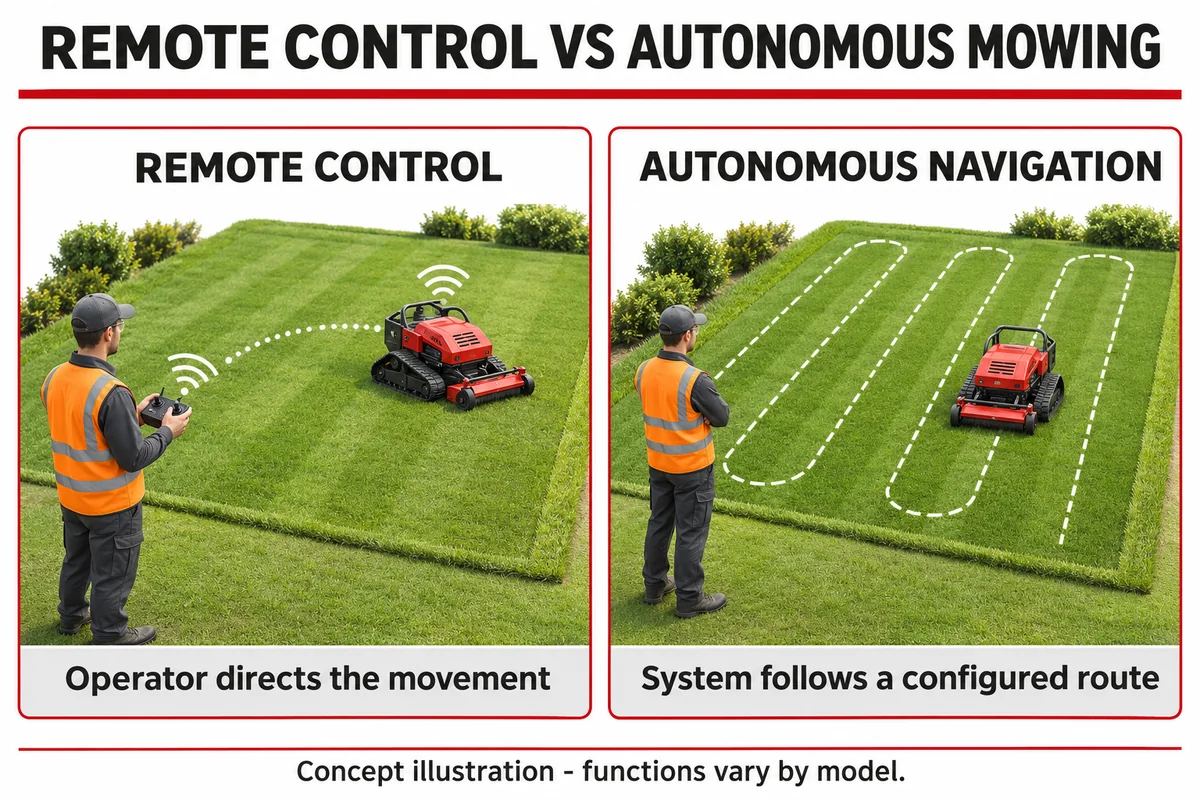
What Is the Difference Between Remote Control and Autonomous Mowing?
Start with the operating instructions: which movements does the operator command, and which tasks can the machine carry out through its own control system? The word “robotic” alone does not settle this question.
For example, RC Mowers calls its operator-controlled range remote-operated robotic mowers. Compare the described operating mode alongside the product name.
Operator-Controlled Mowing
With a remote control mower, the operator stands off the machine and commands travel direction, steering, speed, and any equipped mowing functions through a wireless transmitter. When reviewing a remote control configuration, keep three distinct questions separate:
- How far can the machine receive a control signal? Published remote control mower range figures describe wireless transmission distance under stated test conditions, not how far away an operator should stand in every field.
- What working conditions must the operator see? Plan a position and route that provide the view and separation required by the operating manual, including visibility of edges, obstacles and other people.
- Which functions does the remote controller actually operate? Confirm item by item whether the handset controls only travel and steering, or also operates engine start/stop, blade engagement, and cutting-deck lifting and lowering.
Autonomous Mowing
Autonomous mowing systems use their navigation and control equipment to direct travel within a defined operating area. Compare how a complete job is prepared, executed and supervised:
- Zone and route setup: How the operator defines outer work boundaries, no-go zones around obstacles, and pass spacing.
- Task storage and repeatability: Whether completed maps and mowing plans can be saved and recalled for future cutting cycles on the same plot.
- Turns, boundaries, and exception handling: How the mower executes row-end turnarounds, stays inside perimeter edges, and responds when it encounters thick vegetation, a slipped track, or an unexpected obstacle.
- Ongoing operator responsibilities: What supervision, pre-mow debris clearing, refueling or charging, blade inspection, and undercarriage cleaning still require staff on site.
Setup is part of the comparison. For example, Husqvarna’s commercial EPOS onboarding guide covers installation, work areas and mowing schedules for its system. Use the instructions for the actual model when estimating this preparation time.
How Do CSTAR’s Three Remote Controller Options Compare?
CSTAR’s three choices are Standard Remote Controller, Industrial Remote Controller and Advanced Industrial Remote Controller. Their main difference is the control range. Start with the operating position and the distance your site requires, then have the selected controller identified on the quotation.
The photographs below show three controller designs. They help buyers recognize the handset being discussed; the quoted configuration should also identify its range, compatible mower and controllable functions.


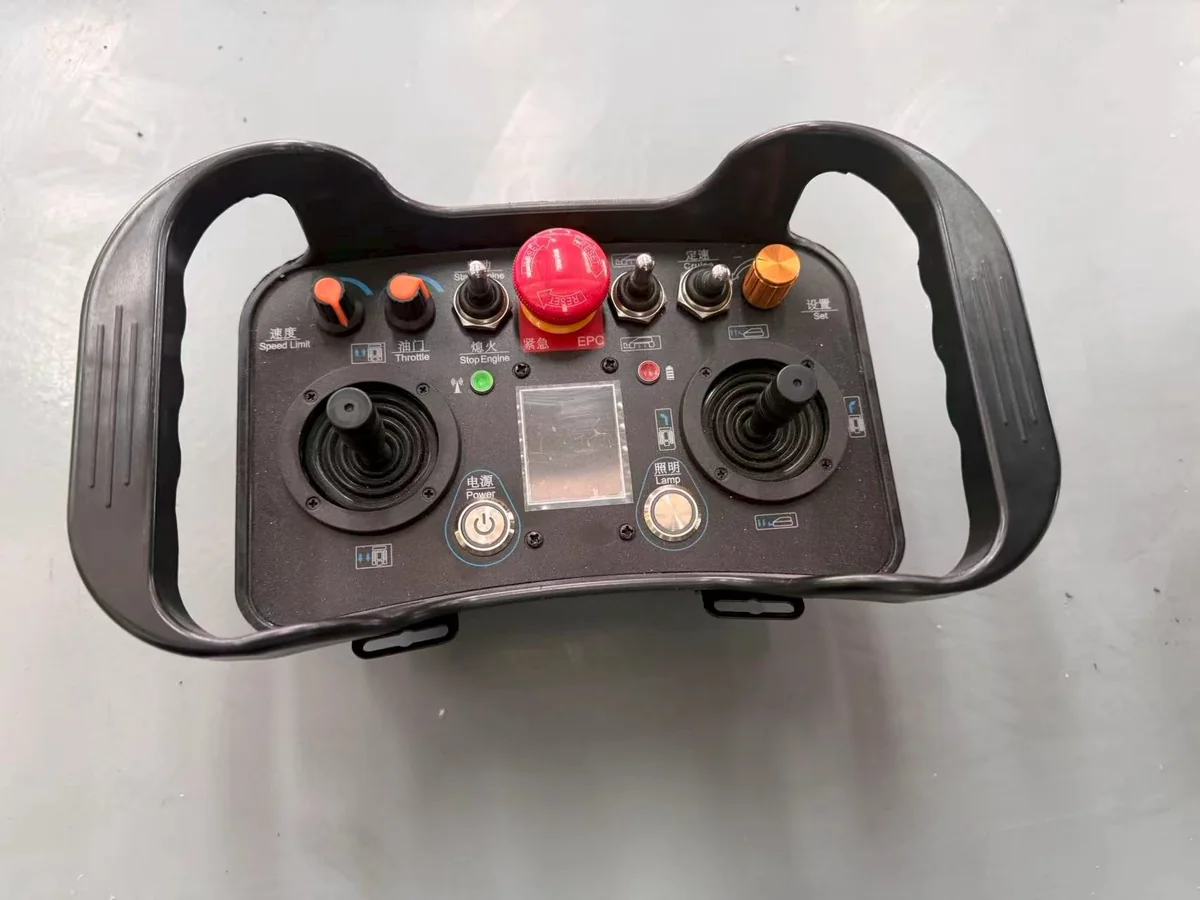
Range is one part of the choice. List engine start/stop, blade engagement, travel-speed adjustment and cutting-height adjustment as separate functions on the order. A longer-range handset does not itself add autonomous navigation or a remotely operated height-adjustment mechanism.
What Does GPS Add to a Lawn Mower?
GPS provides position information; the complete guidance or control system determines how the mower uses it. A GPS lawn mower should therefore be compared by its actual functions and operating workflow.
Positioning, Route Guidance or Automatic Mowing?
Use four separate questions when evaluating a GPS-equipped mower, including a CSTAR GPS configuration:
- Position display or tracking: Viewing or logging where the machine is located on a site map without automating steering.
- Route guidance or assisted driving: Helping the operator maintain straight passes or monitor coverage while retaining active control.
- Area boundary setup and path planning: Defining plot perimeters, obstacles, and planned mowing lines in software or a controller.
- Automatic driving and repeatable mowing tasks: Executing stored mowing routes automatically within the mapped zone under defined supervision rules.
These are separate functions to identify in the equipment specification, not four standard grades of GPS mowing.
What Should Buyers Confirm About the GPS Configuration?
Beyond what the GPS package does on screen, verify how it operates in your local environment:
- Positioning method and hardware: Identify whether RTK (Real-Time Kinematic) positioning is included, how any correction data is supplied, and which base station, antennas or control device are part of the package.
- Creating, saving, and editing work zones: Check how an operator records boundaries (for example, by driving the perimeter manually or plotting coordinates), how many zones can be stored, and how quickly a boundary can be edited if obstacles change.
- Connectivity and recurring services: List any required SIM card, Wi-Fi connection, positioning-correction service or software subscription, including availability and charges in the destination country.
- Positioning and communication faults: Document the system response to degraded positioning or a lost control link, the approved intervention procedure, and how a task can be resumed.

Which Control Method Fits Your Working Routine?
Compare each control method against the way your team actually works: changing routes, repeat visits, setup time and the amount of active operator attention required.
Sites Requiring Frequent Operator Decisions
On sites where routes and work areas change frequently, direct remote operation lets the operator choose each pass and adjust the route during the job. Compare how easily the fitted controller handles the required travel, speed and mowing adjustments. The site still needs preparation, debris removal and the exclusion distances specified for the machine.
Repeated Mowing of a Defined Area
For repeated mowing of a defined compound, open grass area or turf block, compare the effort needed to create and maintain a work-area configuration with the time it saves on later visits. Include changes to obstacles, boundary checks and any intervention needed during a run. A repeatable navigation function is useful when it fits both the site and the team’s working routine.
Contractors Moving Between Multiple Sites
For mobile contractors servicing several properties each week, evaluate four practical workflow factors:
- Arrival preparation time: How long it takes from unloading off the trailer to cutting the first pass—including any base-station setup or boundary verification.
- Map and task reuse: Compare recurring visits that can reuse a site configuration with one-off jobs requiring a new setup. Measure preparation time for both approaches.
- Transport, inspection and site access: Include loading equipment, pre-start inspection and the control method used through entrances and loading areas.
- Actual operator time required: Whether safety policies still require an operator to stay on site watching the machine, which affects how much labor an autonomous mode actually frees up.
Keep physical machine capability separate from the control method: slope limits, cutting width, chassis dimensions, and vegetation handling still depend on the specific mower model rather than a “remote control” or “robotic” label. For a complete walkthrough of matching machine size, cutting height, and terrain, see our Remote Control Lawn Mower Buying Guide.
How Should You Compare Purchase and Operating Costs?
Compare the complete control package against the same mowing workload. A useful purchase and operating budget separates six components:
- Machine and controller build: The base mower chassis paired with the Standard, Industrial, or Advanced Industrial remote controller tier.
- GPS, navigation, and supporting hardware: Onboard receivers, antennas, base stations, or control tablets required for the quoted navigation setup.
- Setup, commissioning, and operator training: Time and support needed to train operators on mapping, route editing, safety stops, and manual takeover.
- Operator and supervision labor: Paid staff hours for active remote driving versus on-site setup, monitoring, and exception handling.
- Energy, routine maintenance, and spare parts: Fuel or charging electricity, blades, belts, filters, tires or tracks, and replacement remote or sensor components.
- Software, cellular data, or correction subscriptions: Include these lines only when the specific navigation system requires paid network access or recurring licenses.
For a full breakdown of export crating, freight terms, destination taxes, and delivered budget worksheets, refer to our remote control lawn mower cost and buying budget guide.
What Should a Supplier Demonstration Show?
Before finalizing an order for a specific controller tier or GPS package, ask the supplier for an unedited demonstration video covering six points:
- Exact hardware being delivered: Show the actual handheld controller tier and the exact mower model code listed on your quotation.
- Core driving and cutting controls: Demonstrate travel and steering, plus the fitted engine, blade and deck-adjustment functions named on the quotation.
- Recorded range test conditions: When demonstrating remote control mower range, state the terrain, line-of-sight setup, and surrounding obstacles rather than quoting an isolated distance figure.
- Stopping and recovery: Ask a trained demonstrator to show the manufacturer-approved stopping, control-link fault and recovery procedures in a controlled test area, following the operating manual.
- Quoted GPS functions: Demonstrate the functions included in the order. For a navigation package, this can include work-area setup, task execution, row-end turns and approved operator intervention.
- Comparable ground and vegetation: State the machine configuration, ground slope, and grass density shown—do not treat unloaded driving on flat concrete as proof of real mowing performance.
What Should You Send Before Requesting a Quote?
Sharing clear operational details allows a supplier to match the right mower chassis, remote controller tier, or GPS configuration to your job:
- Total working area, number of separate plots, and recent site photos
- Grass height, vegetation density, mowing frequency, and required finish
- Narrowest gate or row width, overhead clearances, obstacles, and measured slope angles
- Whether you want continuous operator remote control, assisted positioning, or verified autonomous route execution
- Your preferred remote controller tier (Standard, Industrial, or Advanced Industrial)
- Order quantity and destination port or delivery address
Contact CSTAR with your site conditions and control requirements to request a configuration-based quotation.
Frequently Asked Questions
Is a remote control lawn mower the same as a robotic mower?
Check the operating mode, not the name alone. A remote-controlled mower is directed by an operator, while an autonomous system carries out specified travel tasks through its navigation and control equipment. Some manufacturers also use “robotic” for remote-operated machines, so the specification should describe who directs the mowing route.
Does a longer remote control range mean the mower is autonomous?
No. A longer radio-control range changes the communication distance; it does not itself add route planning or automatic steering. Any assistance or autonomous functions must be specified separately.
Does a GPS lawn mower automatically plan and follow mowing routes?
The GPS label alone does not establish that capability. Position display, route guidance, area setup and automatic route execution are separate functions of the complete system. Compare the functions included in the selected package.
What is the difference between CSTAR’s three remote controller options?
CSTAR offers Standard, Industrial and Advanced Industrial remote controller options. Their main difference is control range. The quotation should identify the selected handset, its stated range and test conditions, compatible mower and controllable functions.
Can a GPS mower also be operated manually by remote control?
This depends on the control package. Establish whether manual remote operation is included, which functions the handset operates, and how the operator changes mode or intervenes during a task.
Can an existing mower be upgraded to another controller or GPS configuration?
An upgrade needs a technical compatibility review. Provide the mower model, serial number and current controller details so the transmitter, receiver, machine controls and required installation work can be assessed before an upgrade is quoted.