
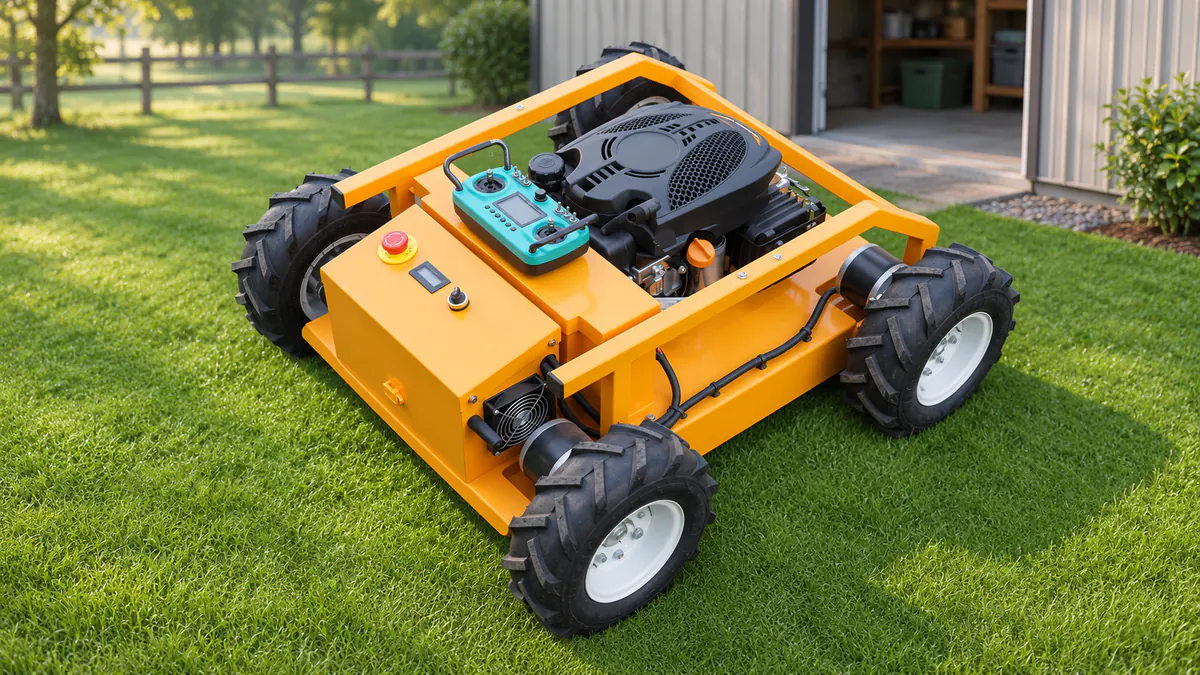
Choosing between a self-generating and a non-self-generating remote control lawn mower comes down to three practical checks: your charging setup, your daily mowing schedule, and the transport weight your crew can handle. Both versions use an onboard battery and require an operator with a handheld controller—the real difference is how electrical power is replenished and how each complete build is configured around it.
On CSTAR’s published specifications for the wheeled CSJ-LB500, the non-self-generating version lists a 24 V / 70 Ah battery and a 105 kg net weight, while the self-generating version lists a 24 V / 40 Ah battery and a 115 kg net weight. Read these battery figures alongside the charging arrangement, daily electrical demand and loading limits. The comparison below connects the published differences to the checks that matter when placing an order.
What Does Self-Generating Mean on a Remote Control Mower?
For the LB500, “self-generating” identifies the version with an onboard generating system. The non-self-generating version requires a charging routine planned around its battery and supplied equipment. Compare how each arrangement fits your available charging access:
- Self-generating: Confirm how the onboard generating and charging system participates during operation, which functions it supports while running, and whether any external charging is still needed for storage or recovery.
- Non-self-generating: Confirm the external charging routine between shifts, the charger’s electrical specification, recharge time, and whether mains power is available where the mower is stored.
When reading any specification sheet, separate four items and verify each one in writing:
- Engine: Fuel type, engine model, and what it drives.
- Onboard battery: Voltage, capacity (Ah), battery type, and which electrical functions draw from it.
- Travel drive system: Wheel or track drive motors and controller arrangement.
- Charging equipment: Onboard generating hardware, external charger, or both.
A complete quotation identifies the power source for each function and the charging equipment supplied with the mower. For broader selection checks such as access clearance, slope limits, or remote functions, see our remote control lawn mower buying guide.
CSJ-LB500 Comparison: Battery, Weight and Dimensions
Comparing both listed versions of the same model on the CSTAR CSJ-LB500 product page shows how the two configurations differ in published hardware figures.
| Specification | CSJ-LB500 (Non-Self-Generating) | CSJ-LB500 (Self-Generating) |
|---|---|---|
| Chassis | Wheeled | Wheeled |
| Voltage / battery capacity | 24 V / 70 Ah | 24 V / 40 Ah |
| Net weight | 105 kg | 115 kg |
| Gross weight | 135 kg | 150 kg |
| Overall dimensions (L × W × H) | 980 × 880 × 460 mm | 1,020 × 880 × 490 mm |
| Packing dimensions (L × W × H) | 1,030 × 930 × 630 mm | 1,070 × 930 × 630 mm |

Four procurement points follow directly from these published figures:
- Overall width is unchanged: Both versions measure 880 mm wide, so straight gate or path width does not change between them.
- Length and height increase slightly: The self-generating build adds 40 mm in length (1,020 mm vs. 980 mm) and 30 mm in height (490 mm vs. 460 mm). Check tight vehicle beds or low storage clearance against the exact version you plan to buy.
- Handling and shipping weights differ: The self-generating version adds 10 kg in net weight (115 kg vs. 105 kg) and 15 kg in gross packing weight (150 kg vs. 135 kg). Match ramps, suitable loading equipment and freight quotations to the selected version.
- Differences reflect complete builds: Because the two versions differ in battery capacity as well as onboard charging hardware, the 10 kg net increase belongs to the complete configuration and should not be attributed to a generator alone.
Parameters listed specifically under the non-self-generating CSJ-LB500 specification—such as the RV225 power unit, 500 mm cutting width, 70 mm listed cutting height, and 4–5 hours listed battery endurance—apply to that listed record. Confirm the exact engine, cutting width, cutting height, and remote functions on the quotation when ordering the self-generating version.
How Does Each Configuration Fit Your Working Routine?
Compare the configuration against how your crew charges, moves and loads the mower each week. Three working routines make the differences easier to evaluate.
Returning to a Fixed Charging Point Every Day
Returning to a fixed shop, garage or depot gives you a defined window for charging between shifts. Check whether your overnight or midday charging window covers the charger’s recharge time, and whether one full charge meets the day’s electrical load with margin for maneuvering.
Moving Between Multiple Plots in One Day
When a crew works across several disconnected sites with no mains power on location, compare how travel between plots, stops, and site access affect available working time. For a self-generating build, verify how the generating system performs under real mowing load rather than at idle.
Frequent Loading and Unloading
If operators load and unload the mower into a van or light trailer several times a day, physical dimensions and weight become daily workflow factors. Check your ramp rating, vehicle bed length, and lifting equipment against the exact net weight (105 kg vs. 115 kg), overall size, and initial delivery gross weight (135 kg vs. 150 kg).
| Working Routine | Key Points to Verify |
|---|---|
| Daily return to a fixed charging point | Available charging window, local voltage/plug match, and whether one charge covers the shift |
| Multiple plots in one day without mains power | On-site charging access, travel and stop time, and generating performance under mowing load |
| Frequent van or trailer loading | Net weight vs. loading-equipment limits, overall length and height, and gross weight for initial offloading |

Compare completed work, charging stops and loading time together. Choose the configuration that fits your charging access and loading limits within the working day you have available.
Battery Endurance, Fuel Runtime and Mowing Output
Keep three separate measurements clear when reviewing any specification sheet:
- Battery endurance: How long specific electrical functions ran on battery power before recharging.
- Fuel runtime: How long the fuel supply lasted under actual grass, terrain, and load conditions.
- Mowing output: How much area was finished to the required standard in a measured working period, including turns, overlap, stops, and repeat passes.
On the CSJ-LB500 page, the published “4–5 hours” figure describes battery endurance for the non-self-generating version. Ask for the test conditions behind that figure, including which functions were active. Do not treat it as a guarantee of continuous mowing across every grass condition or apply it to other builds.
Both electrical endurance and fuel supply ultimately serve one procurement question: Can the quoted configuration finish your required area within the available working hours? For a step-by-step method to estimate completed area per hour and whole-job time, see our remote control lawn mower mowing efficiency guide.
What Should a Supplier Demonstration Show?
Ask the supplier for observable, recorded evidence on the exact configuration being quoted:
- Exact version match: Confirm the demonstrated mower is the same version (self-generating or non-self-generating) written on the quotation.
- Functions by engine state: Observe which controls work with the engine running and which remain available with the engine stopped.
- Generating and charging identification: Review clear photos or video of onboard charging labels, the included external charger, and matching manual pages.
- Representative working record: Note starting and ending battery state, elapsed working time, and any stops during a run on comparable ground.
- Manual alignment: Confirm that demonstrated operating and charging steps follow the written operator manual.
Compare the Complete Quotation
Compare complete commercial packages, including the mower, charging equipment, batteries, packing and requested spares. Align the following items so the quotations cover the same supply scope.
| Quotation Item | What to Confirm in Writing |
|---|---|
| Model and version | Exact model name explicitly stating self-generating or non-self-generating |
| Engine and fuel | Engine brand, complete model code, and fuel type |
| Onboard battery | Battery type/chemistry, voltage, and capacity (Ah) |
| Generating & charging scope | Onboard generating/charging setup (if fitted) and whether an external charger is included |
| Charger electrical specs | Input voltage, frequency (50/60 Hz), and plug standard for destination country |
| Cutting & remote setup | Cutting width, cutting height and adjustment method, and itemized remote functions |
| Packing & commercial terms | Packing dimensions, gross weight, spare parts, warranty coverage, and delivery terms |
To compare machine configuration alongside export crating, initial spares, and freight within one delivered budget, read our remote control lawn mower cost and buying budget guide.
Frequently Asked Questions
Does a self-generating remote control mower still use a battery?
Yes. A self-generating build still carries an onboard battery—for example, the self-generating CSJ-LB500 lists a 24 V / 40 Ah electrical system. Confirm the battery type, capacity, and any external maintenance-charging requirements on the quotation.
Does a 70 Ah battery automatically mean longer mowing time than a 40 Ah battery?
No. Amp-hour capacity is only one variable. Total working time also depends on whether an onboard generating system recharges the battery during work, how much load the terrain places on the drive motors, and how refueling and stops fit into the shift.
Does self-generating mean automatic charging-station docking?
No. Self-generating describes an onboard power-supply arrangement on the mower, not autonomous navigation or automatic return-to-dock charging. Remote control mowers are directed by an operator using a handheld transmitter; automatic docking and unattended operation belong to separate autonomous systems with their own specifications.
What should I specify when requesting an LB500 quotation?
State whether you want the CSJ-LB500 non-self-generating or CSJ-LB500 self-generating version, or ask for both side by side. Include your required cutting height, remote functions, local charger voltage and plug type, spare parts, order quantity, and delivery destination.
Request a Version-Specific Quotation
To compare self-generating and non-self-generating configurations for your site, send CSTAR the following details:
- Plot area and available working hours per day.
- Vegetation photos and expected mowing frequency.
- On-site or depot charging conditions, including local voltage and plug standard.
- Loading equipment, vehicle dimensions, and weight limits.
- Required remote-control functions and cutting-height setup.
- Order quantity and delivery destination.
Contact CSTAR to request a configuration-based quotation covering the exact version, charging package, packing details, and requested spares.