
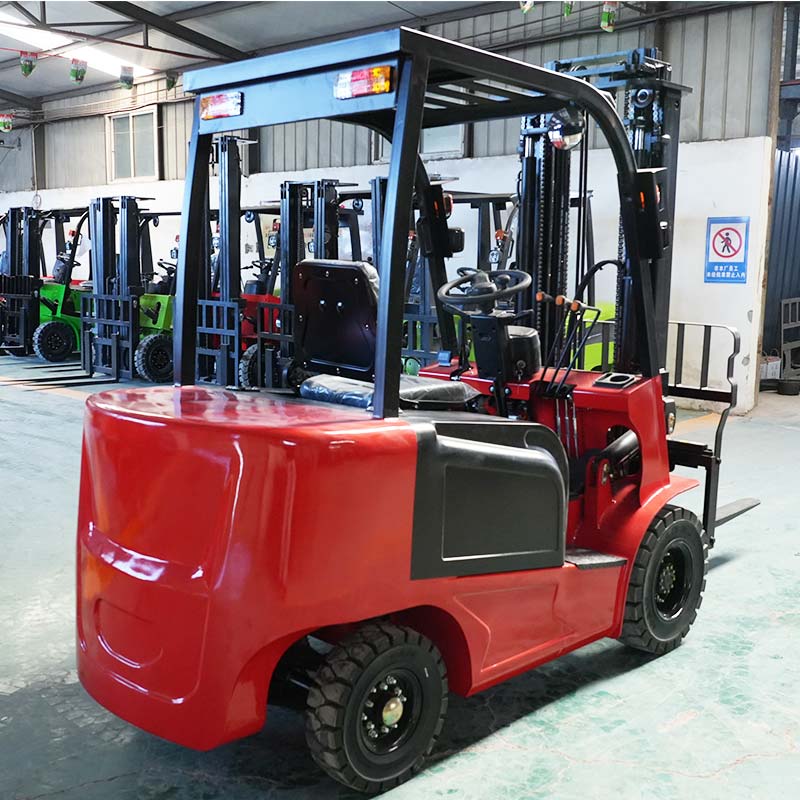
A purchase order lists a “2-ton forklift.” Then someone actually has to weigh it in — a freight forwarder pricing the shipment, say, or a site team checking whether a ramp can take it. “2 ton” doesn’t answer that question. It’s the rated lifting capacity, not the weight of the machine itself.
Weight depends on the model and how it’s configured, so there’s no one figure to memorize. Below are a few real examples to work from, a way to find the number for the truck you’re actually ordering, and the two situations — shipping it, or driving it loaded onto a floor or ramp — where that single total isn’t the whole story.
How Much Do These Forklifts Weigh? Three Published Examples
Here’s what three CSTAR models list on their product pages for rated capacity and weight:
| CSTAR model | Rated lifting capacity | Weight listed on product page |
|---|---|---|
| CSAE-15 electric forklift | 1,500 kg | 2,300 kg |
| CSAH-20 electric forklift | 2,000 kg | 2,700 kg |
| CSQD-30 diesel forklift | 3,000 kg | 4,200 kg |
These are the published weights for three specific models, not an industry average — a different manufacturer’s 2-ton truck, or a different configuration of the same CSTAR model, can weigh something else.
Forklift Weight and Lifting Capacity Are Two Different Numbers
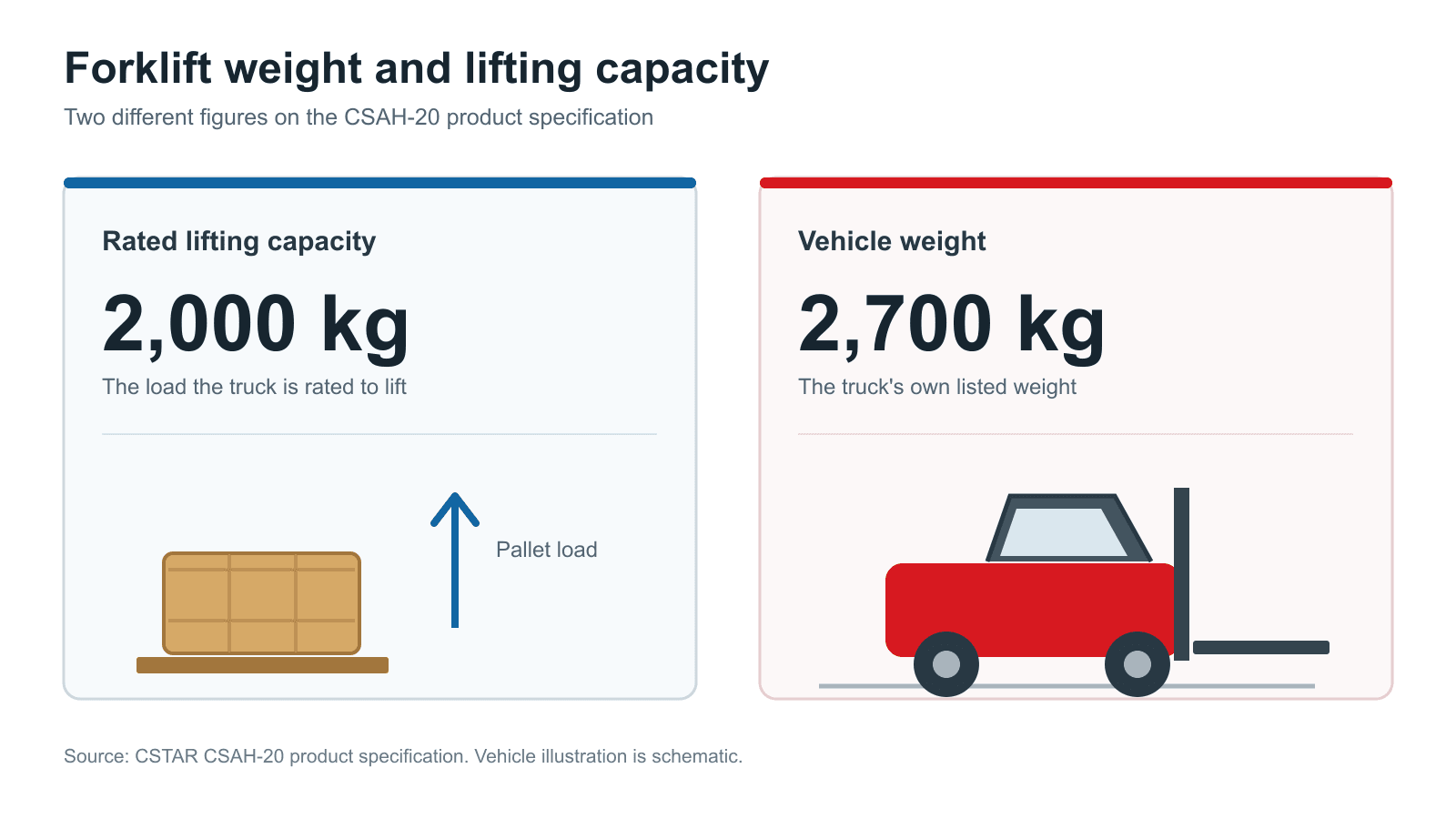
A warehouse manager asking for a 2-ton forklift is describing the load it needs to handle; a freight carrier asking about the same truck needs the truck’s own weight. For the CSAH-20, those are two different figures: 2,000 kg and 2,700 kg.
Both appear on a specification sheet, but they do different jobs:
- Rated lifting capacity is the load the truck can handle at the manufacturer’s stated load center, lift height, and vehicle configuration.
- Vehicle weight (also called service weight) is the weight of the truck itself, under the configuration the documentation defines.
There’s no fixed ratio between the two — a truck rated at 2 tons doesn’t weigh a predictable multiple of that.
Use the capacity figure to shortlist trucks for your pallets, then use the vehicle-weight figure for transport and site planning. If you’re still choosing a capacity class, the Forklift Capacity Guide walks through that decision. How Much Can a Forklift Lift? covers load centers and usable lifting capacity.
What Changes a Forklift’s Weight?
The capacity badge is only part of the specification. Chassis and mast contribute to the total, and so does the power source: an electric truck carries a traction battery, while a diesel truck carries an engine, transmission, and fuel system. Selected forks and attachments add to the total as well.
This is why power type alone doesn’t tell you which truck is heavier. An electric model and a diesel model in the same capacity class can differ in weight either way, depending on battery type and capacity, chassis design, and mast — so it’s the specific models and configurations you’d actually order that are worth comparing, not the power type in the abstract. Within a capacity class, the battery is usually the biggest variable on an electric truck — a larger battery for longer shifts adds weight — while mast height and any attachment add weight on either power type. Ask suppliers to specify those before comparing weights across quotes.
The table above includes one example of each power type, but at different rated capacities — so it isn’t a fair basis for a general electric-versus-diesel comparison. It simply shows what those particular trucks weigh.
Where to Find the Weight of a Specific Forklift
Start With the Product Page or Specification Sheet
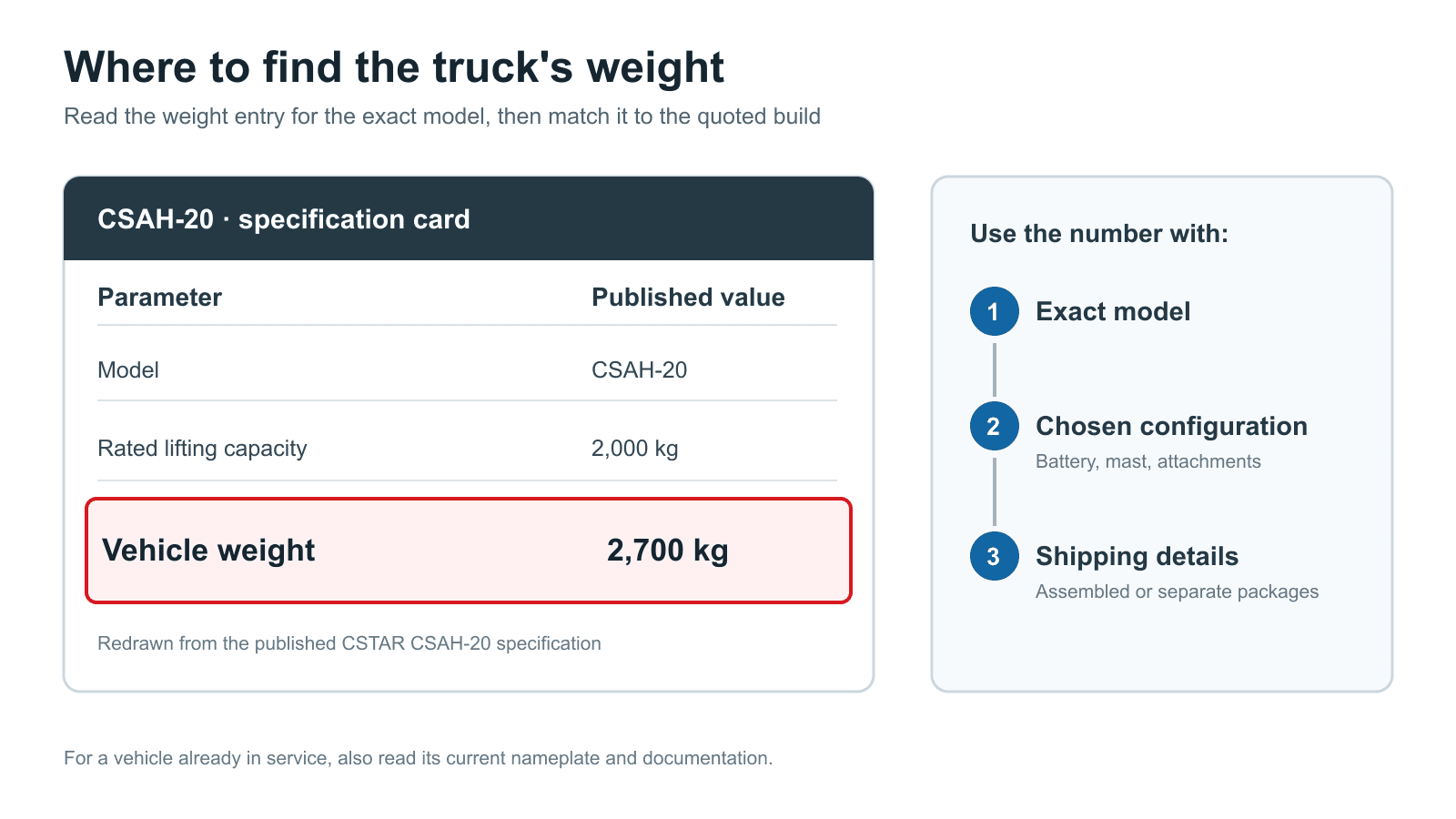
Find the weight entry for the model you intend to buy — it may be labeled vehicle weight, service weight, or forklift weight — and note the configuration it’s tied to, since a different battery, mast, or attachment can change the finished truck’s weight.
Read the Truck’s Nameplate or Data Plate
If the truck is already in your fleet, read its current nameplate rather than a general product listing, especially after a configuration change that a catalog page won’t reflect. In the US, OSHA’s nameplate guidance lists truck weight and capacity among the information to look for; check the plate and documentation supplied with the actual truck.
Confirm What the Figure Includes
Before you rely on a published number, check what it includes — the battery, forks, the selected mast, and any attachments — and whether those components ship with the truck or separately. Toyota’s data-plate guide shows why this matters: some of its weight entries exclude the battery, while others list weight with and without it. That’s an illustration of the question to ask, not a claim about how CSTAR defines its own product-page weights. If a page or nameplate doesn’t spell it out, one question to the supplier covers it: does this weight include the battery, forks, mast, and attachments as configured, and do they ship on the truck or separately?
Using Forklift Weight for Shipping and Floor Planning
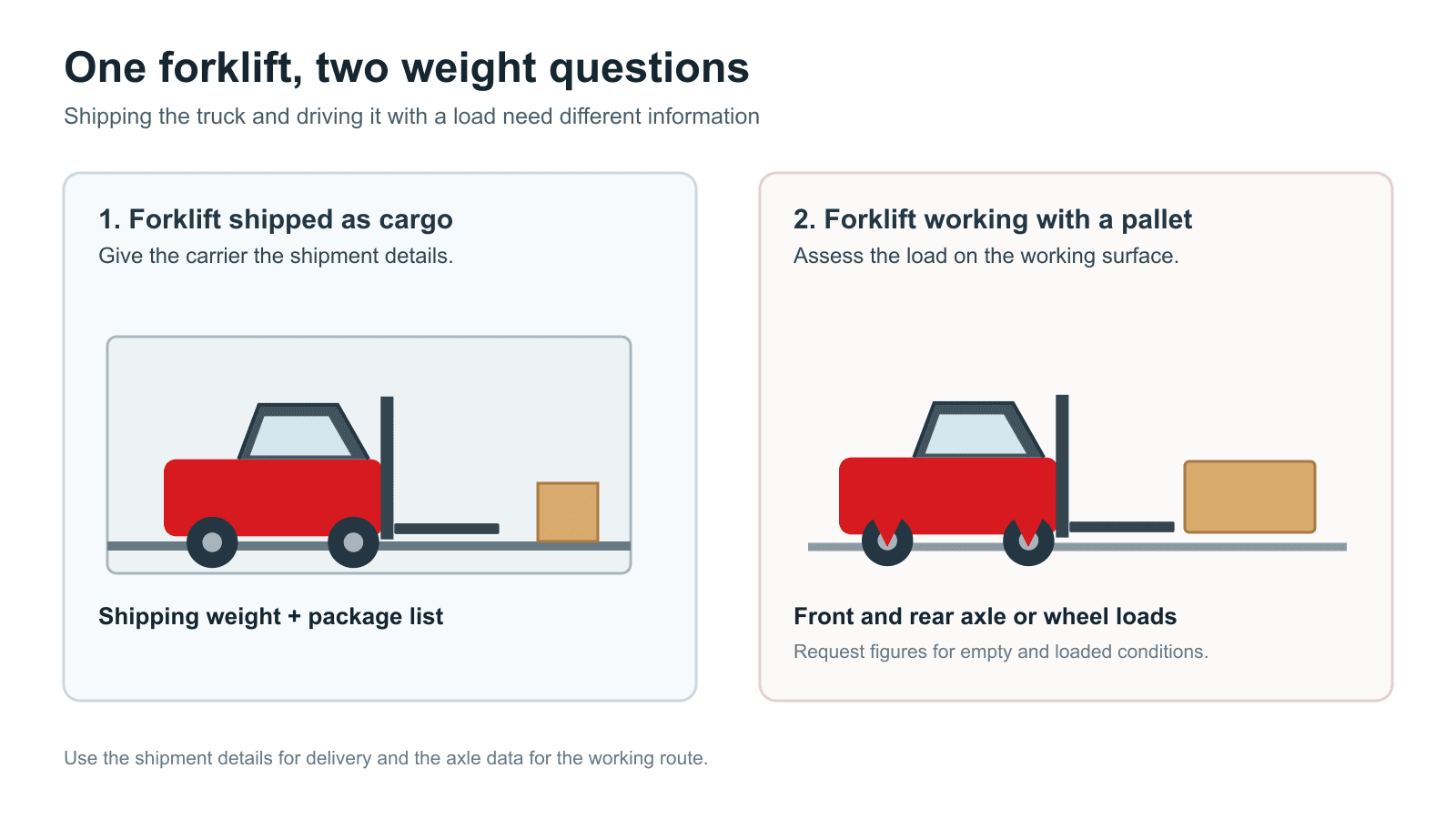
What you do with the weight figure depends on what you’re planning. A freight quote needs the weight and dimensions of what will be shipped. A floor assessment needs to know how the truck and its load bear on the surface.
Shipping the Forklift as Cargo
Give the freight carrier the truck’s shipping weight and dimensions, and tell them whether the battery, forks, and attachments travel on the machine or in separate packages — those packages belong on the packing list too. If the forklift will be driven onto the carrier under its own power, that loading ramp or dock needs its own check against what it can carry. Beyond that, the carrier will tell you what else it needs for loading and securing the truck.
Driving and Working on a Floor, Ramp, or Inside a Container
Now picture the forklift carrying a pallet across a mezzanine or into a container instead. The surface carries both the truck and the pallet, with the weight split between the wheels according to the truck’s geometry and where the load sits. To assess that, ask for front and rear axle loads, or wheel loads, in both empty and loaded conditions.
Pass those figures — along with the planned configuration and the heaviest pallet on the route — to whoever is assessing the floor or ramp. The three CSTAR product pages above list truck weight only; axle-load figures for a particular build need to be requested separately.
Trace the full route before that assessment: where the forklift enters, where it turns, and which ramp, dock plate, or elevated floor it crosses. The heaviest regular pallet on that route tells the site planner more than an average load would.
Frequently Asked Questions
How much does a 2-ton forklift weigh?
CSTAR’s CSAH-20 is one example: 2,000 kg rated capacity and 2,700 kg listed vehicle weight. For a truck you’re buying or shipping, use the weight of its selected configuration.
Does forklift service weight include the battery?
Check the specification or nameplate for how the weight is defined. Some documents include the battery; others list it separately. If the configuration you’re ordering isn’t clearly covered, ask the supplier before relying on the number.
Do I need axle-load figures to ship a forklift?
For a freight quote, provide the shipping weight, dimensions, and package details — your carrier will specify any further loading information it needs. Axle or wheel loads come into play when the forklift drives loaded onto a ramp or into a container, or works on a floor that needs assessment.
Conclusion
Start with the specific model, then find its vehicle weight on the product page, spec sheet, or nameplate, and check what configuration that figure covers. For shipping, confirm the weight and details of the actual shipping condition; for work on a floor, ramp, or container surface, get axle-load figures for that configuration and pass them to whoever is assessing the site.
If you need the weight or axle loads for a specific CSTAR model with a particular battery, mast, or attachment configuration, send the team the model and configuration. Contact CSTAR.