
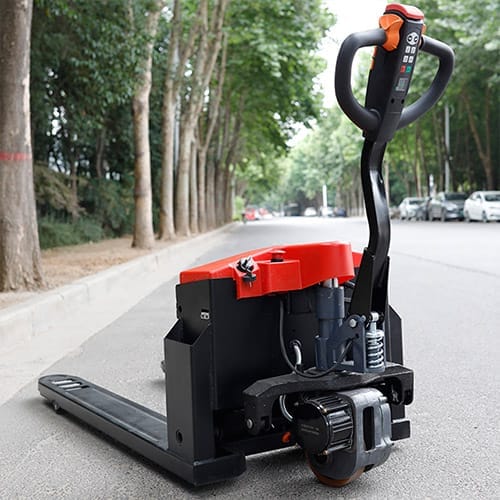
A pallet truck may spend only a few seconds crossing a warehouse aisle—or much of a shift travelling between the same two work areas. That difference matters more than the building’s total floor area when choosing between a walkie pallet jack and a stand-on pallet truck.
Start with the route your operators repeat most often. How far do they travel with a pallet? Where do they turn? How often do they return empty? Once you can describe that route, the equipment comparison becomes much more useful than a simple “walkie for short distances, rider for long distances” rule.
What Changes When the Operator Rides?
Both types move palletized loads primarily at floor level. On a walkie pallet jack, the operator walks with the powered truck. On a stand-on pallet truck, the operator rides on a platform during travel. If your task is to place pallets onto elevated racking, look at a stacker or forklift instead.
Riding can reduce the walking involved in repeated shuttle trips. It does not remove the time spent approaching a pallet, aligning the forks, negotiating a tight turn or waiting at a busy crossing. Those parts of the job are why two warehouses with similar travel distances may reach different purchasing decisions.
| Check on the actual route | Walkie pallet jack | Stand-on pallet truck |
|---|---|---|
| Operator position | Walking beside or behind the truck | Riding during travel |
| Work pattern worth examining | Frequent short moves and precise pallet positioning | Repeated travel between separated work areas |
| Space to check | Truck, pallet and room for the walking operator | Truck, pallet and the occupied operating position |
| Useful purchasing measure | Time and space required for a complete loaded handling cycle—not travel speed alone | |
Follow the Route Your Pallets Actually Take
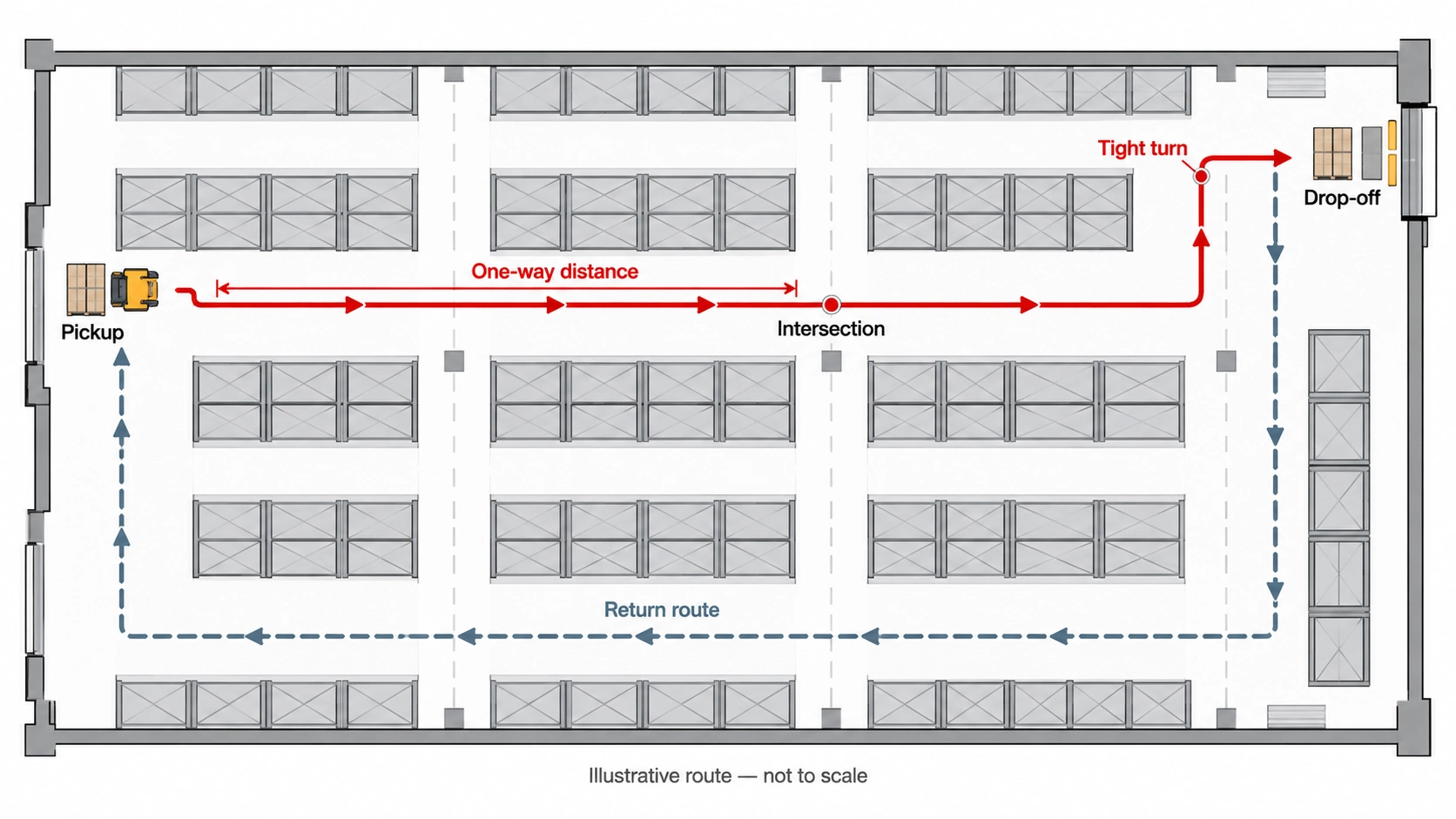
A floor plan gives you aisle dimensions, but it rarely shows the whole trip. Trace a frequent movement from pickup to drop-off, then follow the truck to its next pickup point. Include detours around staged pallets, doorways, intersections and any area where the operator regularly has to slow down.
Record the one-way distance, loaded trips per shift and empty returns. At the tightest point, note the pallet dimensions and fork-entry direction as well as the available space. These details are particularly important if the route ends with a sharp turn into a staging position.
Frequency changes the picture. As an illustration, a 60-meter loaded trip made 40 times in a shift adds up to 2.4 kilometers of loaded travel; the return movements add more. The arithmetic does not tell you which truck will finish the work faster. It tells you which route is worth measuring.
Where a Walkie Pallet Jack Earns Its Place
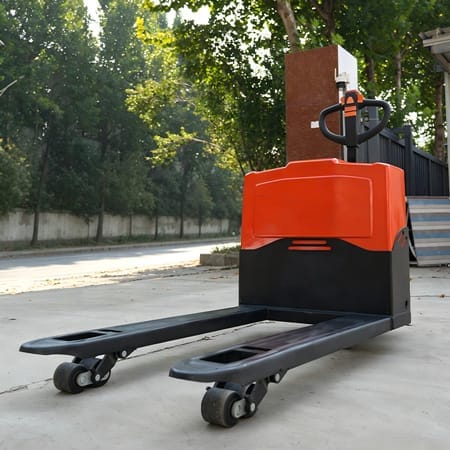
Consider a walkie truck when the operator makes many short, stop-and-start moves around receiving, staging or a production area. On these routes, getting into position and placing the load may take longer than the travel between positions. The operator is already on foot and can move directly to the next handling task.
Space is another practical consideration. A crowded dock or awkward aisle exit needs to accommodate the pallet, the truck and the operator. Check that complete arrangement on site rather than assuming that a particular truck type will always have the smaller turning circle.
Walking becomes a bigger operational consideration when the same person repeatedly covers a longer route throughout a shift. There is no universal distance at which a walkie stops making sense. The number of trips, the interruptions along the way and the work at each end all affect the answer.
When Stand-On Operation Deserves a Closer Look
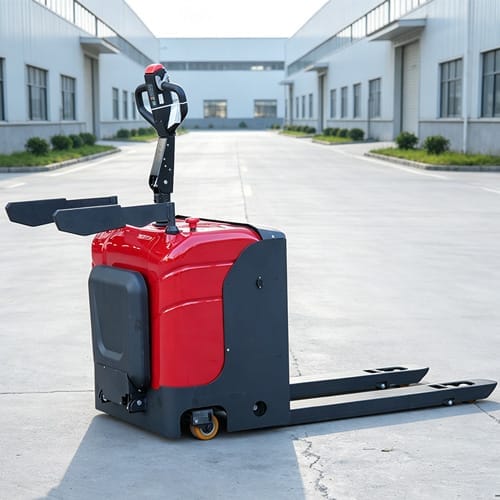
For a regular shuttle between warehouse zones, riding changes a meaningful part of the operator’s day: the travel between pickups and drop-offs. The more often that journey is repeated, the more important it is to compare a suitable stand-on model with the walkie option.
Look beyond the open stretch of aisle. A long run may finish at a congested dock where most of the cycle is spent waiting, turning and positioning the pallet. In that setting, a faster travel segment might make only a small difference to the complete job. Conversely, a clear route repeated many times can make the amount of walking worth serious attention.
Check the operator position on the exact model being quoted. Visibility, platform layout, guarding and the need to step on or off during the task all matter. If you need a folding platform or walkie operating mode, request written confirmation for that configuration; the “stand-on” label alone does not establish those features.
The Difficult Turn Can Decide the Comparison
Warehouse routes are rarely straight lines from one pallet position to another. At an aisle end, the truck must carry the loaded pallet through a turn without striking racking, staged goods or pedestrian barriers. Measure that maneuver where it happens, using your real pallet size and intended direction of travel.
A published turning radius helps narrow the options, but it is not the same as the aisle width needed to complete a particular loaded turn. Ask for an operating-aisle recommendation or a dimensioned drawing for the proposed truck and pallet combination. Doorways, dock openings and intersections deserve the same attention as the main aisle.
While tracing the route, note floor transitions, dock plates and ramps. For a gradient, request the model’s loaded operating limit and confirm it suits the load you intend to carry. Also check the proposed battery and charging arrangement against the number of shifts the truck must cover. These are route and schedule questions, not details to settle after ordering.
What the Published CSTAR Specifications Tell Us
The CSTAR CSHP-N30 is listed as a 3.0-ton full-electric walkie pallet truck. Its published specifications give a 1,550 mm minimum turning radius and maximum travel speeds of 4 km/h loaded and 4.5 km/h unloaded.
For stand-on operation, CSTAR lists the CSHP-Z20 at 2.0 tons and the CSHP-Z30 at 3.0 tons. Their public pages identify both as full-electric stand-on trucks, but do not list the travel speeds or turning radii needed for a numerical comparison with the N30.
If the N30 and Z30 are both capable of carrying your load, their shared 3.0-ton rating still does not make them interchangeable. Ask CSTAR for the current technical sheets and a drawing showing the truck in its operating configuration. The useful figures for this decision are loaded and unloaded travel speed, turning radius, required operating space, platform and guard arrangement, fork dimensions, loaded gradeability, battery configuration and charging requirements.
Time the Whole Job, Then Consider the Cost
If you can arrange a demonstration, use a route your team works regularly. Keep the pallet, load and destination the same for each suitable truck. Start timing when the operator begins the pickup and stop when the truck is ready for the next pickup—not when it first reaches the drop-off point.
Make several runs during a normal working period. Separating travel, waiting, turning and pallet positioning times will show where any difference comes from. Ask the operators what they noticed about visibility, control and repeated mounting or dismounting. A single smooth run through an empty warehouse is less informative than the work they will actually repeat.
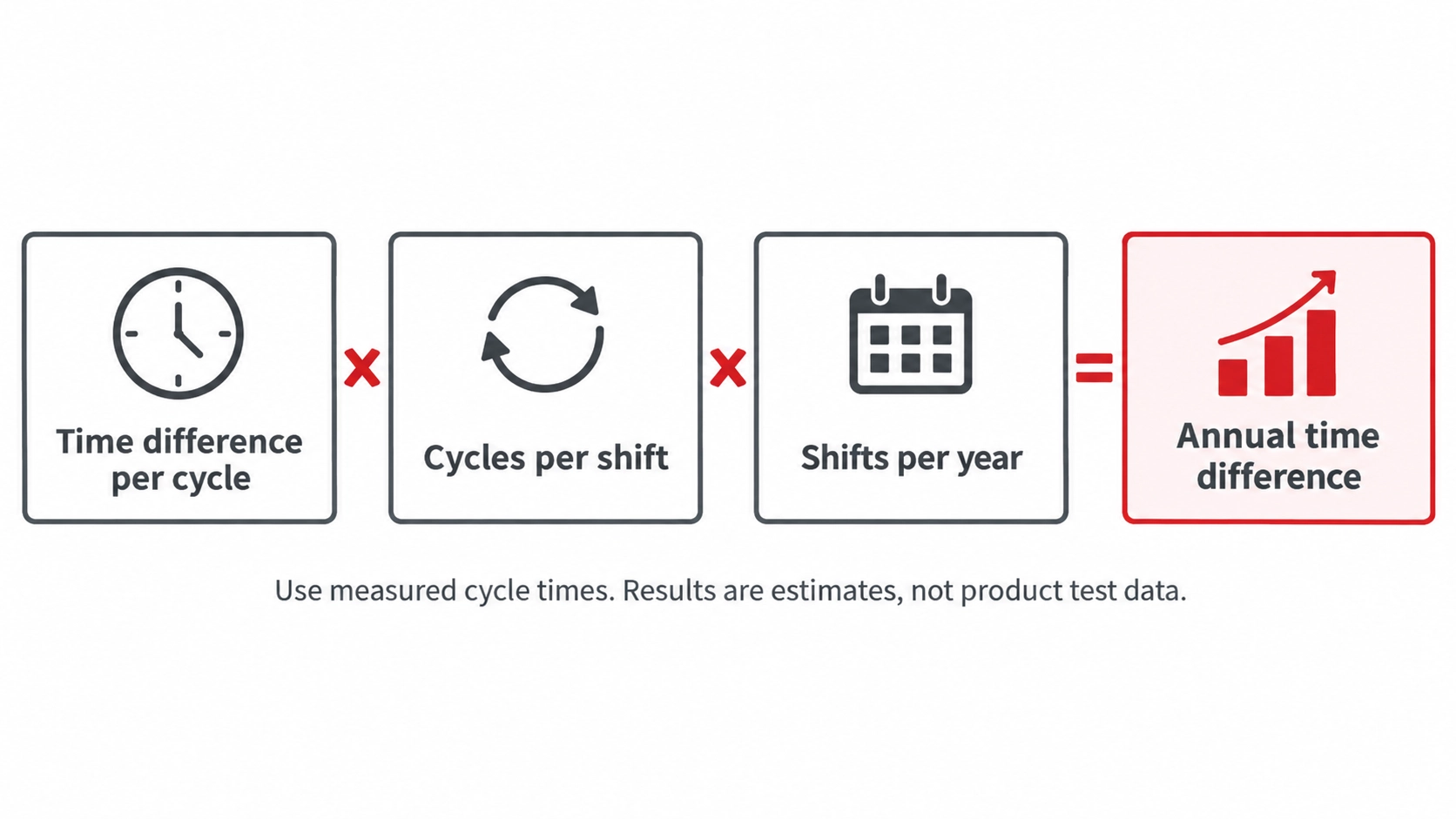
Once you have a measured difference in complete cycle time, the annual calculation is straightforward:
For example, a 15-second difference across 50 cycles per shift and 250 shifts equals approximately 52 hours per year. Those numbers illustrate the calculation; they are not CSTAR test results. To judge the financial value, compare the actual quotations and expected charging, maintenance and training needs, then consider whether your operation can use the released time to increase throughput or reduce labor pressure.
Making the Choice for Your Warehouse
If most movements are short and dominated by pallet positioning, begin with a suitable walkie model. If operators repeatedly travel between separated areas, put a stand-on model into the comparison. In either case, the loaded turn, route interruptions and complete cycle time deserve more weight than a rule based on distance alone.
For a CSTAR model recommendation, send your maximum load, pallet dimensions, busiest route distance, loaded trips per shift and the dimensions of the tightest turning point. Include any ramps and your shift schedule. That gives the team enough context to discuss the CSHP-N30, CSHP-Z20 or CSHP-Z30 against the work the truck will actually do. If you are still deciding among pallet-truck types, see the pallet truck buying guide.
Frequently Asked Questions
Can the CSHP-Z20 or CSHP-Z30 also operate as a walkie truck?
The public product pages identify them as stand-on models but do not confirm a folding platform or dual-mode operation. Ask CSTAR to confirm the operating modes and platform configuration for the exact truck being quoted.
What measurements should I provide for an aisle-fit check?
Provide the pallet dimensions, fork-entry direction, narrowest aisle or doorway, and space available at the tightest loaded turn. A drawing or short video of the maneuver can help the supplier assess the complete truck-and-pallet path.