
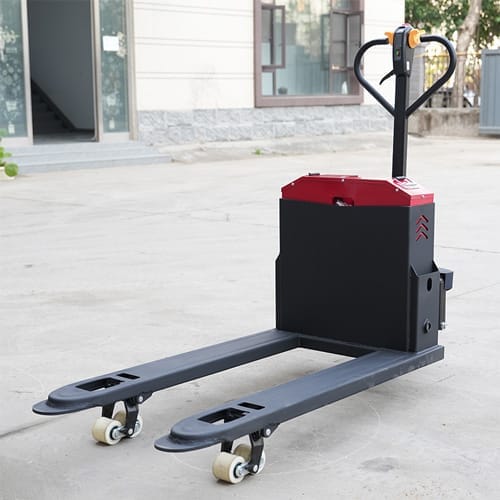
A warehouse moves pallets weighing 1,200–1,600 kg every day. A 2,200 kg delivery arrives now and then. Buying a 3-ton electric pallet truck for the whole operation may sound straightforward, but the useful question is how often that heavier pallet moves and what equipment is available for it.
Start with the heaviest complete pallet you move regularly, then separate occasional heavy loads from the daily workload. A 2-ton truck may suit routine loads within its rated conditions. Any pallet above that truck’s rating needs a different, appropriately rated handling method. A 3-ton truck becomes a stronger fleet candidate when those heavier moves are part of ordinary work rather than an exception.
Capacity is only the first filter. Pallet dimensions, load center, fork entry, turning space and the number of trips per shift shape the final specification. This guide walks through those checks before showing two CSTAR models as a practical example. For a broader introduction to truck types, see the pallet truck buying guide.
What Does 2-Ton or 3-Ton Capacity Tell You?
A 2-ton rated truck is specified to handle up to 2,000 kg under its stated rating conditions; a 3-ton truck is specified to handle up to 3,000 kg under its own stated conditions. Those labels are useful for an initial shortlist. For a real pallet, include the weight of the goods, pallet, stillage and any packaging lifted with the load.
The load center matters as much as the weight on the shipping document. It describes the position of the load’s center of gravity relative to the forks. A long pallet with most of its mass near the far end of the forks may not match the load-center condition used for a published rating. Keep total weight, dimensions and weight distribution together when comparing trucks.
If pallets vary considerably, record the largest and most awkward configurations as well as the most common one. The rated-capacity and load-center guide explains the terminology. Use the rating plate and operating instructions for the particular truck being considered when confirming its application.
Build a Load List Before Comparing Trucks
One maximum-weight figure rarely describes a warehouse. Separate the pallets that move throughout a normal shift from the occasional delivery that requires special handling. A simple load list reveals whether 3-ton capacity belongs in the daily fleet or is needed only for a small number of planned moves.
| Record | Why it matters |
|---|---|
| Typical loaded pallet weight | Shows the capacity used on most trips. |
| Heaviest regularly moved pallet | Sets the capacity requirement for routine work. |
| Heaviest occasional pallet | Identifies loads that may need a separately rated truck or handling plan. |
| Moves per shift for each weight group | Shows how often each capacity is needed and how much work the truck will do. |
Use weights from actual loaded pallets, not product weights alone. If loads can arrive in different pallet formats, note which format accompanies each weight. A 1,800 kg load on one pallet and the same weight on a much longer pallet may call for different checks at the forks.
One Heavy Delivery or Heavy Loads Every Shift?
Consider two illustrative warehouses. In the first, most complete pallets weigh 1,200–1,600 kg. A 2,200 kg pallet arrives once every few weeks. The normal fleet can be selected around the regular loads, while the heavier delivery has its own appropriately rated handling plan. Whether 3-ton capacity belongs in the regular fleet depends in part on how often that delivery appears.
In the second warehouse, pallets above 2,000 kg travel from receiving to storage and back to dispatch throughout the shift. Here, capacity above 2 tons is a routine requirement. The buyer can then focus on which 3-ton configuration fits the pallets, route and daily schedule.
The distinction is about frequency, not permission to exceed a rating. A single 2,200 kg pallet still requires equipment rated for that load and its operating conditions. If a new supplier or product line will make heavier pallets common next quarter, include that documented change in the load list rather than sizing the fleet solely around today’s mix.
Will a 3-Ton Truck Fit the Same Aisles?
A higher capacity label does not specify a truck’s width, length or turning radius. Those dimensions vary by model. Look at the truck’s overall width and the tightest point on its loaded route, particularly an aisle-end turn, doorway or pallet-positioning area.
A loaded pallet may occupy considerably more space than the truck body. At a turn, its corners sweep through an arc; at the drop-off point, the operator may need room to line up the forks. Measure that space with the pallet format you actually handle. A published turning radius describes the truck, while the working aisle includes the pallet and the maneuver.
For a straightforward site check, sketch the pickup-to-drop-off route and mark the narrowest doorway, sharpest loaded turn and final placement position. If two trucks have similar body dimensions, this route sketch still helps decide whether either configuration works with the pallet.
Match the Forks to the Pallet
Fork length and outer fork width have a direct effect on pallet entry and support. Check the opening between the pallet supports, the direction from which the forks enter and the position of the load after pickup. A capacity rating alone cannot tell you whether the forks will fit a particular pallet.
For mixed pallet inventories, record at least the most common pallet and the one most likely to cause a fit problem. A drawing or a few measured dimensions is more useful than a description such as “standard pallet,” which may mean different things to different suppliers. The pallet truck fork-size guide covers the measurements worth sharing.
Also note the pallet’s loaded height and the clearance available under it. These details become especially important where several suppliers use different pallet bases or where the truck enters from only one side.
Trip Count, Routes and Shift Length
Count the movements that make up a normal shift: loaded trips, empty returns and repeated positioning at racks or staging lanes. Two warehouses can move the same heaviest pallet yet demand very different work from their trucks. A short receiving task several times a day is different from continuous travel between receiving and storage.
Distance matters, but the full handling cycle includes pickup, turns, stops, unloading and the return trip. A quoted maximum travel speed is useful for comparing specifications; it is not the same as a completed pallet move through an occupied warehouse. Where cycle time is important, time a representative route with its normal pallet and traffic conditions.
Frequent heavy moves also affect how the fleet is managed. Keep inspection and service records for the equipment assigned to those routes, using the machine’s manual for its required procedures and intervals. The maintenance checklist provides a general planning framework.
Floor Conditions, Ramps and Battery Planning
Add floor transitions, thresholds and ramps to the route description. A ramp’s gradient is relevant, but its surface, entry and exit transitions, travel direction and whether the truck is loaded also matter. Compare those conditions with the instructions and ratings for the specific truck and configuration.
For electric trucks, daily operating hours and charging opportunities belong in the same brief as the load list. Battery chemistry, amp-hour capacity and charger configuration can differ between quotations. State whether the truck works one shift or several, and whether charging can take place during breaks.
This is why capacity and battery selection should be discussed together for a busy warehouse. A truck may have the right rated load yet need a different battery or charging arrangement to cover the scheduled work. Keep any requirement for battery changes between shifts in the quotation brief.
A Quick 2-Ton vs 3-Ton Decision Guide
| Your load pattern | Capacity direction | Next check |
|---|---|---|
| Routine pallets stay within a 2-ton truck’s stated rating conditions | Shortlist suitable 2-ton models. | Confirm load center, pallet fit and route. |
| Heavier pallets arrive occasionally | Plan a separately rated handling method; consider 3-ton fleet capacity if the pattern grows. | Record actual frequency and availability of the heavier-load equipment. |
| Pallets above 2,000 kg are routine | Shortlist trucks with an appropriate higher rating, such as a suitable 3-ton model. | Confirm the exact load, load center, forks, route and shift plan. |
| A heavier product line is scheduled to start | Include the expected pallets in today’s specification. | Obtain expected weights, dimensions and delivery frequency. |
The table identifies a capacity class; it is not a substitute for checking the rating and application of the exact truck being quoted. It is most useful when completed with measured pallets and a real shift pattern rather than estimates.
Compare Quotations on the Same Basis
A lower quoted price can reflect a different battery, charger, fork configuration or support package. Ask suppliers to quote against the same load list and route. Then compare the included equipment, spare-parts availability, warranty scope and delivery terms alongside the truck price.
This keeps a 2-ton versus 3-ton comparison focused on the actual purchase. Extra capacity may be valuable for regular heavy pallets; for a fleet that almost never sees them, the relevant alternative could be a separate plan for those occasional moves. The quotation should make that trade-off visible rather than bury it in a model label.
A Brief CSTAR Model Example
For a real-world illustration, CSTAR lists the CSHP-X20 at 2,000 kg and the CSHP-N30 at 3,000 kg, both with a 500 mm load center. They share a listed 685 mm overall width, 1,550 mm minimum turning radius and maximum travel speeds of 4 km/h loaded and 4.5 km/h unloaded. The N30 is listed as 1,700 mm long; the X20 is 1,730 mm long.
These figures show why it is worth comparing actual models rather than assuming every 3-ton truck is physically larger or faster than every 2-ton truck. The product pages contain the full specifications; the guide’s broader decision remains the same: match rated capacity to the pallet, then check the route and daily workload.
What to Prepare Before Requesting a Quote
A short, measured brief makes the supplier’s recommendation more useful:
- □ Typical and heaviest regular pallet weights
- □ Heaviest occasional pallet weight
- □ Pallet dimensions and fork-entry direction
- □ Load-center or weight-distribution details
- □ Moves per shift by weight group
- □ One-way route length and empty return
- □ Narrowest doorway and tightest loaded turn
- □ Ramps, thresholds and floor transitions
- □ Daily operating hours and number of shifts
- □ Available charging windows
- □ Preferred battery arrangement, if any
- □ Operating format required at the site
Frequently Asked Questions
What is the main difference between a 2-ton and 3-ton electric pallet truck?
The rated capacity is the main difference: 2,000 kg versus 3,000 kg under each truck’s stated conditions. Dimensions, forks, motor and battery configuration vary by model, so compare the actual trucks after identifying the load rating you need.
Can a 2-ton pallet truck occasionally move a 2,200 kg pallet?
No. A 2,200 kg pallet exceeds a 2,000 kg rating. Use equipment rated for the complete load and its operating conditions, even when the move is occasional.
Is a 3-ton electric pallet truck always larger?
No. Size depends on the model. Compare overall width, length and turning radius, then check the working space needed by the loaded pallet.
When does moving from 2-ton to 3-ton capacity make sense?
When pallets above the 2-ton truck’s rating become regular work, a suitably rated higher-capacity truck belongs on the shortlist. The final choice also needs to fit the pallet, route and shift schedule.
Does trip frequency change a truck’s rated capacity?
No. The rating applies to each move. Trip frequency helps decide which capacity should be available in the regular fleet and what battery and charging arrangement the shift requires.
Is a higher motor rating the same as a faster pallet move?
No. Compare listed travel speeds and, for a time-sensitive operation, the complete pickup-to-drop-off cycle. Turns, stops and pallet positioning are part of that cycle.
Choose Capacity Around Your Pallets and Workload
Send CSTAR your pallet weights and dimensions, trips per shift, route and charging schedule. We can use that information to discuss a suitable electric pallet truck configuration.