
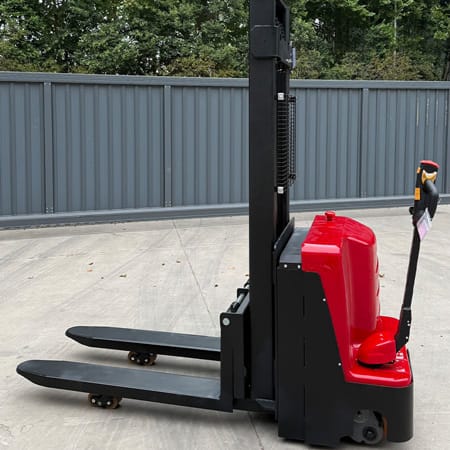
A self-lifting stacker must suit both your pallets and your delivery vehicle. Rated capacity describes load handling under specified conditions. Vehicle compatibility also depends on floor height, door clearance, cargo space, machine weight and the permitted loading procedure.
Start with the vehicle measurements, loaded pallet details and delivery route. Keep these together as a buying brief so every model and quotation is assessed against the same job.
What Is a Self-Lifting Stacker?
A self-lifting stacker, also called a self-loading pallet stacker, combines pallet handling with a mechanism for loading the machine itself into a suitable vehicle. It is designed for delivery work where handling equipment needs to travel with the goods.
Pallet Lifting and Self-Loading Are Different Functions
Fork lift height describes the lifting function. It does not establish the vehicle floor heights that the self-loading mechanism can accommodate. Confirm the permitted vehicle interface, loading sequence and operating limits for the exact model.
If your application requires the machine to load itself while carrying a pallet, request explicit confirmation of that operation. The operating instructions must identify which movements are permitted with a load on the forks.
Does Self-Lifting Also Mean Powered Travel?
Check travel drive, fork lifting and self-loading separately. The word “electric” can describe different functions, and self-loading does not mean autonomous operation. The CSTAR CSHF-S10 and CSHF-S15A specification pages list separate drive and lifting motors.
Will the Stacker Fit Your Van or Delivery Truck?
Evaluate the loading movement and the transport position as well as the door opening. An electric self-lifting stacker may suit the cargo but still be incompatible with the vehicle’s loading height, available space or remaining payload.
Vehicle Floor Height and Loading Access
Record the following at the intended loading point:
- Load-floor height above the ground and the vehicle’s loading state when measured
- Whether access is through a rear or side opening
- Sill, bumper and other projections
- Any surface the machine must contact or use for support during loading
Vehicle floor height can vary with operating conditions. Ask the supplier which conditions must be measured and compare those measurements with the approved loading range. Confirm that the proposed support surfaces and access arrangement are suitable for the mechanism.
Door Opening and Interior Space
Measure the clear door width and height, usable cargo length and proposed parking space. Include hinges, latches, trim and other projections that reduce the opening. Ask for the machine’s full outline throughout the approved loading movement.
Keep mast height and overall machine height separate. For example, the CSHF-S10 page lists a minimum mast height of 1,647 mm and an overall height of 1,670 mm. Neither figure alone confirms clearance throughout loading. Use the configuration drawing and loading procedure to check the complete movement.

Vehicle Payload, Floor Support and Transport Position
The stacker’s weight, including its battery, counts toward the weight carried by the vehicle. Include the cargo and other carried equipment when checking the vehicle’s remaining payload and applicable weight limits.
Also check axle limits and local floor loading at the machine’s contact points. Overall weight alone does not describe how the load is distributed during movement or transport. Confirm the parking position, approved restraint points and securing arrangement with the relevant equipment and vehicle information.
Plan Access Throughout the Delivery Route
Sketch the stacker and pallet positions with the vehicle loaded for departure. For each delivery, check access to the equipment and the pallet in the handling sequence permitted for that model. A layout that fits everything for transport can still leave goods blocking the machine or its required working space.
Check the layout again after a partial delivery. Allow for returning the machine to its approved transport position, reaching its restraint points and accessing the next load. Include collections and the return journey in the plan, using the loading sequence permitted for the exact model.
Match the Stacker to Your Pallets and Loads
Load Weight, Load Center and Lift Height
Provide the weight of the heaviest loaded pallet, its dimensions and the required working height. Include overhang, uneven weight distribution and unusual packaging. The quoted capacity needs to match that load arrangement.
Both CSTAR models compared below list a 400 mm load center. Ask for the permitted capacity at your actual load center and working height. A pallet can fit the forks while its loaded center of gravity sits farther forward than the rated position, so check the load arrangement as well as its total weight.
Our guide to rated capacity and load center explains the principle. The pallet stacker dimensions and lift-height guide covers the measurements used in equipment selection.
Fork Dimensions and Pallet Entry
Compare fork length, outside width and lowered height with the pallet openings. Check whether bottom boards interfere with load wheels or support legs in the intended entry direction. Photographs of the pallet underside help identify these restrictions.
The CSHF-S10 page lists 1,200 mm fork length and 620 mm fork outside width. The CSHF-S15A page lists 1,250 mm fork length and outside-width values of 565 / 685 mm. Confirm which S15A configuration is supplied; those two listed values do not establish a continuously adjustable fork-spacing range.
Our pallet truck fork-size guide explains the measurement terms. Use the self-lifting stacker’s own drawing to confirm compatibility.
Check the Conditions at Every Delivery Stop
Assess the route from the vehicle to the final pallet position. Record surface condition, thresholds, cracks, drainage channels and slopes. Allow working space for the pedestrian operator and control handle as well as the machine. Include travel distance, daily pallet movements, charging arrangements and exposure to wet conditions.
A published gradeability figure describes a particular travel condition; it does not establish permission to lift, turn or self-load on that slope. Confirm the permitted conditions for each operation in the model’s instructions.
The UK Health and Safety Executive’s loading and unloading guidance emphasizes suitable loading areas, sound vehicle floors and secured loads. Agree the arrangements with the delivery site before the equipment arrives.
Compare Self-Lifting Stackers with Other Loading Arrangements
Compare the complete delivery arrangement, including how equipment reaches the vehicle and how pallets move at each destination.
| Arrangement | What to confirm before buying |
|---|---|
| Self-lifting stacker | Pallet handling, approved self-loading interface, vehicle payload, transport space and restraints |
| Ordinary stacker | How the equipment itself will be loaded, unloaded and transported |
| Tail lift with pallet-handling equipment | Platform dimensions, permitted loading, vehicle compatibility and pallet movement at each end |
| Receiver-provided forklift or dock | Suitable facilities and equipment available at every required delivery point |
Compare CSTAR Self-Lifting Stacker Models
The CSHF-S10 and CSHF-S15A provide two starting points for a configuration enquiry. The figures below come from their published product pages.
| Specification | CSHF-S10 | CSHF-S15A |
|---|---|---|
| Rated capacity | 1,000 kg | 1,500 kg |
| Rated load center | 400 mm | 400 mm |
| Published fork lift height | 1,300 mm standard maximum | Options: 800, 900, 1,000, 1,100, 1,200, 1,300, 1,500 or 1,600 mm |
| Published height information | Minimum mast height: 1,647 mm; overall height: 1,670 mm | Mast-closed overall height: 1,163 to 1,963 mm across the listed configurations |
| Overall length × width | 1,660 × 890 mm | 1,657 × 802 mm |
| Service weight including battery | 420 kg | 390 to 425 kg, depending on configuration |
| Fork length | 1,200 mm | 1,250 mm |
| Published fork outside width | 620 mm | 565 / 685 mm; confirm the supplied configuration |
| Operation | Pedestrian | Walkie |
| Drive / lifting motor | 0.8 / 2.2 kW | 0.8 / 2 kW |
| Battery voltage / capacity | 48 V / 25 Ah | 48 V / 25 Ah |
Source: linked CSTAR product pages, checked on 29 October 2026. Confirm the dimensions, weight, battery and charger for the quoted configuration.
What the Model Differences Mean for Your Vehicle
The S15A’s listed overall width is 802 mm, compared with 890 mm for the S10. That narrower outline is worth investigating when width is the limiting dimension. Their listed lengths are almost identical at 1,657 and 1,660 mm, so the published figures give little reason to expect a shorter transport footprint. Check the complete loading movement and transport-position drawing for the selected configuration.
Compare rated capacity and carried weight separately. The S15A is rated at 1,500 kg, but its published service weight is 390 to 425 kg against 420 kg for the 1,000 kg-rated S10. Higher rated capacity does not automatically mean a heavier machine. The S15A also has longer forks, so confirm pallet entry and support before treating it as a direct substitute.
Lift-height selection also changes the S15A’s published closed height and weight. Ask for the drawing and service weight of the quoted option, together with the permitted vehicle floor-height range for self-loading. Fork lift height and vehicle compatibility need separate confirmation.
What Should a Self-Lifting Stacker Quote Include?
When comparing self-lifting stackers for sale, compare the complete supply scope. Two quotations may list the same rated capacity while covering different lift heights, batteries, accessories or delivery terms.
- Exact model, lift-height option and dimensional drawing
- Vehicle and pallet requirements used for the assessment, with the permitted self-loading range and procedure
- Battery specification, charger and charging requirements
- Included accessories and operating documents
- Packing method, shipping dimensions and shipping weight
- Price, currency, delivery terms, destination and quotation validity
- Confirmed lead time, warranty terms and spare-parts arrangements
Before ordering, keep the confirmed configuration, dimensional drawing and loading instructions with the quotation. A demonstration should show the quoted model and explain the vehicle interface and load conditions; a video of another configuration cannot establish the fit of your order.
Self-Lifting Stacker Pre-Purchase Checklist
Use this checklist to prepare a configuration enquiry. Add photographs and mark the measurements on a vehicle sketch where possible.
| Item | Information to provide |
|---|---|
| Vehicle | Make, model and photographs of the loading area |
| Load floor | Measured height and the vehicle loading state when measured |
| Door opening | Clear width, clear height, sill and projections |
| Cargo area | Usable space, stacker transport position, access and restraint points throughout the delivery round |
| Vehicle loading limits | Remaining payload, axle limits and applicable floor-loading information |
| Pallets | Dimensions, underside structure and intended fork-entry direction |
| Cargo | Loaded pallet weight, dimensions, overhang and weight distribution |
| Lift requirement | Required working height and intended handling sequence |
| Delivery sites | Surface, slopes, obstacles, working space and site photographs |
| Workload | Delivery stops, pallet movements and travel distances |
| Charging | Available power supply and charging location |
| Purchase | Quantity, destination country and required delivery date |
Frequently Asked Questions
Can a self-lifting stacker fit inside any van?
No. Compatibility depends on the vehicle interface, door opening, available space, payload and the stacker’s approved loading movement. Send the vehicle measurements and photographs before selecting the configuration.
Is self-loading height the same as fork lift height?
No. Fork lift height is a lifting specification. The vehicle floor heights suitable for self-loading must be confirmed from the loading mechanism’s approved range and requirements.
Can the stacker load itself while carrying a pallet?
Have this confirmed for the exact model and loading arrangement. Request the operating instructions and permitted sequence; a description of self-loading alone does not establish that a loaded self-loading movement is allowed.
Does a self-lifting stacker replace a tail lift?
It may offer an alternative for a suitable delivery arrangement. Compare the complete loading and unloading process, vehicle compatibility and facilities at every delivery point before changing equipment.
Does the stacker’s weight reduce the vehicle’s available payload?
Yes. Use the stacker’s complete service weight, including its battery, when checking the weight available for goods. Add other carried equipment separately and check axle limits, floor loading and the proposed transport position.
What measurements should I send before requesting a quote?
Start with vehicle floor height, clear door dimensions, cargo space, pallet dimensions, loaded pallet weight and required lift height. Include photographs of the vehicle interface, pallet underside and delivery surfaces.
Request a Self-Lifting Stacker Configuration Check
Share your vehicle measurements, pallet details and delivery-site photographs with CSTAR Machinery. Include the load weight, required lifting height and intended loading sequence so the enquiry can be reviewed against a specific model and configuration.