
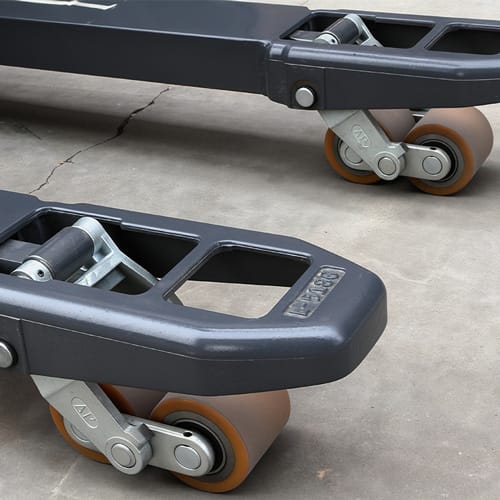
The difference between these two stackers often becomes clear only after something changes in the warehouse. A supplier sends a different pallet, a rack guard is added, or a loaded pallet begins to overhang its deck. The truck may still have enough rated capacity and lift height, yet the operator cannot complete the job: the support legs strike a bottom board, the rack base blocks their path, or the loaded truck cannot finish the turn into the aisle.
At that point, the choice between an electric straddle stacker and a counterbalance stacker is no longer a catalog comparison. It is a question of how the truck reaches, supports and positions the actual pallet. A straddle stacker carries forward support legs along the outside of the load. A counterbalance stacker keeps the front of the chassis open and balances the load with mass behind the mast. That structural difference affects pallet entry, rack clearance, aisle space and floor loading.
This guide follows the same order as the handling task itself: first the pallet entry and support-leg path, then the loaded turn and rack approach, followed by capacity at height and floor loading. Pallet labels such as “Euro,” “GMA” and “four-way” are useful references, but the decision should be based on the pallet as it is actually loaded and presented to the truck.
What Is an Electric Straddle Stacker?
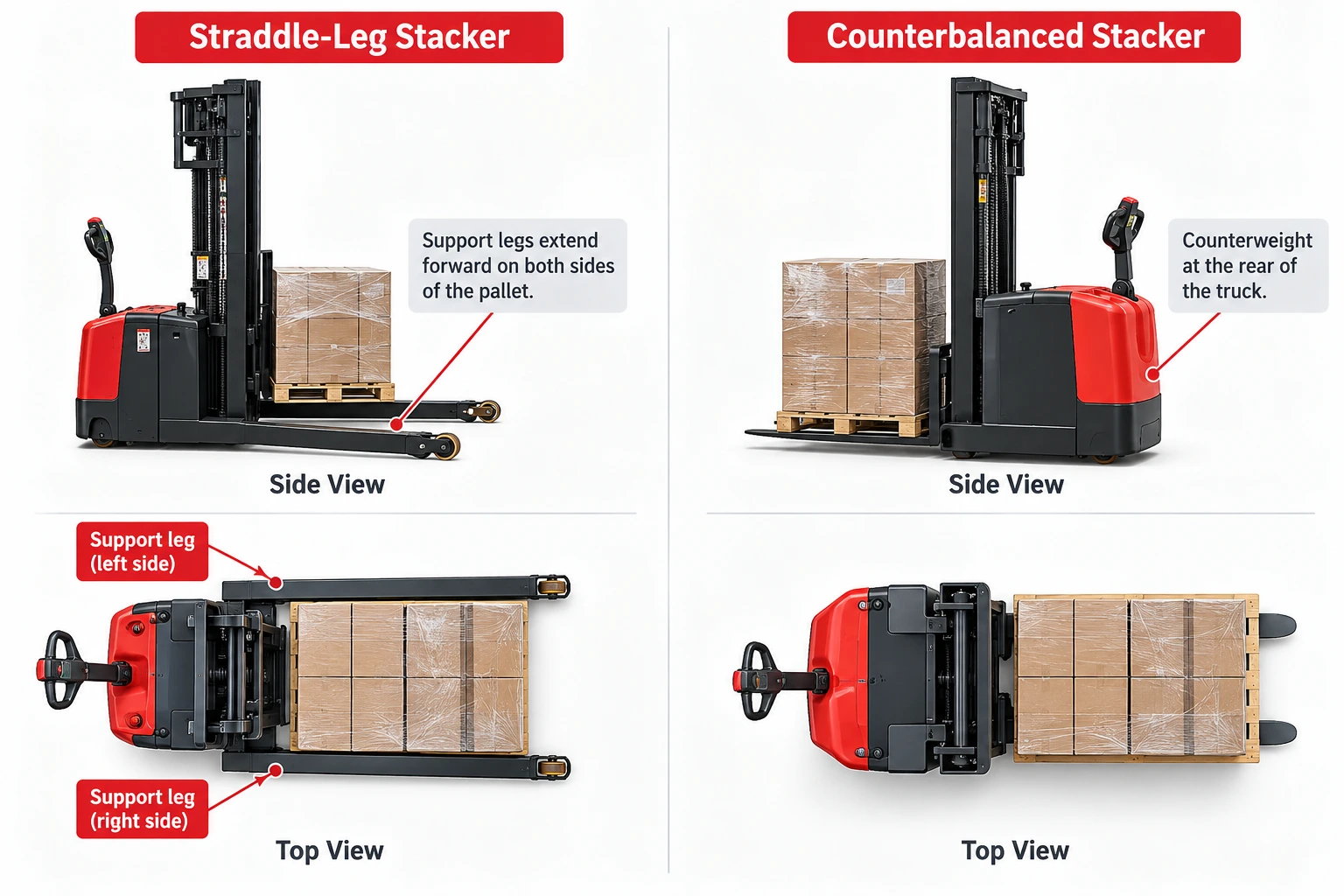
An electric straddle stacker — sometimes called a straddle leg stacker — uses forward support legs to create a support base around the pallet area. As the forks enter the pallet, the legs remain on the floor and travel along its outer sides, allowing the pallet to be lifted between them.
Because the support base extends toward the load, this design can use a more compact rear chassis than a comparable counterbalance layout. The pallet, wrapping and any load overhang must still fit inside the leg spread, with a clear floor path on both sides. Bottom deck boards can still be compatible with a true wide-straddle layout because the support legs travel outside the pallet rather than through its fork openings.
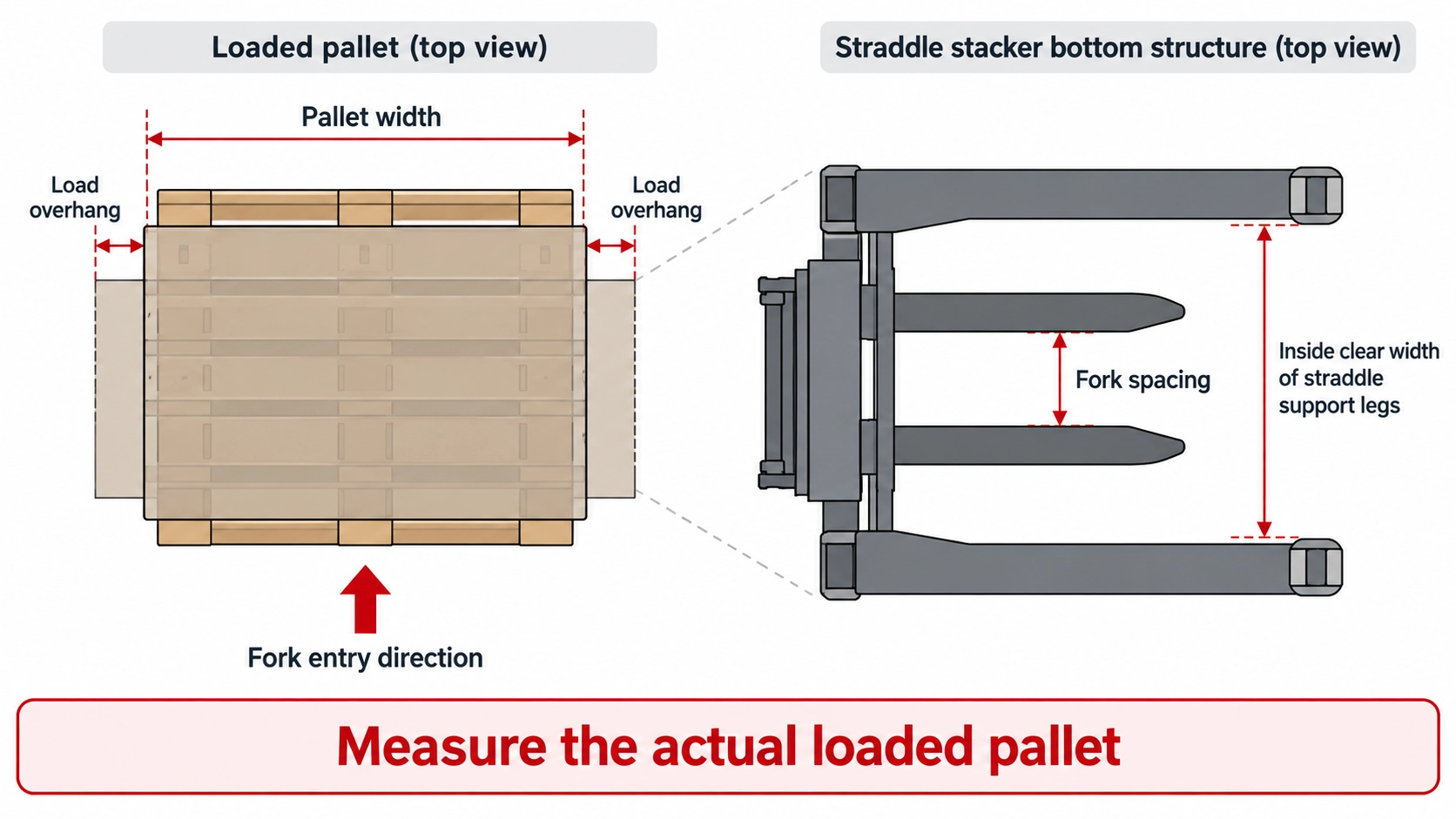
The figure that actually decides compatibility is clear inside-leg width, not the pallet’s nominal size. A “1,200 mm” pallet can end up wider once cartons, wrap or a damaged board extend past the deck, and the available path can narrow further at rack uprights, guards or neighboring pallets. Adjustable-outrigger models need their adjustment range to reach the working position; fixed-width models have to fit the route as built.
The CSNS-20 full-electric stacker with support legs is a useful reference point: 2,000 kg rated capacity at a 500 mm load center, with a 1,300 mm inside-leg width. That 1,300 mm figure is what you’d check against the widest point of the loaded pallet — before you look at the aisle or the rack at all.
What Is a Counterbalance Legless Stacker?
When the pallet or rack leaves no usable path for straddle legs, a counterbalance layout removes those legs from the front of the truck. The load moment in front of the mast is balanced by the chassis mass behind it, following the same general stability principle used by a counterbalanced forklift.
Only the forks reach the pallet, so leg clearance stops being part of the pickup. That makes it a workable option for stringer pallets, closed-base containers, controlled load overhang, and rack layouts that would otherwise block a straddle-leg path.
Removing the legs solves one access problem but opens a different set of checks. Fork length and spacing need to suit the entry opening, and the longer weighted chassis needs room to swing behind the mast when turning. Its service weight also becomes a live concern on trailer floors, dock plates and mezzanines — more on that below.
The CSHF-C20 full-electric counterbalance legless stacker is rated at 2,000 kg at a 500 mm load center, with a 3,000 mm standard lift height and a 1,020 mm overall width — figures worth setting next to the pallet dimensions, required lift height and available turning space at the same time.
Straddle Stacker vs Counterbalance Stacker: Structural Differences at a Glance
A straddle chassis uses floor space beside the pallet; a counterbalance chassis pushes more of the truck’s length behind the mast. Neither is more compact across the board — which dimension matters depends on the maneuver you’re doing.
| Selection Point | Electric Straddle Stacker | Counterbalance Stacker | What to Check |
|---|---|---|---|
| Load support | Forward legs straddle the pallet or load. | Chassis and rear counterweight balance the load. | Pallet width, load overhang and support-leg path. |
| Pallet access | Works when the pallet and load fit inside the leg spread. | Only the forks approach the pallet from the front. | Bottom boards, openings, fork entry and orientation. |
| Rack approach | Needs a clear route for both support legs. | No forward support-leg path required. | Rack uprights, guards, floor beams, adjacent pallets. |
| Aisle geometry | Leg spread affects total width and the loaded turn. | Counterweight can add body length and rear swing. | Right-angle stacking aisle, turning path, pallet sweep. |
| Floor loading | Depends on truck weight, wheel layout and load. | Counterweight commonly increases truck mass. | Service weight, wheel loads, structural floor limits. |
Read this as a sequence of site checks, not a ranking — one truck isn’t universally more compact than the other. The more basic question is simply whether either truck can engage the pallet from the direction your warehouse actually uses.
Pallet Compatibility: Entry Direction and Bottom Structure
Start at the pickup point, with the pallet loaded the way it normally arrives. That’s what shows whether the support legs, forks and load can occupy the required space at the same time.
Where Can the Support Legs Travel?
Look at the pallet from the entry side and from above. For a straddle stacker, check the clear space between the inside faces of the support legs against the widest part of the loaded pallet — including leaning cartons, stretch wrap, and any base component extending past the deck.
For a counterbalance stacker, the relevant dimension shifts from outside leg spread to fork openings and support beneath the load. Where more than one entry direction is possible, record each orientation separately — a four-way-entry pallet can present different clearances from its long and short sides.
Open-Bottom, Closed-Bottom, Stringer and Block Pallets
Pallet construction determines which parts of the truck need clearance. An open-bottom pallet leaves more room beneath the deck, while a closed-bottom pallet adds boards or runners that can obstruct trucks whose load arms or wheels must enter beneath the pallet. Stringer and block pallets may provide two-way, partial four-way or full four-way entry, depending on how they are built.
A true wide-straddle layout is different because its support legs travel outside the pallet. A closed-bottom or GMA-style pallet can therefore be compatible when the loaded pallet fits inside the leg spread and both legs have a clear floor path. If the pallet, load overhang or rack blocks that outside path, a counterbalance stacker becomes the more practical layout to investigate.
Aisle Width, Turning Radius and Rack Access
A successful pickup is only step one. The loaded truck still has to clear the pickup point, pass through the narrowest opening, turn at the aisle end, and align with the rack — each stage draws on a different part of the available space.
Rack-Bottom Clearance and the Support-Leg Path
For a straddle model, trace both support legs through the full placement — depending on rack and truck arrangement, they may pass outside the pallet, between uprights, or beneath a beam. Upright protectors and floor-mounted guards often eat into the clearance shown on the original layout drawing.
A counterbalance stacker has no forward legs, so a blocked rack base matters less. But its body, mast and load still need a clear approach — check the lowest rack position as it exists today, guards, damage and nearby stock included.
The Complete Loaded Turn
Overall width only tells part of the story at the turn. A straddle model can be broad at the support legs; a counterbalance model can carry more length behind the mast and produce more rear swing. The pallet corners sweep across the opposite side of the aisle either way.
Use the manufacturer’s right-angle stacking aisle figure for your pallet orientation, then draw the hardest maneuver on the warehouse plan — aisle-end turn, doorway approach, final rack alignment. If clearances remain tight on paper, a controlled site trial with the actual pallet and a trained operator is more reliable than comparing turning-radius figures in isolation.
Load Center, Lift Height and Floor Loading
Once the layout checks confirm that the truck can reach and position the pallet, the next question is whether it can support the load at the required height without exceeding the limits of either the truck or the floor.
Rated Capacity at the Required Load Center
Record the full loaded weight and the position of its center of gravity. A long pallet or an unevenly distributed load can push the load center farther from the fork face than the condition used for the truck’s headline rating — which lowers the capacity actually available for the job.
Capacity at the Required Lift Height
State the fork height needed at the highest storage position, then ask for the applicable capacity for that mast and fork configuration. Where residual-capacity data or a load chart exists, match it to the actual load center and height — that gives you a working figure for the rack position, not a nominal ground-level rating.
Service Weight, Wheel Load and Floor Strength
Counterbalance trucks carry mass behind the mast to balance the load, which makes service weight especially relevant on mezzanines, upper floors, elevators, dock plates and trailer floors. A straddle stacker distributes weight differently across its wheel positions and support-leg track, and small load wheels can concentrate their own forces. Either way, get the service weight and wheel-load figures from the supplier, and have load-sensitive structures reviewed by the site’s responsible engineer.
What to Record Before Requesting a Quote
Start with the pallet that’s hardest to handle — not an empty sample sitting nearby — and record it loaded, in its normal condition:
- □ Total loaded weight, including pallet and packaging
- □ Pallet length and width
- □ Maximum loaded width, including overhang
- □ Fork entry direction used in the warehouse
- □ Height and width of each fork opening
- □ Bottom boards, blocks, stringers or skids
- □ Required inside leg width or adjustment range
- □ Fork spacing or outside fork width
- □ Load center or known center-of-gravity position
- □ Required fork height at the highest rack position
Then follow the pallet’s route: narrowest doorway, tightest loaded turn, space around the lowest rack level, ramps or floor transitions. Add the required lift height and ask for the truck’s capacity at that height with the proposed mast and fork configuration. The forklift capacity and load-center guide covers how load position and configuration affect usable capacity.
Photos help most when they show scale — a straight-on view of the pallet entry, a side view of the base, and a wider shot of the rack approach. A tape measure in frame, or dimensions listed alongside the image, keeps perspective from distorting the read.
A Practical Selection Path
| Observed Condition | Useful Starting Point | Next Check |
|---|---|---|
| Every loaded pallet fits inside the proposed leg spread, and both legs have a clear route at the rack. | Include an electric straddle stacker on the shortlist. | Loaded turn, support-leg clearance, capacity at height. |
| Pallet bases or rack structures block the support-leg path. | Examine a counterbalance legless configuration. | Fork fit, chassis length, rear swing, floor loading. |
| The warehouse receives several pallet types or frequent overhanging loads. | Map each pallet and route before standardizing on one fleet. | Worst-case dimensions, load center, entry direction. |
| Both truck layouts appear to fit. | Look past physical fit to working cycles and ownership. | Operator position, traffic, charging, maintenance, site trial. |
Physical compatibility comes first for a reason: it filters out unsuitable options before price and headline specifications dominate the comparison. A consistent pallet layout may suit a straddle design without requiring a counterbalance chassis, while mixed pallets or blocked rack approaches may justify the additional access flexibility of a counterbalance arrangement.
Where CSTAR Fits Into the Selection
The same sequence applies to CSTAR’s own range. When a measured pallet fits the stated inside-leg width and the route leaves both legs clear, the CSNS-20 is a full-electric, rider-operated straddle option. Where support legs would obstruct the pallet or rack approach, the CSHF-C20 offers a full-electric counterbalance layout instead. Both sit within the broader CSTAR stacker range. Pallet drawings or photographs, together with the load weight, lift height and route measurements, give the team the basic information needed to begin model and configuration selection.
Conclusion: Choose Around the Pallet and the Route
An electric straddle stacker is a practical starting point when every regular loaded pallet fits inside the leg spread and the support legs have a clear path through the pickup, turn and rack placement. A counterbalance stacker becomes more suitable when pallet construction, load overhang or the rack base blocks that outside-leg path. Neither chassis is the better choice in every warehouse; the useful choice is the one that completes the actual handling sequence within the site’s capacity and clearance limits.
The selection order is straightforward: document the most difficult regular pallet, follow its loaded route, verify capacity at the required lift height, and then compare duty cycle, charging, maintenance and price. This keeps an attractive purchase price from hiding a physical mismatch, while avoiding extra chassis complexity where a straddle design already fits the work.
Frequently Asked Questions
What is the main difference between a straddle stacker and a counterbalance stacker?
Straddle legs pass outside the pallet on either side; a counterbalance stacker has no forward legs and balances the load through the chassis and counterweight behind the mast.
Can a straddle stacker handle a closed-bottom, GMA or stringer pallet?
Yes, as long as the loaded pallet fits inside the support-leg spread, the forks match the chosen entry, and the legs have a clear floor path. The pallet name alone doesn’t confirm any of that.
Are Euro pallets always suitable for an electric straddle stacker?
No — condition, load overhang and rack layout can all change the outcome even for the same nominal pallet type. Check the actual orientation, loaded width, fork openings and leg clearance.
Does a counterbalance stacker fit every pallet?
It removes the restriction created by forward support legs, but fork dimensions, entry openings, load center, weight and lift height still have to line up with the application.
Which type needs more aisle space?
It depends on the models being compared. A straddle stacker’s leg spread affects width, while a counterbalance truck’s chassis and rear counterweight can affect length and rear swing. Check the loaded right-angle stacking figures for the specific trucks.
What should I send a supplier before requesting a stacker quotation?
Loaded pallet weight and dimensions, bottom and entry photographs, load center if known, required lift height, narrowest aisle, rack-bottom clearance, floor conditions and expected operating hours.
Send Us Your Pallet and Route Details
Send CSTAR your loaded pallet dimensions, bottom and entry photographs, load weight, required lift height, narrowest aisle and rack-bottom clearance. Our team can use those details to identify a compatible support-leg or counterbalance configuration and provide the applicable capacity information for the quoted model.