
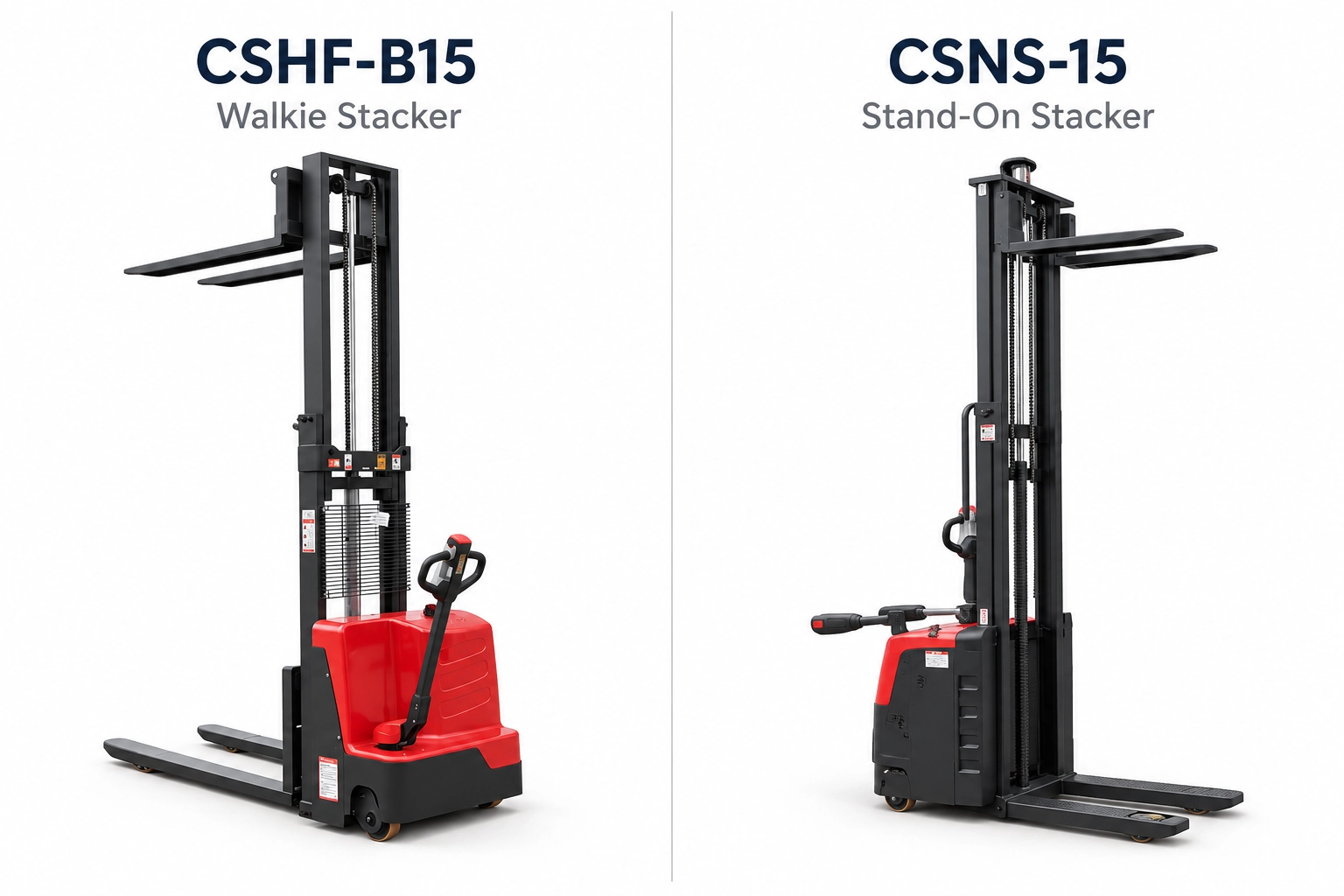
A warehouse with short moves and tight pallet-positioning tasks may be well served by a walkie stacker. On a route repeated throughout a long shift, a stand-on stacker may spare the operator a substantial amount of walking. Start with the work: where the pallet travels, where the truck turns, and how often the trip is made. Those details matter more than a general preference for one operating style.
The Core Difference: How the Operator Travels
A walkie stacker is a powered truck controlled by an operator walking beside or behind it. On a stand-on stacker, the operator rides on a standing platform during travel. Both types move and lift pallets; the difference is what the operator does between pickup and drop-off.
Consider a shift spent moving pallets from a receiving area to nearby rack positions. Much of the operator’s time may go into fork alignment, turning and placing loads, with little travel between those tasks. Now consider a repeated run between two distant work areas. The operator covers that route on foot with a walkie model. With a stand-on model, platform position and the truck’s operating dimensions become part of the layout assessment.
Aisle Space: Compare the Loaded Maneuver
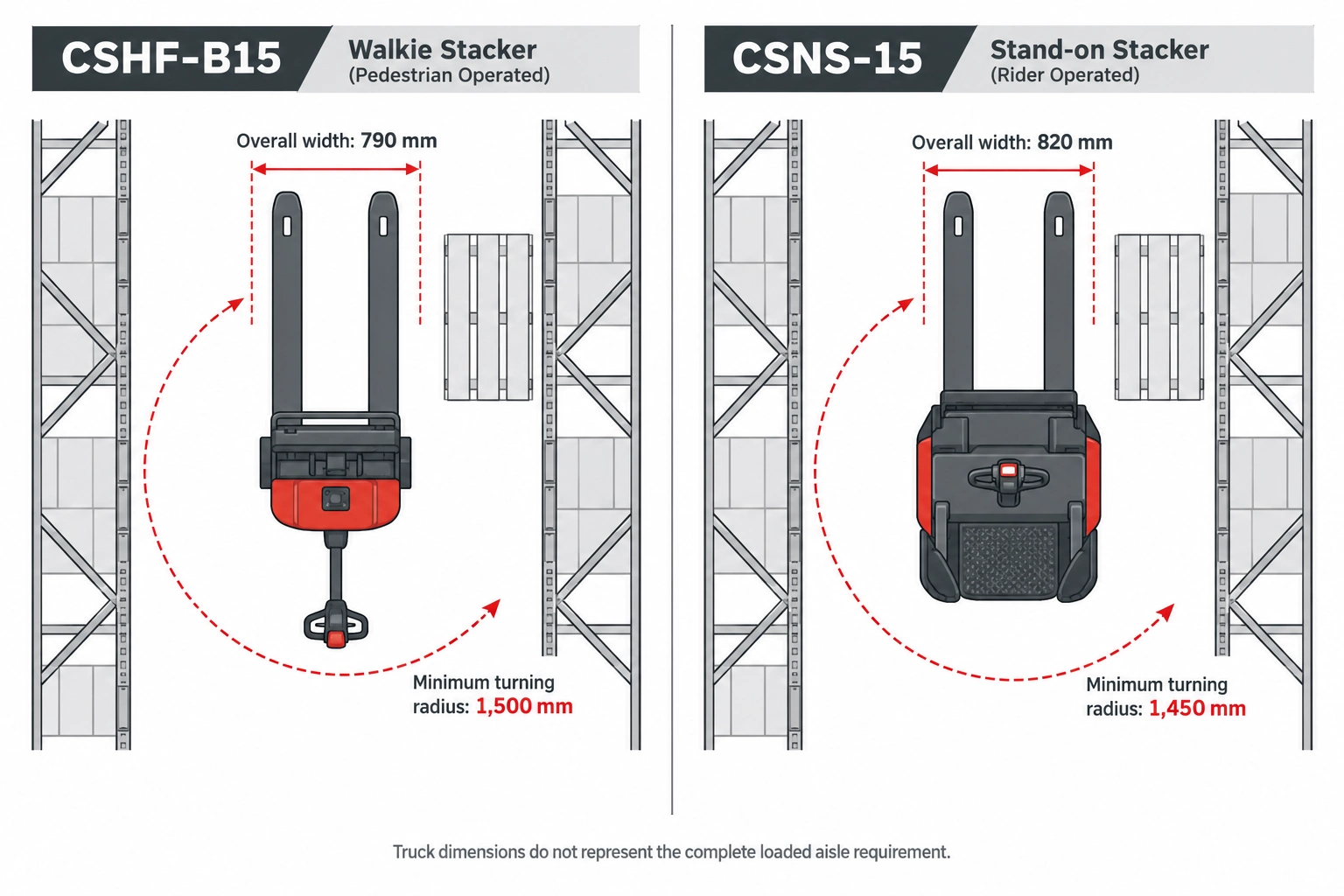
The CSHF-B15 walkie stacker and CSHF-B20 walkie stacker each have a published overall width of 790 mm. The CSNS-15 rider stacker is 820 mm wide. That 30 mm difference helps with initial screening, particularly at doorways and other fixed openings. At an aisle end or rack entry, the loaded turn is the more useful test.
The published minimum turning radius is 1,500 mm for the CSHF-B15 and 1,450 mm for the CSNS-15. In this comparison, the wider truck has the smaller stated turning radius. The figures describe the trucks, while the space needed at a rack also includes the pallet and the path taken through the turn.
Mark the route’s tightest maneuver on a layout drawing: an aisle-end turn, a doorway approach or a pallet placement beside another load. Use the intended pallet size and fork-entry direction, and show the stand-on truck in its operating configuration. The warehouse stacker selection guide covers the broader layout questions; for a particular model, its aisle-space specification and a site trial can settle the difficult turn.
Travel Distance and Speed: Where Riding May Help
The published travel speeds make one point clear: a standing platform is not necessarily paired with a faster truck. The CSHF-B15 and CSHF-B20 list 5 km/h loaded and 6 km/h unloaded. The CSNS-15 lists 4 km/h loaded and 5 km/h unloaded; the CSHF-C20 stand-on counterbalance stacker lists the same loaded and unloaded speeds. These are maximum specifications for different models, not timings for a complete warehouse job.
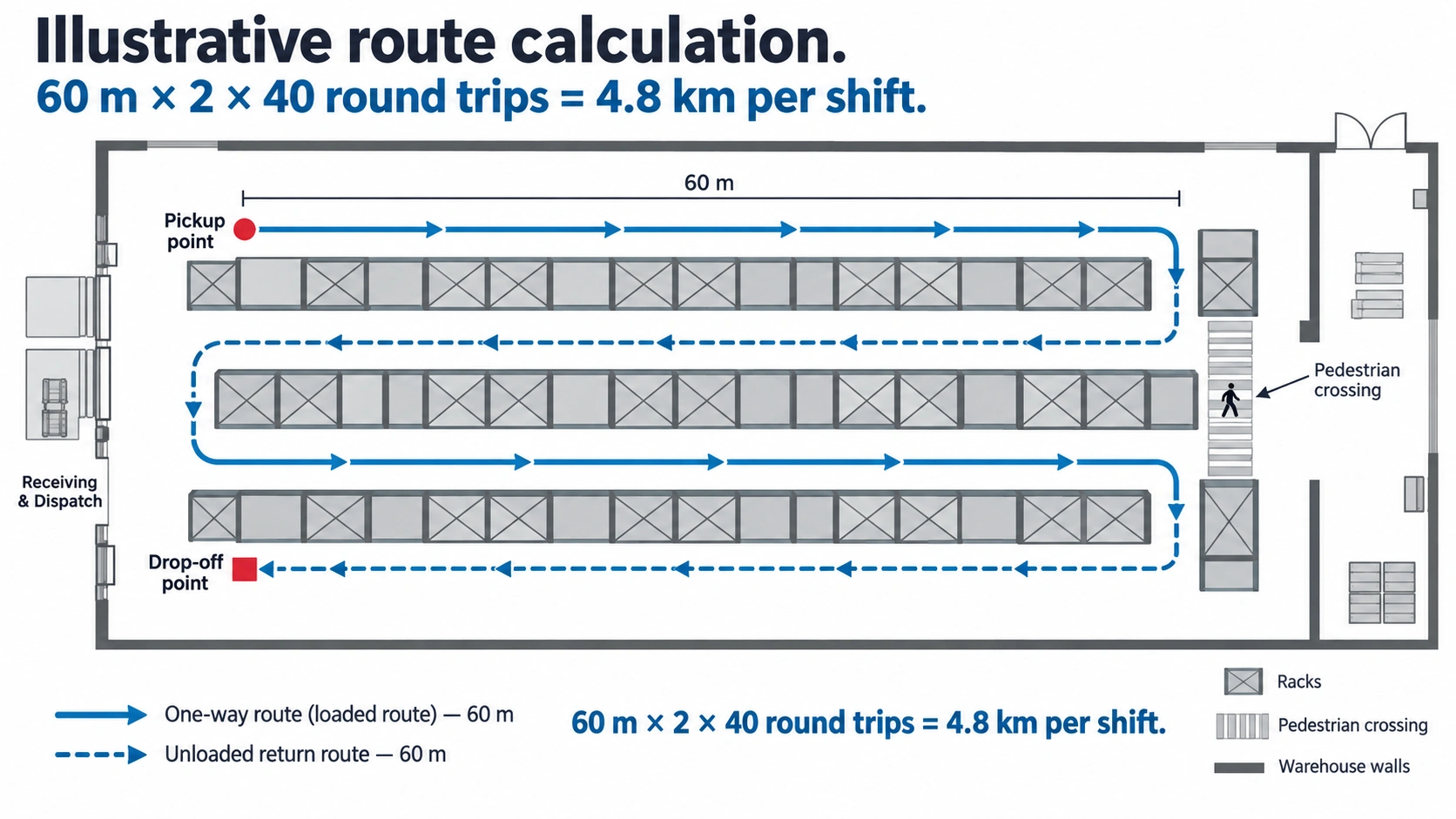
Distance becomes more meaningful when it is repeated. A 60 m one-way route covered for 40 round trips amounts to 4.8 km of travel during the shift. On a walkie truck, the operator walks with the machine along those trips. The calculation is a way to describe the workload; it makes no claim about either truck’s cycle time.
For a purchasing comparison, time the work from approaching one pallet to being ready for the next. Include loaded travel, the unloaded return, aisle-end turns, fork alignment, pallet positioning and normal interruptions from pedestrian traffic. A longer straight section may favor riding, while a route dominated by stops and careful placement gives travel speed less influence over the result.
Operator Fit: Fatigue, Training and Shift Length
Walking with a truck can suit an operator whose tasks are close together: pick up a pallet, move it a short distance, place it and continue working nearby. Repeated trips across a larger warehouse put more walking into the shift. That is the practical reason to evaluate a stand-on model, even when its published travel speed is no higher.
The operator also needs a clear view and workable position throughout the route. Review mounting and dismounting points, platform position at tight turns, doorway clearance and areas shared with pedestrians. A route that looks straightforward on a plan can feel quite different with a loaded pallet and normal warehouse traffic.
Training and authorization should cover the specific truck and site conditions. Requirements vary by location; the on-site assessment should include load handling, visibility, pedestrian routes and the way the truck is operated during a full shift.
Quick Decision Table
| Warehouse Task | Useful Starting Point | CSTAR Models to Examine |
|---|---|---|
| Short, intermittent moves with frequent turns or pallet positioning | Walkie stacker; focus on the loaded turn and rack entry | CSHF-B15 or CSHF-B20, according to capacity |
| Repeated travel between work areas, mixed with stacking tasks | Time the complete job with both operating styles | CSHF-B15 and CSNS-15 form a 1.5-ton shortlist |
| Frequent trips where operator walking occupies a substantial part of the shift | Examine stand-on operation and its fit through the full route | CSNS-15; CSNS-30 where its 3-ton rated capacity and dimensions suit the task |
| A pallet or load arrangement requiring a counterbalance, legless design | Resolve pallet entry and chassis requirements first | CSHF-C20 stand-on counterbalance stacker |
What Does Not Change Between the Two Types
The pallet still has to match the truck. Establish its loaded weight, load center, dimensions and fork-entry direction, along with the required lift height. Those requirements narrow the model shortlist regardless of whether the operator walks or rides. Our rated-capacity and load-center guide explains the capacity side of that assessment.
Browse Walkie and Stand-On Stackers by Capacity
Walkie models: The 1.5-ton CSHF-B15 and 2-ton CSHF-B20 provide two capacity options in the walk-behind arrangement discussed above.
Stand-on models: The range includes the 1.5-ton CSNS-15, 2-ton CSHF-C20 counterbalance model and 3-ton CSNS-30. Their chassis and operating arrangements differ, so capacity is only the first filter. See the full electric stacker range for other configurations.
Frequently Asked Questions
What is the difference between a walkie stacker and a stand-on stacker?
With a walkie stacker, the operator walks beside or behind the powered truck. A stand-on stacker carries the operator on a standing platform during travel.
Can a walkie stacker be used for high-frequency operations?
Yes, if the model suits the load and duty requirements. On frequent trips, calculate how far the operator walks per shift and include that in the comparison.
Do stand-on stackers require more aisle width than walkie models?
Not always. The pallet, turning path and platform configuration affect the loaded maneuver as well as the truck’s overall width.
Which type is easier to train new operators on?
Neither type is inherently easier at every site. Training should address the specific truck, load, route and nearby pedestrian traffic.
Choose Using Your Warehouse Layout
For a useful model recommendation, send CSTAR the loaded pallet weight and dimensions, required lift height, narrowest passage, tightest turn, one-way travel distance and estimated trips per shift. Include ramps or floor transitions if they are part of the route.