
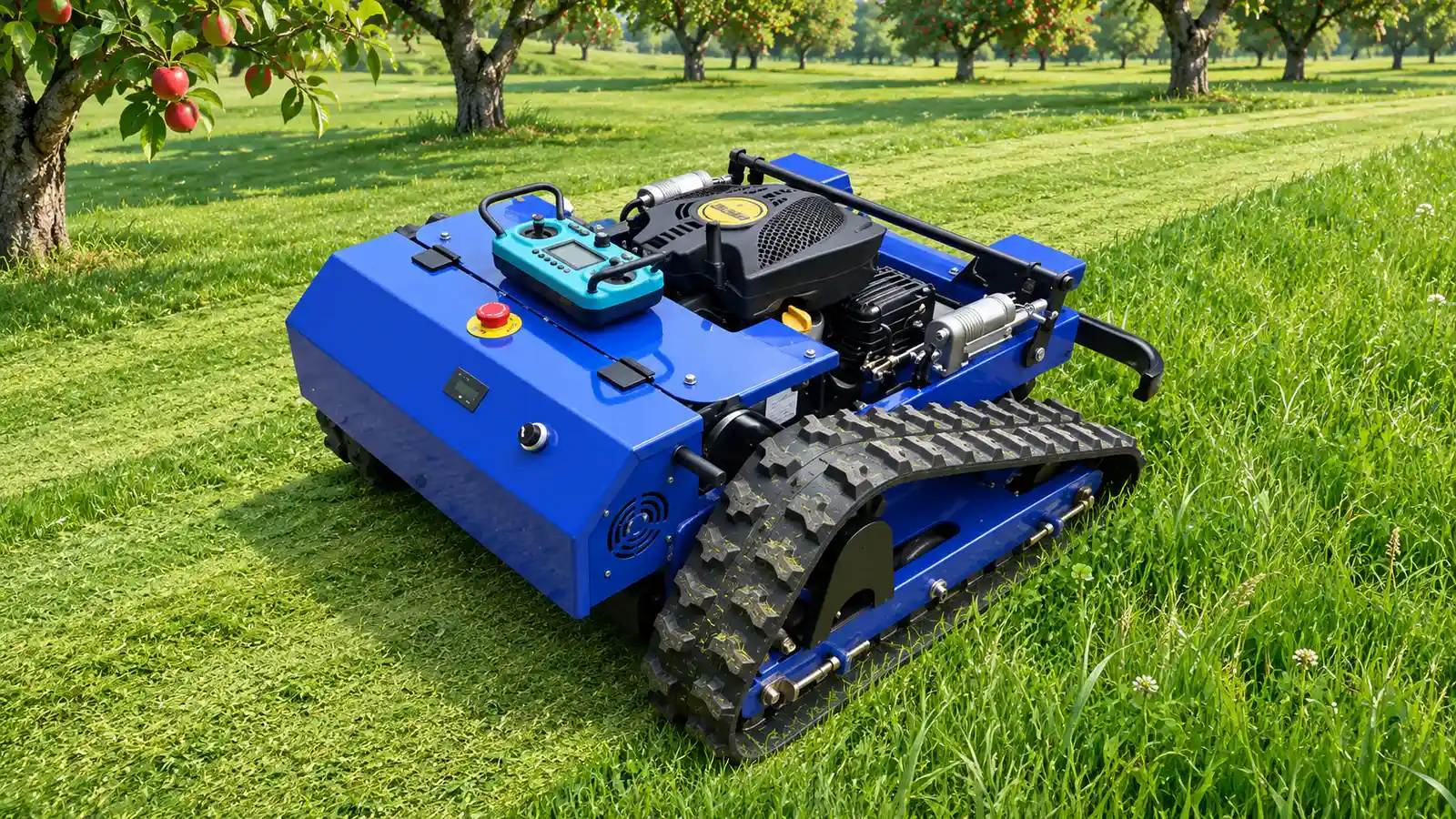
Short answer: estimate remote control lawn mower output from the cutting width, sustainable mowing speed and time spent turning, stopping and cutting an area again. A timed test on comparable vegetation gives you a completed-area rate for planning the job.
To plan a job, separate three numbers: the manufacturer’s listed efficiency, the theoretical coverage you can calculate from cutting width and speed, and the completed area per hour measured on a real plot, including turns, overlap, stops and repeat passes. Use the measured rate within its recorded timing boundary, then add any setup, transport or other job time excluded from that measurement.
This guide shows how to calculate each figure, how site conditions change the result, and how to turn a measured rate into hours for a whole job. If you are still choosing a machine by access width, slope limits or remote functions, start with our remote control lawn mower buying guide; this article assumes you already have a shortlist and need a realistic time estimate.
Listed, Theoretical and Completed Area: Three Different Answers
Buyers often compare an hourly figure from one supplier with a field estimate from a contractor and find they are far apart. Check how each figure was obtained and what its timing boundary includes before comparing them.
| Figure | Where it comes from | What it tells you | What it leaves out |
|---|---|---|---|
| Listed (published) mowing efficiency | A product page or specification sheet, e.g. “3,000 m²/h” | A reference value the manufacturer publishes for that model | Test conditions are often not stated: vegetation, speed, overlap, turns and stops may or may not be included |
| Theoretical coverage | Your own calculation: cutting width × speed | The area swept in one hour of continuous straight-line cutting at that speed | Overlap, turning, obstacles, repeat passes, refuelling and every other stop |
| Completed area per hour (measured efficiency) | A timed job: area finished to the required standard ÷ time used | What the machine and operator actually achieved on that site | Nothing within the timing boundary you chose, which is why that boundary must be recorded |

Use published figures to identify what needs checking in a demonstration. For job pricing, crew scheduling and fleet sizing, compare completed area per hour on similar vegetation, with the same required finish and timing boundary.
How to Calculate Theoretical Coverage
Theoretical coverage needs only two inputs: the cutting width in metres and a speed in kilometres per hour.
The 1,000 converts kilometres to metres: a mower travelling 1 km while cutting a 1 m swath sweeps 1,000 m².
Two quick examples:
- 0.6 m cutting width at 3 km/h: 0.6 × 3 × 1,000 = 1,800 m²/h
- 1.0 m cutting width at 2 km/h: 1.0 × 2 × 1,000 = 2,000 m²/h
The narrower deck at a higher speed and the wider deck at a lower speed end up close together. Both speed and width determine the result. Iowa State University Extension explains this distinction between theoretical and effective field capacity in Estimating the Field Capacity of Farm Machines. Here, the examples use metric units and assumed mower inputs; no agricultural-machine efficiency percentage is assigned to a CSTAR mower.
Converting to hectares and acres
- 1 hectare (ha) = 10,000 m², so m²/h ÷ 10,000 = ha/h. Example: 1,800 m²/h = 0.18 ha/h.
- 1 acre ≈ 4,046.86 m², so m²/h ÷ 4,046.86 = acres/h. Example: 1,800 m²/h ≈ 0.44 acre/h.
- Hectares and acres are not interchangeable: 1 ha ≈ 2.47 acres. If your site records use local land units, convert them to m² first and state the conversion you used in the inquiry.
Use cutting width, not machine width
Specification sheets list cutting width in millimetres. Divide by 1,000 before using the formula (600 mm = 0.6 m). Use the cutting width, not the overall machine width. The overall width matters for gates, rows and transport, but it is not the swath being cut.
Travel Speed Is Not Mowing Speed
Most specification tables list a travel speed. That figure describes how fast the machine can move; it is not a promise that the mower can cut at that pace all day. Plugging the highest listed travel speed into the formula gives the largest theoretical number, not a realistic one.
The speed you can sustain while still getting an acceptable finish depends on the load on the cutting deck and on the ground:
- Light, short, dry grass may allow a pace close to normal travel.
- Tall, dense or wet growth loads the blades and the engine. Operators usually slow down to keep the cut clean, avoid leaving uncut stems and reduce clogging.
- Bumpy, soft or sloping ground and obstacles require slower, more careful steering, regardless of what the engine could manage.
How to measure real mowing speed
- Mark a 50 m straight section in vegetation that represents the site.
- Set the target cutting height and engage the blades.
- Time the mower over the 50 m at a steady operating pace that produces the required finish and follows the model’s operating instructions. Start timing once the mower is already moving.
- Repeat over three representative sections. Calculate speed from the combined distance divided by the combined time.
Example: 50 m in 60 s = 50 ÷ 60 × 3.6 = 3.0 km/h.
Use this measured speed, not the catalog travel speed, when you calculate theoretical coverage for a specific site.
Reading CSTAR’s Listed Efficiency Figures
The table below compares figures published on CSTAR product pages (checked November 26, 2026) with a simple calculation: cutting width × listed travel speed × 1,000. The calculated column is a straight-line theoretical reference at the listed travel speed; it is a calculation rather than a field-test result. The listed column is the figure shown on each product page; the pages do not describe the test conditions behind those values.
| Model | Chassis | Cutting width | Listed travel speed | Calculated at listed travel speed | Listed mowing efficiency |
|---|---|---|---|---|---|
| CSJ-HB500 | Tracked | 500 mm | 4 km/h | 2,000 m²/h | 1,500 m²/h |
| CSJ-LB600 | Wheeled | 600 mm | 5 km/h | 3,000 m²/h | 3,000 m²/h |
| CSJ-HB800 | Tracked | 800 mm | 5 km/h | 4,000 m²/h | 3,800 m²/h |
| CSJ-LJ800 | Tracked | 800 mm | 5 km/h | 4,000 m²/h | 4,000 m²/h |
| CSJ-HS1000 | Tracked | 1,000 mm | 5 km/h | 5,000 m²/h | 4,000 m²/h |
| CSJ-LJ1000 | Tracked | 1,000 mm | 5 km/h | 5,000 m²/h | 4,000 m²/h |
Three practical points come out of this comparison:
- Some listed values match the width × speed calculation. For the LB600 and LJ800, the two columns are numerically equal. That equality does not establish the test method or prove the published figure is a guaranteed maximum. Request the test conditions and measure completed output on comparable ground.
- Listed values do not scale neatly with width. The 800 mm LJ800 and the 1,000 mm HS1000 and LJ1000 all list 4,000 m²/h. Check the conditions behind those figures, then compare the machines with a timed test using the same timing boundary.
- Not every model has a listed figure. The CSJ-QL500S page and the CSJ-LB500 page give cutting width and travel speed but no hourly mowing-efficiency figure. For these models, plan from your own measured speed and a timed test instead of borrowing a figure from another model.
Dividing 6,000 m² by a listed 3,800 m²/h gives about 1.58 hours as a paper calculation. Without the conditions behind the listed rate, that result does not establish a minimum job time. Build the site estimate from measured completed output and add any work excluded from the test. You can compare the full set of dimensions and configurations in CSTAR’s wheel and crawler lawn mower range.
Measuring Completed Area per Hour
Completed area per hour is the figure that answers the buyer’s real question. The calculation is simple; the discipline lies in defining what “area” and “time” include.
Area: measured, not estimated by eye, and only counted when the finish meets the agreed height and quality. Time: elapsed clock time within a stated boundary.
Choose and record the timing boundary
The same job can produce very different hourly figures depending on when the clock starts and stops. State which boundary you used every time you quote a rate.
| Timing boundary | Includes | Excludes | Best used for |
|---|---|---|---|
| Cutting time only | Time with blades engaged while moving forward | Turns, stops, refuelling, setup | Comparing decks and mowing speeds; closest to theoretical coverage |
| On-site mowing time | Cutting, turns, repositioning, overlap, repeat passes, clearing the deck, height changes, refuelling or charging stops | Unloading, transport between sites, pre-start inspection, cleaning after work | Estimating hours per plot and comparing machines on the same site |
| Total job time | Everything above plus unloading, pre-start checks, site walk for debris, loading and travel | Nothing that happens for that job | Pricing contracts and planning crew days |
For the same completed job, including additional setup and travel time produces a lower or equal hourly rate. Compare machines using the same timing boundary and required finish.
Stops that belong in the measurement
- Refuelling and charging. Record each stop, its duration and the fuel or energy used during the test. Use the observed refill or charging routine for the supplied configuration when planning a working day.
- Cutting-height changes. On a model with manual height adjustment, such as the QL500S, the operator stops the machine and adjusts the deck by hand. Models that list remote cutter-head lifting, such as the HB500, HB800 and HS1000, change height from the handset. If the site needs several height settings, count those changes in the test.
- Clearing and inspection. Stops to clear clippings, remove debris or check blades are part of real work, especially in wet or tall growth. Follow the operator manual’s shutdown procedure before any inspection or clearing.
Site Factors That Change the Hours
Each site condition changes one or more terms in the calculation. Linking each factor to the term it affects makes it easier to explain why two sites of the same size need different hours.
| Site factor | What it changes in the estimate | What to record |
|---|---|---|
| Incoming grass height vs. target height | Lower mowing speed; more repeat passes when a lot of material must be removed | Average and maximum standing height; required height after mowing |
| Density and stem type | Lower mowing speed; more clearing stops | Close-up photo; presence of thick stems, vines or woody shoots |
| Moisture | Lower speed; clumping and clearing stops; possible traction loss | Dew, recent rain, wet patches; time of day |
| Obstacles (trees, posts, rocks, irrigation risers) | More turns and slow maneuvering; uncut pockets left for trimming | Obstacle count or density; minimum spacing between obstacles |
| Terrain, slope and soft ground | Lower speed; restricted mowing direction; extra turns | Measured slope (° or %), direction of travel, soil firmness |
| Overlap between passes | Smaller effective width, so more passes | Estimated overlap in mm (measure a few passes) |
| Repeat cutting | Extra distance on part or all of the area | Share of area cut twice and the reason |
| Plot shape and pass length | Number of turns per m² | Plot dimensions; pass direction |
Grass height, density and moisture
These three factors mostly act on mowing speed and repeat passes. Mowing a maintained lawn every week and cutting a seasonal overgrowth are different tasks, even at the same cutting height. When the incoming material is much taller than the target height, a second pass at a lower setting can give a cleaner finish than forcing a single pass. That doubles the distance on that area, so the time estimate should reflect it. Note that a deck’s cutting-height range describes where the blades sit, not the maximum height of grass the machine can process in one pass.
Obstacles and plot shape
For a comparison that assumes the same time per turn, turning takes a larger share of the cycle on short passes. At 3 km/h, a 100 m pass takes 120 seconds; a 20-second turn adds about 17% on top. A 30 m pass takes 36 seconds, so the same turn adds about 56%. Orchard rows, small fenced plots and areas broken up by posts therefore produce lower hourly figures than one open field of the same total size.
Obstacles also leave areas the mower cannot reach. If those strips are finished with a brush cutter, count that time in the job, even though it is not mower time.
Slopes and ground conditions
Sloping ground usually reduces mowing speed and may limit the direction of travel, which can add turns. A listed climbing angle is a machine specification, not a permitted mowing slope. Take working angles and directions from the operating instructions for the exact model and assess grip, moisture and edges on the actual site before any timing test on a slope.
Overlap and effective width
Operators overlap each pass slightly to avoid leaving uncut strips. That overlap reduces the width actually gained on each pass:
Example: a 0.6 m deck with 0.1 m overlap gains 0.5 m per pass — 17% less than the nominal width.
Overlap tends to increase on uneven ground, on curves and around obstacles. When the overlap distance is held constant, it takes a larger share of a narrow deck than of a wide one. Measure the overlap used on the actual route.
500, 600, 800 and 1,000 mm: Why Double the Width Is Not Double the Output
A 1,000 mm deck cuts twice the swath of a 500 mm deck, but completed output can rise by more or less than twice that amount. The worked examples below show why. They use generic deck widths and assumed values to demonstrate the method; they are not CSTAR test results and do not describe any specific model.
Example 1: open, maintained grass (all values assumed)
- Plot: 100 m × 60 m open rectangle = 6,000 m² (0.6 ha, about 1.48 acres); passes run along the 100 m side.
- Maintained grass, firm level ground, dry conditions, no obstacles.
- Overlap 0.10 m per pass; same mowing speed of 3 km/h for every width.
- 20 seconds per end turn; 15 minutes of stops for the whole job.
- The first pass covers the full cutting width; each later pass adds cutting width minus overlap. Passes = 1 + round up [(60 m − cutting width) ÷ effective width]. Cutting time = passes × 100 m ÷ 3,000 m/h. Turning time = (passes − 1) × 20 seconds; no entry or exit turn is included.
| Cutting width | Effective width | Passes | Cutting time | Turning time | Stops | Total on-site time | Completed rate | Theoretical at 3 km/h |
|---|---|---|---|---|---|---|---|---|
| 500 mm | 0.40 m | 150 | 5.00 h | 50 min | 15 min | 6.08 h | ≈ 990 m²/h | 1,500 m²/h |
| 600 mm | 0.50 m | 120 | 4.00 h | 40 min | 15 min | 4.91 h | ≈ 1,220 m²/h | 1,800 m²/h |
| 800 mm | 0.70 m | 86 | 2.87 h | 28 min | 15 min | 3.59 h | ≈ 1,670 m²/h | 2,400 m²/h |
| 1,000 mm | 0.90 m | 67 | 2.23 h | 22 min | 15 min | 2.85 h | ≈ 2,110 m²/h | 3,000 m²/h |
On this ideal plot, the 1,000 mm deck finishes about 2.1 times the 500 mm rate, slightly more than double. The fixed 0.10 m overlap takes 20% of the narrow deck but only 10% of the wide one, and the wide deck makes 83 fewer turns. Even so, every width finishes only about two-thirds of its theoretical coverage once turns, overlap and stops are included.
Example 2: tall, dense growth on the same plot (all values assumed)
- Same 6,000 m² plot, now with tall, dense, slightly damp growth.
- Overlap 0.15 m; repeat 20% of the initial full-length passes, rounded up to a whole pass.
- Assume one 25-second turn between consecutive full-length passes, including repeat passes; 30 minutes of other stops for clearing, refuelling and checks. The first pass uses the full cutting width. This is a simplified route calculation.
- Assumed mowing speed: 2.0 km/h for 500 and 600 mm, 1.7 km/h for 800 mm, 1.5 km/h for 1,000 mm. The assumption is that a wider deck takes in more material per metre travelled, so the operator slows down to keep the cut clean. A real machine may behave differently; that is what a test is for.
| Cutting width | Effective width | Initial passes | Repeat passes | Assumed mowing speed | Total on-site time | Completed rate |
|---|---|---|---|---|---|---|
| 500 mm | 0.35 m | 171 | 35 | 2.0 km/h | 12.22 h | ≈ 490 m²/h |
| 600 mm | 0.45 m | 133 | 27 | 2.0 km/h | 9.60 h | ≈ 620 m²/h |
| 800 mm | 0.65 m | 93 | 19 | 1.7 km/h | 7.86 h | ≈ 760 m²/h |
| 1,000 mm | 0.85 m | 71 | 15 | 1.5 km/h | 6.82 h | ≈ 880 m²/h |
Under these assumptions, the 1,000 mm deck finishes about 1.8 times the 500 mm rate, and each width completes around half the area per hour it managed in Example 1. The width advantage holds only as long as the wider machine can keep up its speed in the actual vegetation.
Example 3: narrow strips and complete-pass coverage (assumed values)
In orchard alleys, solar rows and road verges, count how much new width each pass adds. Assume a straight 2.8 m mowable strip, 0.10 m overlap, full cutting width on the first pass and enough boundary clearance for the route.
For a strip wider than one cutting pass: N = 1 + round up [(strip width − cutting width) ÷ (cutting width − overlap)]. A strip no wider than the cutting width needs one pass.
| Cutting width | Width added after the first pass | Passes needed | Full-width coverage at that count |
|---|---|---|---|
| 500 mm | 0.40 m | 7 | 2.90 m |
| 600 mm | 0.50 m | 6 | 3.10 m |
| 800 mm | 0.70 m | 4 | 2.90 m |
| 1,000 mm | 0.90 m | 3 | 2.80 m |

The 1,000 mm deck covers 1.0 + 0.9 + 0.9 = 2.8 m in three passes. The 800 mm deck needs four passes. Where the calculated coverage exceeds the strip width, use only the width needed on the final pass and keep the machine within the permitted working area.
The complete machine also has to fit: on CSTAR’s product pages, the HS1000 and LJ1000 list overall widths of 1,250 mm and 1,220 mm, compared with 1,150 mm for the HB800 and 1,080 mm for the LJ800. Measure the strip, the full machine envelope and row-end turning space together. The pass-count calculation alone does not establish which machine fits the route.
When a wider deck saves the most time
- Large, open, regular plots with long passes.
- Vegetation light enough for the wider deck to hold its mowing speed.
- Access routes, turning areas and transport that suit the larger machine.
- Strip widths where the extra width actually removes a pass.
On divided sites, narrow rows or heavy growth, the gap between widths narrows, and a more compact machine may finish the whole job in a similar time with less trimming.
From Hourly Rate to Whole-Job Hours
A single hourly rate rarely fits an entire property. Splitting the site into zones with similar conditions gives a far more reliable estimate.
- Divide the site into zones, for example: open grass, areas around obstacles, slopes, and strips that need trimming.
- Measure each zone’s area in m².
- Assign a completed rate to each zone, using measured results from similar conditions where possible.
- Calculate mowing hours per zone: zone area ÷ completed rate.
- Add job overheads not included in the rate: unloading, pre-start checks, debris walk, trimming by hand, cleaning and loading.
- Convert to working days using the productive hours you can realistically achieve per day on that site.
Example 4: a 2.5 ha site (all values assumed)
| Zone | Area | Assumed completed rate | Mowing hours |
|---|---|---|---|
| A: open maintained grass | 18,000 m² | 1,600 m²/h | 11.25 h |
| B: grass between trees and posts | 7,000 m² | 700 m²/h | 10.00 h |
| Total | 25,000 m² (2.5 ha, ≈ 6.18 acres) | Blended ≈ 1,180 m²/h | 21.25 h |
If the crew can mow for six productive hours per day after unloading, checks and cleaning, the job needs about 3.5 days, so plan four. Using the open-grass rate for the whole site would have suggested about 15.6 hours, an underestimate of more than five hours.
Once you have reliable hours per job, you can convert them into operating cost per 1,000 m² with the method in our remote control lawn mower cost and budget guide.
Field Test Record Sheet
A timed test on representative ground is the most useful evidence for planning. A short demonstration clip shows how a machine moves and cuts, but unless the area is measured and the full elapsed time is recorded, it cannot be used to calculate area per hour. Copy the fields below into a spreadsheet or printed form and fill in one sheet per test.
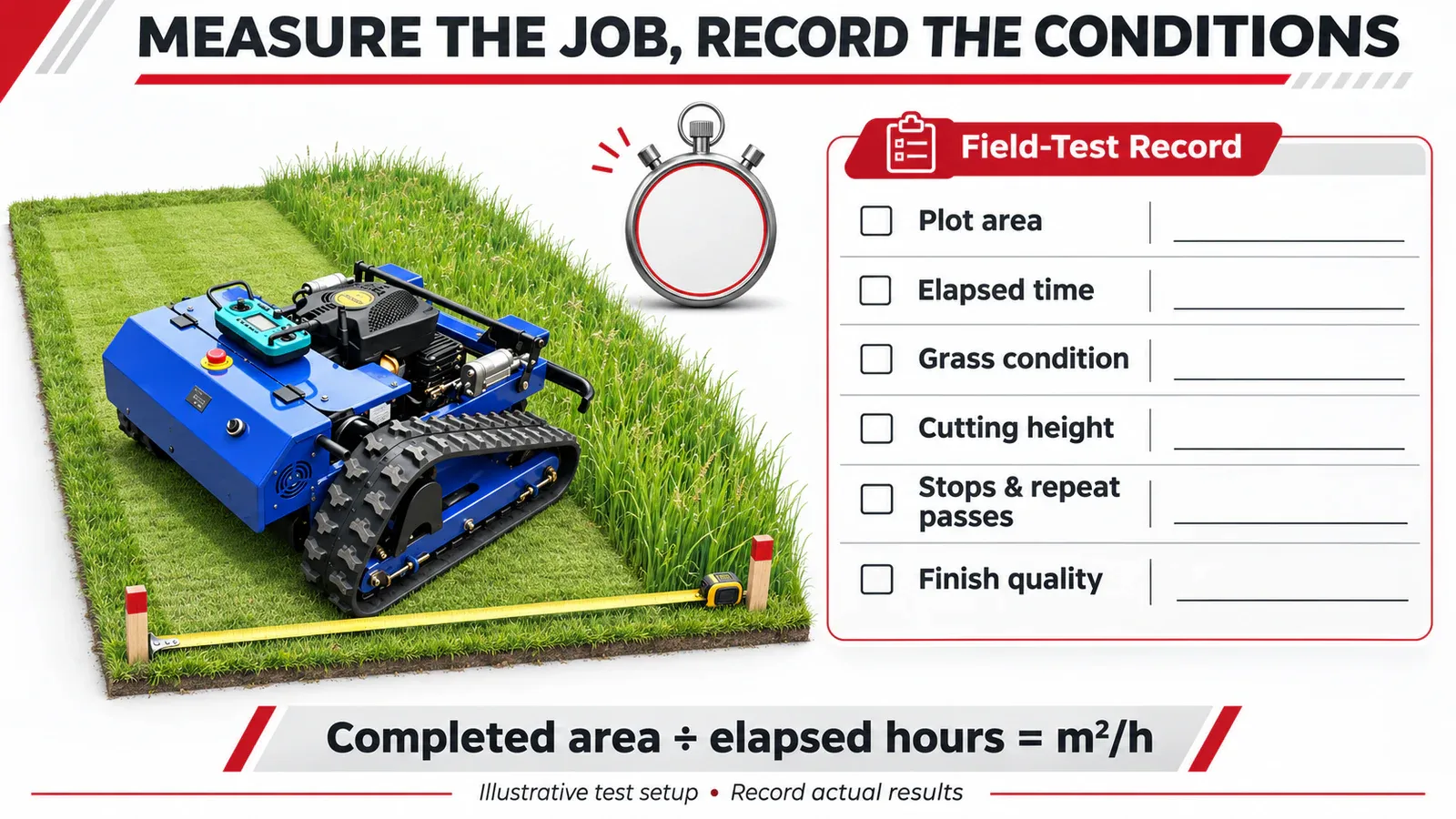
| Field | What to record | Entry |
|---|---|---|
| Date, location, operator | Test date, site name, operator name and experience | |
| Model | Full model name as quoted | |
| Configuration | Chassis, engine or power option, deck and blade type, cutting width, height-adjustment method, controller | |
| Test area | Measured length × width or mapped area in m²; method of measurement | |
| Vegetation condition | Grass or weed type, average and maximum standing height, density, moisture (dew, recent rain); photos before mowing | |
| Ground condition | Firm, soft or uneven; measured slope (° or %) and direction of travel; obstacles and their number | |
| Target cutting height | Deck setting and required remaining grass height | |
| Measured mowing speed | Combined distance ÷ combined time × 3.6 from three representative timed runs | |
| Timing boundary | Cutting only / on-site mowing time / total job time | |
| Start and finish time | Clock times | |
| Total time used | Finish minus start, in hours | |
| Stop time | Each stop with duration and reason: refuelling, clearing, height change, adjustment, other | |
| Repeat cutting | Share of area cut twice or more and the reason | |
| Fuel or energy used | Litres added or charge used during the test | |
| Final result | Remaining height check, missed strips, scalping, clipping distribution; photos after mowing; accepted / not accepted | |
| Calculated results | Completed rate = area ÷ total time; theoretical coverage = width × measured speed × 1,000; completed ÷ theoretical as a percentage |
What to Send With Your Inquiry
A supplier can only give a useful time-based recommendation if it knows what the mower will face. Include the following in your inquiry:
- Areas: total area in m², ha or acres (state the unit), number of separate plots and the size of each.
- Plot layout: typical pass length, row or strip widths, headland and turning space, narrowest access point.
- Vegetation: type, typical incoming height, density and how often it will be cut; photos close-up and wide.
- Required finish: target remaining height and whether different areas need different heights.
- Ground: measured slopes with direction of travel, soft or wet zones, and obstacle types and spacing.
- Time targets: hours available per day or per visit, and the area you need to finish in that time.
- Current method: how the site is mowed now and how long it takes, if known, including the timing boundary.
- Machine preferences: wheeled or tracked, preferred cutting width, fuel type and remote functions needed.
- Transport and order details: transport vehicle limits, quantity and delivery destination.
Send this site brief through CSTAR’s mower enquiry page for a configuration recommendation and quotation. Include your required finishing time so the discussion covers both model selection and the evidence needed to plan the work.